Fez — A new stage production in Fez is turning the ancient symbol of the Ouroboros into a contemporary reflection on irregular migration, displacement, and the repeated search for a better life.
“Ouroboros,” a theatrical and circus production by Association Bladi Arts in collaboration with WE ART Lab, was presented on September 22 at Centre Kan Ya Makan… Rdda in Fez Jdid. Independent coverage published ahead of the performance also confirmed the production as part of the organizations’ new cultural season.
Written and directed by Abdou Jalal, the production features actors Fattah El Gharbaoui, Hanane El Allam, and Mourad Moutaouafiq. Ilyass El Marbouh serves as project director and producer.
At the center of the work is the Ouroboros, the ancient image of a serpent consuming its own tail and a symbol commonly associated with cycles, repetition, and eternal return.
Here, that circle becomes a metaphor for people attempting to escape circumstances they can no longer endure, only to encounter another cycle of hope, failure, and renewed departure.
When leaving does not mean escaping
The production approaches irregular migration less as a journey between two geographical points and more as a psychological and human cycle.
According to the production materials, “Ouroboros” follows people searching for somewhere else and pursuing the possibility of a better life. Their movement becomes trapped inside what the creators describe as a recurring sequence of injury, collapse, and renewed hope.
The work also addresses the dehumanization associated with migrant trafficking networks, where individuals can be reduced to commodities rather than treated as people with histories, relationships, and ambitions.
Another concern is what migration leaves behind psychologically.
Rather than treating departure as the end of one story and the beginning of another, the production questions whether a new beginning is always possible. Its central image suggests that escaping one reality can sometimes lead a person back into another version of the same cycle.
Circus becomes part of the storytelling
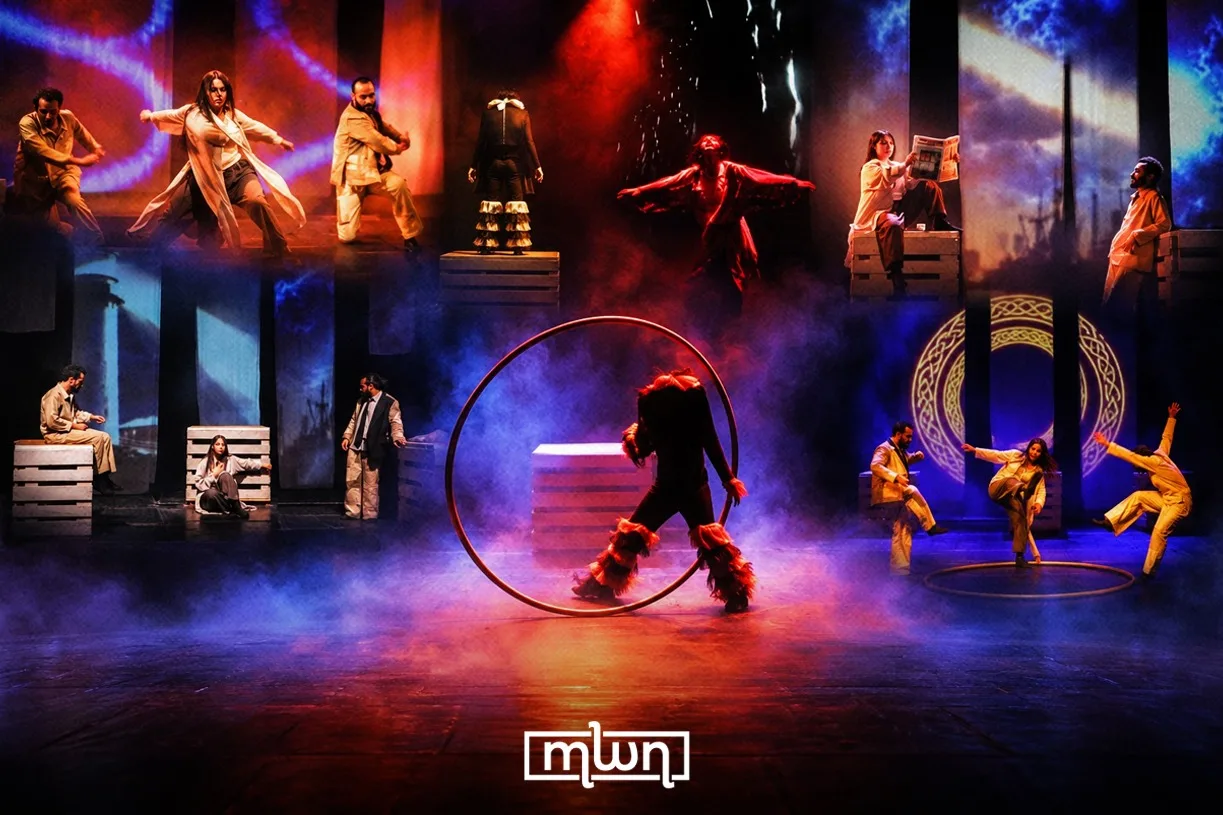
“Ouroboros” also moves beyond conventional dramatic theater by incorporating circus arts directly into its storytelling language.
The production uses physical performance to give form to experiences that can be difficult to express through dialogue alone. The approach allows the actors’ bodies to become part of the work’s exploration of vulnerability, repetition, falling, and persistence.
The wider artistic team includes Oumayma El Khodri on scenography, Aya Harrouch on costumes, Amine Bouzmadouen on mapping and visual effects, and Mohamed Chah on scenography production. El Marbouh also worked on lighting and musical composition, according to the production credits.
Promotional artwork for the production reinforces its central metaphor, placing the three performers beneath a large circular serpent consuming its own tail, with the image looming behind them like a cycle they cannot easily leave.
By bringing circus, theater, visual design, and movement together, “Ouroboros” uses the stage to approach migration beyond statistics and routes. Its focus remains on the people caught inside the cycle and on the difficult question at its center: whether leaving is enough to create a genuinely new beginning.