Rabat — After her father’s sudden death, teenager Carrie White, raised by her overprotective mother, enters public high school, where she faces a viral bullying scandal and discovers mysterious telekinetic powers, typically unleashed when she is stressed, afraid or angry.
Speaking to ET, the director said he saw plenty of room in Stephen King’s central idea that’s relevant to teenage experiences today.
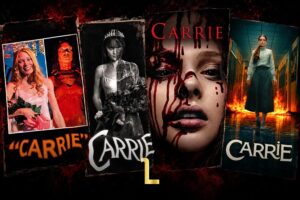
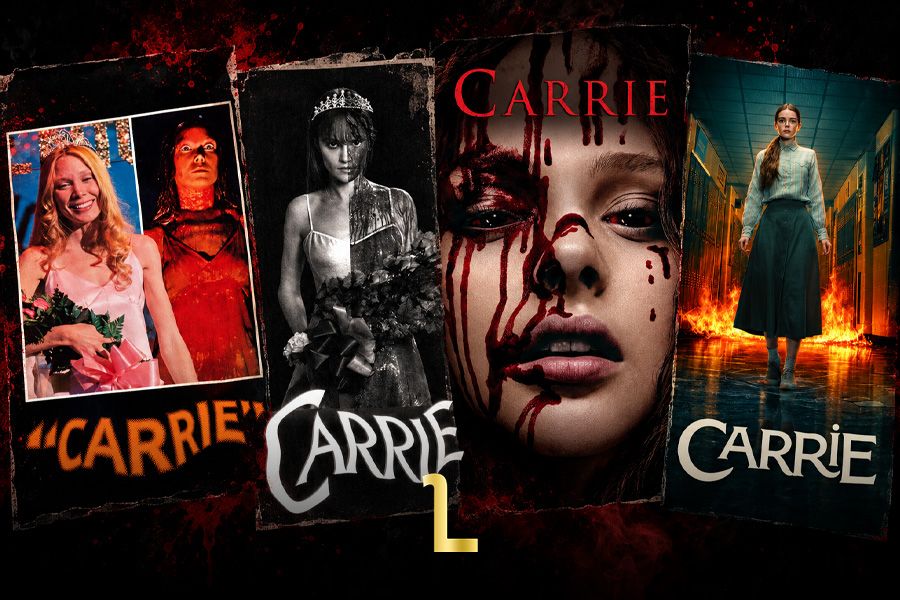
That may explain why “Carrie” has been filmed four times: Brian De Palma’s 1976 feature, a 2002 television movie, Kimberly Peirce’s 2013 remake and now Flanagan’s 2026 Prime Video series.
Each one changes how we see Carrie White. She can be a tragic outsider, a terrifying force, a student her classmates failed, or a girl whose power might finally connect her to other people.
Where it began: the 1974 novel
King’s first novel, published on April 5, 1974, follows a girl who is abused at home and humiliated at school, and who discovers she has telekinetic powers.
Controlled by her extremely religious mother and bullied by her classmates, she struggles to fit in, leading to a dramatic confrontation at her senior prom.
So the famous prom is both an event and a retelling of what happened. It allows the story to explore guilt, rumors, and how people try to explain a tragedy they helped cause.
‘Carrie’ 1976
Sissy Spacek plays Carrie, Piper Laurie plays her mother Margaret, and Amy Irving plays Sue Snell. De Palma, the film’s director, turned the detailed novel into a focused and tragic story.
As the BFI points out, the film’s visual style is closely linked to its horror. During the prom, the camera and music build tension and make the audience feel that something terrible is about to happen.
The famous final scene shows how Carrie’s brief moment of acceptance turns into a nightmare when she is publicly humiliated by a cruel plan.
De Palma ends the film with a shocking image connected to Sue’s trauma.
‘Carrie’ 2002
Angela Bettis takes the title role in the 2002 TV movie, with Patricia Clarkson as Margaret White. The television adaptation moves at a different pace from De Palma’s theatrical release. Its biggest departure is the ending, where Carrie survives and escapes with Sue’s help.
That matters for anyone discussing Flanagan’s finale, because his series is not the first to spare her. What is new is pairing her survival with a wider circle of people who have their own psychic abilities. Those two ideas open a very different future for her.
‘Carrie’ 2013
Kimberly Peirce’s film stars Chloë Grace Moretz as Carrie and Julianne Moore as Margaret. It goes back to the feature-length format and updates the bullying for a more connected era, with screens and the spread of humiliating images adding to Carrie’s vulnerability.
Between 1976 and 2026, the 2013 version shows that modernizing the technology behind the cruelty doesn’t necessarily change where the heroine ends up. What matters more are choices about responsibility, sympathy and what kind of future the story will grant her.
‘Carrie’ 2026
The biggest difference in the 2026 series is the length of the story. With eight episodes, Flanagan has more time to develop Carrie, Sue, Chris, and the adults around them.
The series also focuses on cyberbullying and the role of social media, and unlike the novel, the story does not end with a tragedy.
According to a BBC article, some fans were disappointed that the latest adaptation, like those that came before it, failed to portray the characters as they are described in Stephen King’s original novel.
In the book, King describes Carrie in the school showers, terrified by her first period, as “a frog among swans”. However, all four screen adaptations to date have cast actresses who fit conventional standards of beauty to play the character.
Entertainment writer Kayleigh Donaldson highlighted this in an article for Pajiba, writing: “Even in a story of cruelty and bullying, the world thinks having Carrie White be a fat girl is too much…You can imagine a teenage girl setting her school on fire with her magical mind powers but she can’t be larger than size 6 because that’s stretching credulity?”
The novel also presents Carrie as a darker and more complex character than her screen counterparts. She is less innocent and has greater control over her destructive abilities.
But does an adaptation really need to follow the original story as it is?
The director described two ways of adapting a book. One is to move the story from page to screen as faithfully as possible. The other is to take the pieces and build something new from them. Flanagan said he saw plenty of room in King’s central idea to speak to what teenagers go through today.
And according to the BBC article, Dr Sorcha Ní Fhlainn, a horror expert, believes that Mike Flanagan’s series can succeed on its own terms while bringing a fresh perspective to the original story.
She adds that “this Carrie seems to conjure new means of navigating the familiar horrors of teenage life and bullying.”
Filmmaker Liam Gavin points out that adaptations must often balance staying true to the original work with meeting commercial demands. He explains: “Production funding is frequently dependent on cast, and so there can be external pressures. It’s not always fair or just, it unfortunately ‘just is’.”