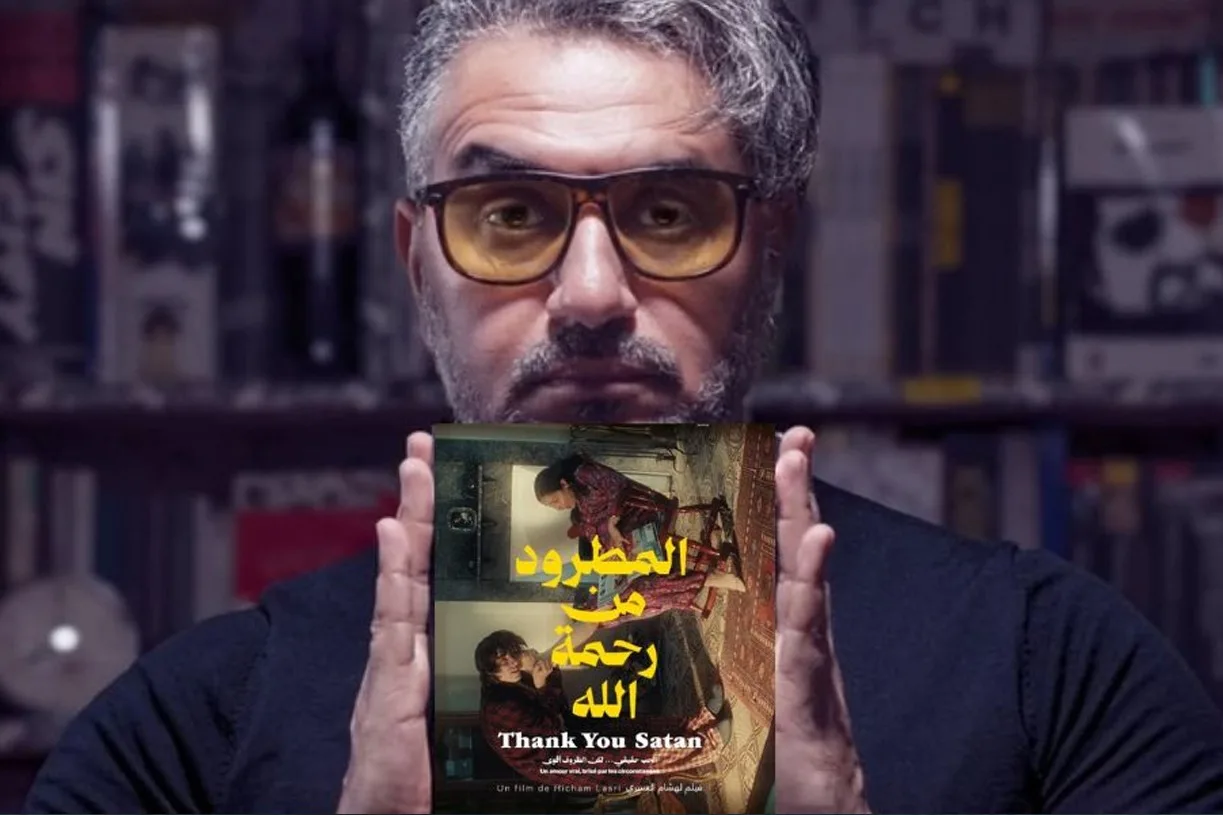
Casablanca – Weeks after its release, “Thank You Satan” has been withdrawn from major cinemas, cutting short its theatrical run and reopening questions around censorship, and public reception.
From its earliest stages, the film faced backlash tied to its title, teaser, and legal complaints, even before its official release and without a clear understanding of its themes. The irony? This tension did not fade after release.
A film misread from the start
The reaction to the film also reflects a broader tendency to judge without context.
As explored in its earlier screenings, “Thank You Satan” does not promote violence or ideology. It questions them.
By following a character who adopts religion as a performative step toward violence, the film argues that violence is shaped by human conditions and choices, challenging the idea that extremism is rooted in faith.
The controversy surrounding the title alone suggests that, for some, the conversation stopped before the film even began.
‘A covert censorship’
In an exclusive interview with MWN Lifestyle, Moroccan film director, Hicham Lasri, argues that the withdrawal goes beyond commercial logic. “It’s not a question of profitability,” he said. “It’s a question of embarrassment, censorship, and disinterest.”
Lasri describes what he sees as deliberate marginalization, claiming that cinemas limited the film’s visibility through programming choices.
Screenings were reportedly placed at difficult hours, in smaller rooms, and without promotion. In some cases, audiences were told the film was not yet available despite being scheduled.
“It’s a covert censorship. A covert exclusion,” he said.
Beyond his own film, Lasri describes the issue as part of a wider pattern.
He criticizes what he calls an “exploitation” system that prioritizes commercial films over more demanding works. According to him, films that do not fit mainstream expectations are often sidelined through limited screenings and lack of visibility.
“There is a way of short-circuiting a film and cutting its life short,” he said, adding that such practices are well known among filmmakers working outside commercial formulas.
A paradox at play
The situation reveals a deeper contradiction. The film had already received support from powerful institutions such as the Moroccan Cinematographic Center (CCM) and SNRT, both involved in its production.
Yet, despite official approval, its circulation in cinemas faced obstacles.
Lasri points to a disconnect between cultural institutions and those who control film distribution and exhibition, suggesting that decisions on the ground do not always reflect institutional backing.
Lasri also returned to what he sees as a deeper irony running through the situation, one that becomes even more visible in light of how the film has been received and circulated.
“I think it’s almost ironic that a film about freedom of expression is prevented from existing in a cinema hall,” he told MWN Lifestyle.
Surface-level reactions
The issue stretches beyond simple criticism of a film or a disagreement with its ideas. It points to a broader pattern of surface-level reactions, where judgments are often formed from a title or a teaser, without engaging with the work in its full context.
“I know for a fact that the people in charge of Pathé didn’t want to pass the film because there is the title “Thank You Satan” in English, without understanding that it’s a reference to a song, without understanding that there is a dramaturgical stake,” Lasri told MWN Lifestyle.
Even after its release, the film was not always approached with a willingness to engage with its substance. Preconceived readings appeared to take precedence, leaving little room for the kind of reflection the film calls for.
In this case, the irony remains difficult to ignore. A film that attempts to unpack violence beyond religion has been met with reactions shaped, in part, by the very assumptions it seeks to challenge.
Read also: ‘Thank You Satan’ Pre-Premieres in Rabat Amid Early Controversy, Legal Action