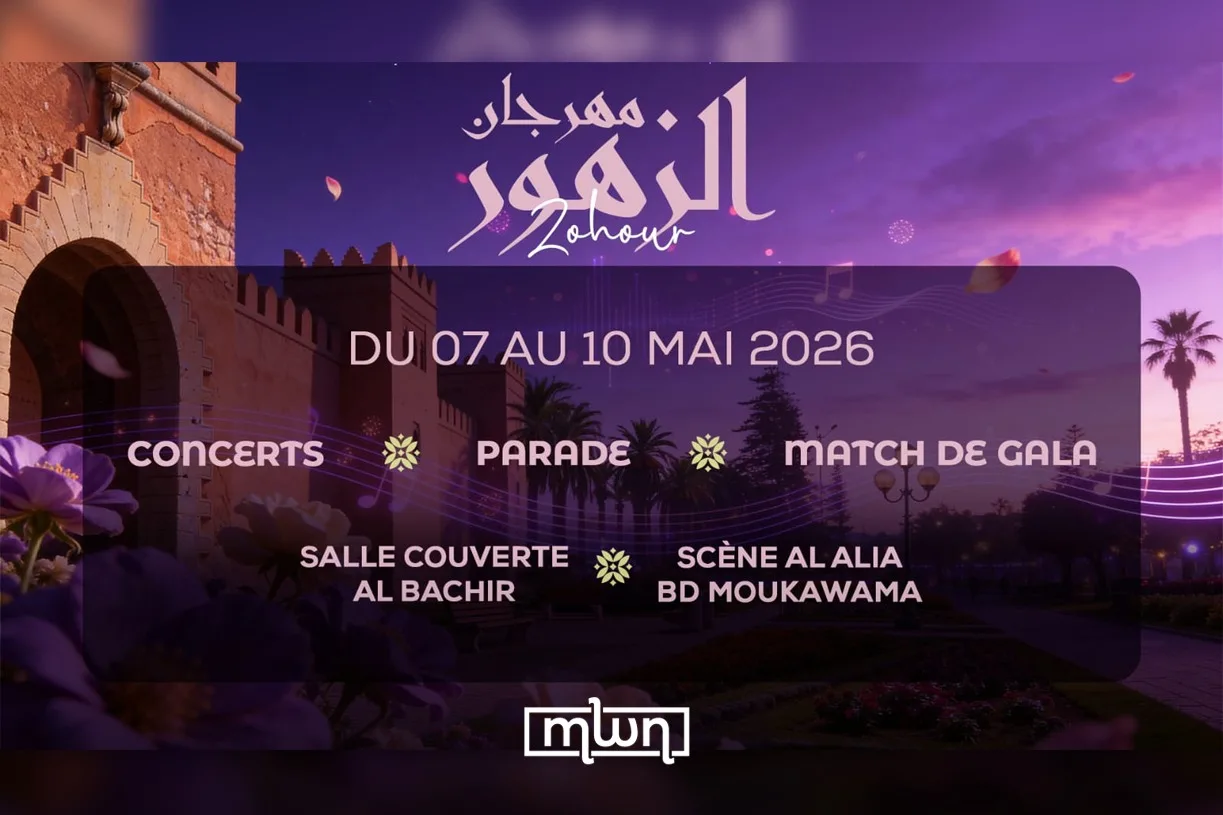
Rabat – From May 7-10, Mohammedia will host the Festival of Flowers (Zouhour Festival,) returning with a program full of live performance, civic celebration, and ecological awareness.
Timed to coincide with Morocco’s National Music Day, the festival opens on May 7 with a symbolic fusion of sound and season.
What unfolds is a carefully curated cultural circuit: large-scale concerts, open-air performances, community-led initiatives, and a steady undercurrent of environmental reflection that anchors the spectacle in something more grounded than entertainment alone.
At the heart of the programming is the indoor arena at El Bachir Hall, where a four-night lineup brings together some of the region’s most recognizable voices.
Among them: Lartiste, Muslim, Hatim Ammor, the duo Blmire, Kawtar Sadik, and Boucharart. The programming signals a deliberate balancing act between mainstream popularity and contemporary Moroccan pop sensibilities.
Outside the ticketed arena, the city opens up. A parallel series of free concerts at Avenue de la Résistance transforms public space into an accessible stage, featuring artists such as Douzi, Najat Aatabou, Hind Ennaira, Majid Bekkas, Badr Ouabi, and Daoudia, a lineup that leans into generational crossover and popular heritage.
Yet the festival is not confined to music.
On May 8, a symbolic football match at El Bachir Stadium brings together former players, journalists, and artists in a tribute match honoring former Moroccan player Ahardane.
It is less about competition than continuity, an echo of collective memory translated into performance.
Elsewhere, a moving street parade will wind through Mohammedia’s main arteries toward the city park, turning the urban landscape into a procession of color and choreography. The gesture is both aesthetic and civic: a visual affirmation of the city’s floral identity.
At street level, the festival extends into everyday life through a neighborhood decoration competition, encouraging residents and nurseries to reimagine their immediate surroundings.
The initiative reframes beauty as participation, and public space as shared authorship.