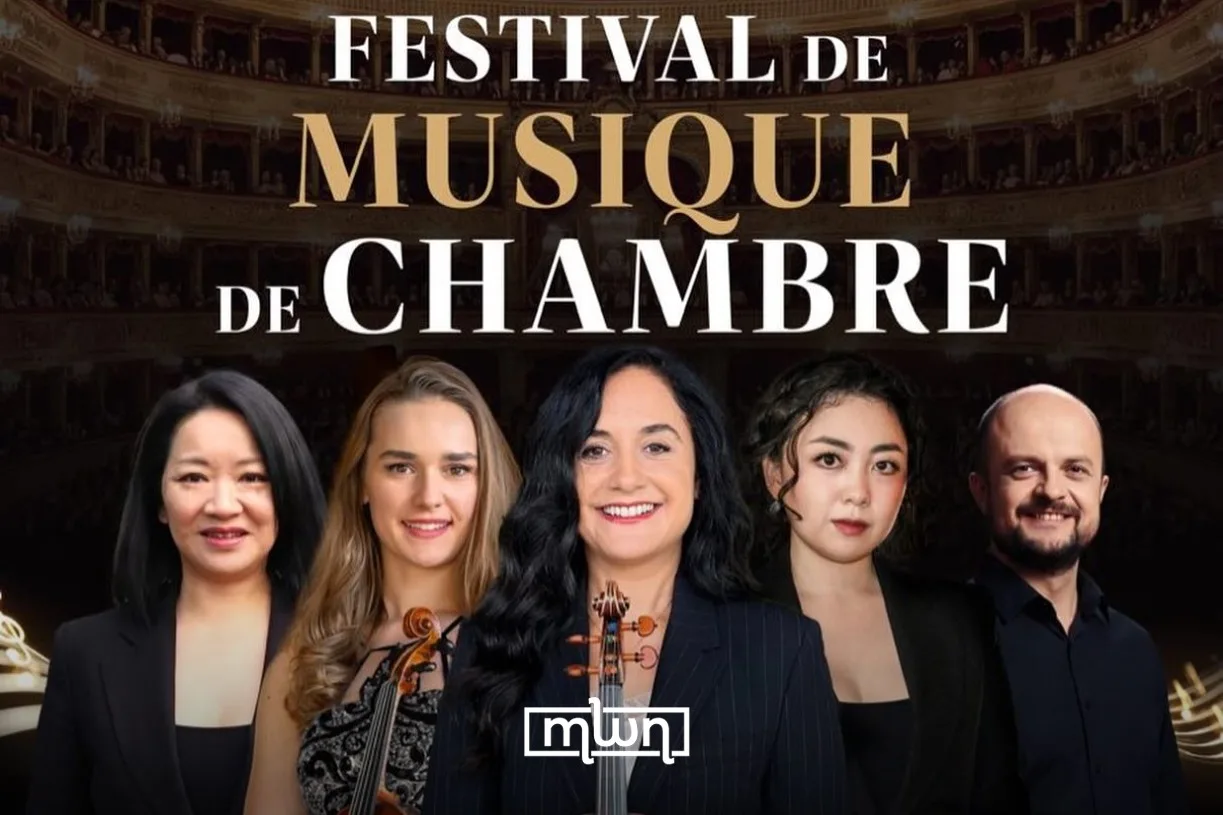
Safi – El Akademia will return to Rabat’s National Higher Institute of Music and Choreographic Arts (INSMAC) for its 11th masterclass, taking place from July 17-22. This year’s edition marks a milestone, introducing the institute’s first-ever chamber music festival alongside its renowned training program.
The festival will host three public concerts on July 17, 18, and 22 at 8 p.m. at INSMAC, next to the Mohammed V National Theatre in Rabat. Admission is free, with seats available on a first-come, first-served basis.
The initiative is led by violinist Monia Rizkallah, who has built her career in Germany. Since 2002, she has served as principal second violin at the Deutsche Oper Berlin while also teaching at the opera house’s orchestra academy.
That connection with Berlin continues to shape El Akademia. Three of the five musicians featured in this year’s edition are members of the Deutsche Oper Berlin, while INSMAC has become the program’s artistic home.
Rizkallah also serves on the institute’s advisory committee, following her appointment by Morocco’s Ministry of Youth, Culture and Communication.
The event is organized in partnership with the German Embassy in Morocco, INSMAC, and the Hassan II Foundation for Moroccans Residing Abroad, with support from Morocco’s Ministry of Youth, Culture and Communication.
El Akademia received 80 applications before registration closed on June 29, with the selected participants announced on July 3 and 4. The next challenge was ensuring the musicians could make it to Rabat for the week-long program.
Furthermore, Rizkallah shared in an Instagram video, that the education minister had agreed to house the musicians from other regions at the ministry’s National Training and Meeting Centre.
“The masterclasses and the Academia are a very large human and financial investment,” she added. “But we are convinced it is essential to offer the same chances to talented musicians, whether they live in Rabat or in other regions of Morocco.”
The opening night on July 17 is opera. Hye-Young Moon, a South Korean soprano who sings at the Deutsche Oper Berlin, will perform “Nocturnal Opera”, a program that runs from Handel to Wagner.
She has sung the Queen of the Night in Mozart’s “Die Zauberflöte” (The Magic Flute) at the same house.
Tango follows the next evening. Guitarist Krzysztof Meisinger and violinist Magdalena Heinz will play July 18 together.
Meisinger has led his own festival in the Polish city of Szczecin since 2017, and Heinz plays first violin in the same Berlin orchestra as Rizkallah.
The teaching runs alongside both concerts, from July 17-22. Because this year’s residency is built around chamber music, candidates were asked to arrive with a program already prepared and their scores in hand, and ensembles that had already formed could apply as groups. Pianist Tuyêt Pham completes the faculty alongside Rizkallah, Meisinger and Heinz.
What the auditions turned up
El Akademia has come a long way from where it started. The first masterclass ran in Rabat from July 15-21, 2017, and the players came mostly from the capital.
The initiative expanded the following year. In the fall of 2018, Rizkallah held auditions across 12 Moroccan cities, attracting more than 130 applicants.
Sixty musicians were awarded scholarships to attend a 10-day masterclass in Fez led by six instructors from Berlin and Frankfurt.
The program also gave rise to a lasting legacy. Drawing on the talent discovered through El Akademia, Rizkallah founded the National Youth Orchestra of Morocco, the country’s first youth orchestra.
A shared legacy
Rizkallah’s journey began far from Morocco. Born in Bordeaux to parents from Casablanca, she discovered classical music through her father, a driver and mechanic with a deep passion for the genre.
She began playing the violin at the age of seven, laying the foundation for an international career in music.
Rizkallah credits her father with giving her the determination to keep going.
In a post announcing this year’s edition, she reflected on the years of work behind El Akademia, writing that there had been “countless times” when she questioned whether to continue.
Her father’s response, she recalled, was always the same: “You were not programmed to give up.”