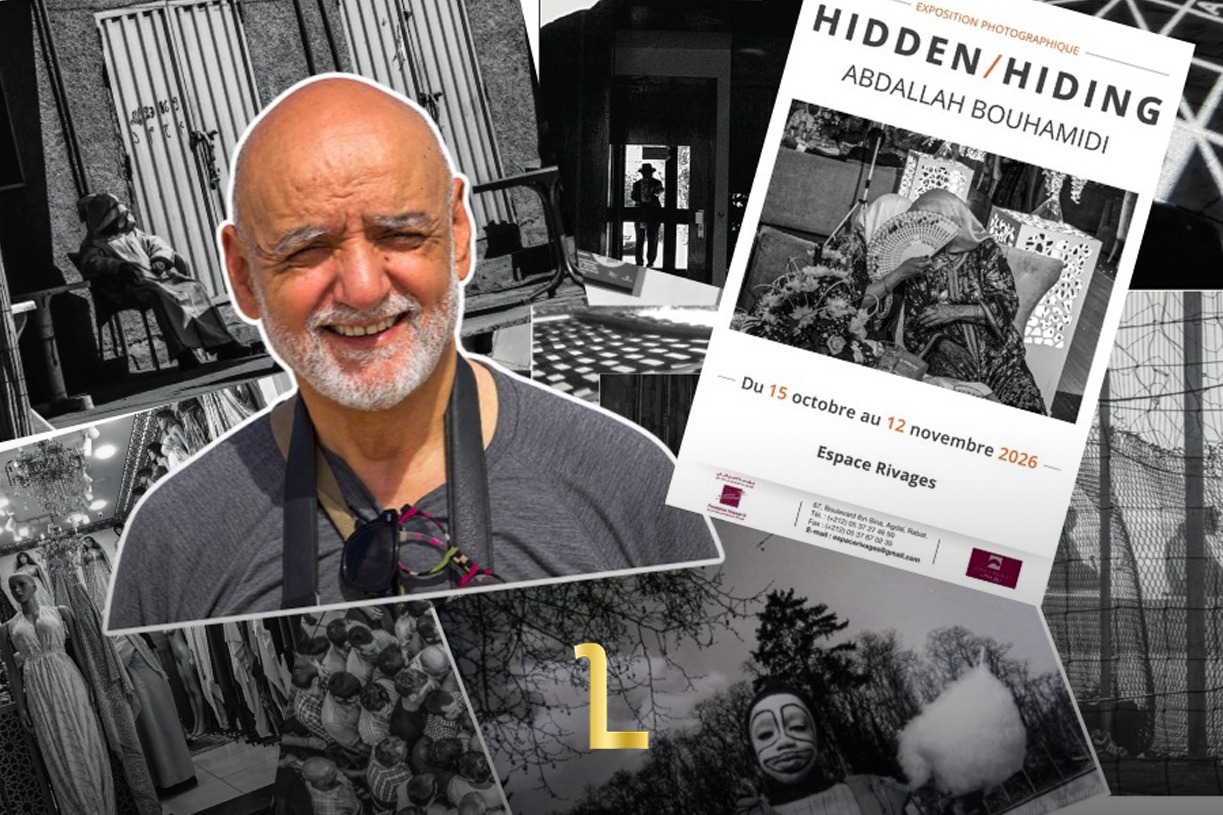
Fez — A face disappears behind a fan. A child offers the camera only one eye. Elsewhere, figures dissolve into shadows, reflections, doorways, screens, and fragments of the city.
For Moroccan photographer Abdallah Bouhamidi, what escapes the camera can matter as much as what remains visible.
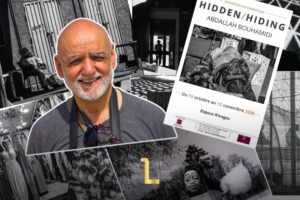
That tension drives “Hidden/Hiding,” his new monochrome exhibition opening October 15 at Espace Rivages in Rabat. The show runs through November 12, with an opening reception at 6:30 p.m. in the artist’s presence.
The Hassan II Foundation for Moroccans Residing Abroad organized the exhibition to bring together photographs spanning different periods of Bouhamidi’s practice.
It is also unusual within his career. Bouhamidi says this is the first time he has deliberately organized much of an exhibition around a defined theme.
“Normally, I consider every photograph a particular story,” he explained in an interview with E-Taqafa, arguing that imposing a theme can restrict both an image and the viewer’s interpretation.
This time, he made an exception.
Hidden is not the same as hiding
The distinction in the title is a deliberate choice.
“Hidden” refers to something concealed, sometimes through Bouhamidi’s own composition. “Hiding” introduces an active subject who withdraws, plays with the camera, or partially refuses to be seen.
That movement between photographer and subject runs throughout the exhibition.
In one photograph from Agoudal Imilchil, a child peers through a partially opened doorway, revealing just one eye. In another image, made on Murano in Venice in 1975, a young girl attempts to disappear behind her grandmother’s skirt.
For Bouhamidi, those gestures are not obstacles to a portrait. They become the picture.
“The invisible that is captured gives greater visibility, paradoxically, to the characters in my story,” he said.
The result also touches on privacy and the right to one’s image. Rather than revealing everything, Bouhamidi uses suggestion, inviting viewers to continue stories that the photograph deliberately leaves unfinished.
A psychologist behind the camera
Bouhamidi’s approach is closely connected to a career spent observing people.
Born in Azrou in 1946, he trained as a clinical psychologist and directed child-protection institutions from 1976 to 2010. He has practiced photography since 1970 and has lived in Vienna for the past 16 years.
He describes himself as part of the tradition of humanist street photography, with people remaining at the center of his images.
“In each of my photographs, I question first of all my own humanity,” Bouhamidi said. His subjects, he added, become temporary mirrors of his own psychological state.
That empathy shapes his visual choices. Even when an image is humorous, he avoids presenting people in humiliating or ridiculous situations.
His photographs instead emerge from waiting, moving, and watching.
Bouhamidi compares himself less to an image hunter than to a director who cannot alter the set. He cannot move the person, light, objects, or surroundings. He can only reposition himself until those elements briefly align.
The photograph might last just 1/125 of a second, but for him it contains a constructed story.
A return to Rabat
The exhibition also carries a personal dimension.
Bouhamidi previously helped organize trips to Morocco for children of Maghrebi and African backgrounds and contributed to establishing around 16 libraries in the country. He also worked with the Hassan II Foundation’s virtual Moroccan cultural center.
That history gives his return to Espace Rivages a meaning beyond another exhibition date.
“Exhibiting at Espace Rivages is a return home,” he said, “and above all, a happiness.”
“Hidden/Hiding” ultimately asks viewers to look at absence differently. A covered face, an obstructed body, or a figure slipping toward the edge of the frame does not necessarily leave less to see.
In Bouhamidi’s photographs, hiding often becomes another way of being present.