Fez — For decades, Morocco has been a behind-the-scenes powerhouse for global denim. The country’s textile sector produces hundreds of millions of garments a year and ranks among Europe’s key suppliers, with a growing specialization in denim and washed casualwear.
Most of those pieces have long shipped out under foreign labels. Now, a new generation of Moroccan brands is asking a different question: what if the same know-how and machinery that feed European fast fashion could be redirected into homegrown jeans with a clear local identity?
From “factory for others” to front-of-label
Morocco’s denim ecosystem has been built around proximity to Europe, competitive lead times, and an increasing focus on sustainability. Industry roadmaps highlight the dense concentration of mills and garment factories in Casablanca and Tangier, as well as an ambition to move up the value chain and capture more of the design and branding work instead of limiting activity to subcontracting.
Trade fairs like Maroc in Mode and Morocco Fashion & Tex now dedicate entire zones to denim, signalling both the weight of the category and the interest of buyers looking for nearshoring options. Within that context, a handful of Moroccan jeans labels are trying to flip the script. Instead of exporting anonymous five-pocket basics, they are building stories around cut, comfort, and an explicit “100% made in Morocco” stance.
Syd Denim: a finance career turned into a jeans manifesto
Syd Denim is one of the clearest examples of this shift. Founded by Fedwa Moukhliss after nearly a decade in banking and finance in France, the brand was born from a conscious decision to change direction and root value creation in Morocco.
Moukhliss returned home to launch a jeans label that leans heavily into local sourcing. From fabrics to manufacturing, buttons, labels, and accessories, Syd Denim collaborates exclusively with Moroccan companies and artisans. It presents itself as a “100% made in Morocco” brand rather than a logo stitched onto imported garments.
The brand’s communication emphasizes premium, body-hugging fits and a push-up effect, targeting women who want both comfort and a fashion-forward silhouette. Its showroom in Casablanca’s Racine district and worldwide shipping underline a dual ambition: speak to Moroccan consumers at home and export a distinctly Moroccan denim signature abroad.
Mieux Jeans: comfort, durability, and everyday wear
Another name gaining ground on Moroccan social feeds is Mieux Jeans, a Casablanca-based label that frames denim as an “expression of character” rather than a disposable trend. On its digital platforms, the brand describes its jeans as premium, comfortable, and built to withstand everyday life, with attention paid to stitching, fabric resistance, and long-term wear.
The message is clearly positioned against throwaway fashion. Mieux stresses considered design, limited series, and a slower rhythm of release. The vocabulary echoes broader sustainability conversations in Morocco’s textile industry, where brands and factories are under pressure to reduce waste, trace their supply chains, and align with stricter European environmental rules.
An ecosystem quietly filling out
Around these names, a broader ecosystem is taking shape. Morocco already counts dozens of companies fully dedicated to jeans manufacturing and finishing, from Tangier-based specialists in denim for men, women, and children to Casablanca workshops focusing on washing, dyeing, and special treatments. Many continue to produce for international clients, but the same infrastructure can now support local labels who want industrial quality with a Moroccan signature.
At the consumer level, denim appears inside wider streetwear and ready-to-wear projects, from 100% Moroccan brands that mix jeans with hoodies, jackets, and dresses to smaller Instagram-native labels testing new cuts and washes in short runs. What sets the newest wave apart is their insistence on visibility. Where previous generations often treated Moroccan origin as a technical footnote on a care label, these brands put it at the center of their storytelling, linking local production to pride, jobs, and a different relationship to clothing.
What it means for Moroccan shoppers
For Moroccan shoppers, the rise of homegrown jeans brands offers more than a national flag on the tag. It brings shorter feedback loops between designers and wearers, faster adjustments in sizing and fits adapted to local bodies, and the option to repair or alter a pair of jeans within the same ecosystem that produced it.
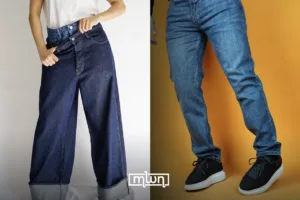
It also plugs everyday wardrobe basics — straight legs, slim fits, high-waisted cuts, relaxed silhouettes — into a supply chain that is physically close. In a global market where the environmental cost of fashion is increasingly scrutinized, buying jeans conceived and made in Casablanca or Tangier instead of shipped from across oceans is becoming part of the conversation.
Morocco will likely remain a key manufacturing base for international denim labels. But as brands like Syd Denim, Mieux Jeans and others expand their reach, the country’s relationship with denim is changing. It is no longer only the place where jeans are cut and sewn for other people’s logos. Increasingly, it is where Moroccan stories are stitched into the fabric — and where the name on the back pocket finally reflects the reality on the factory floor.