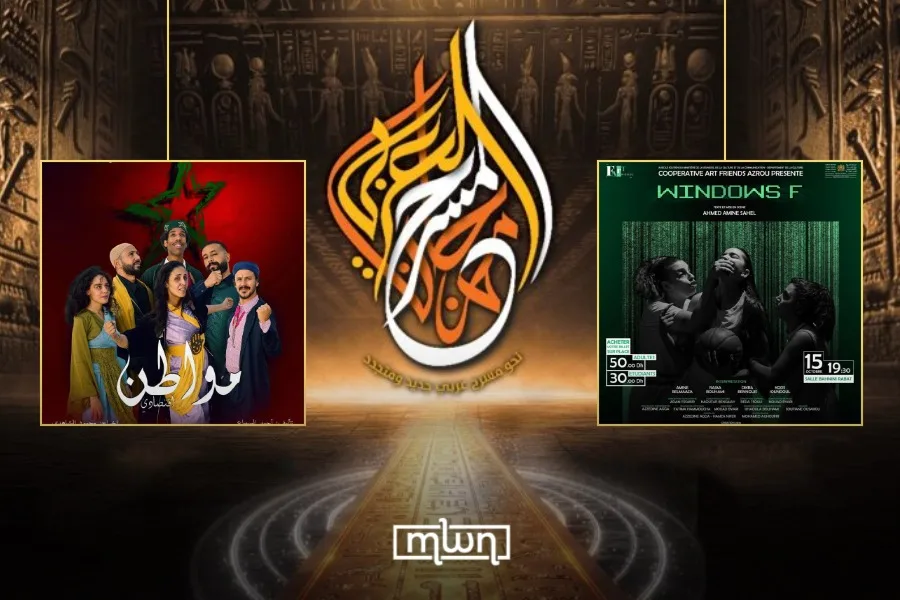
Fez — Cairo will host the 16th edition of the Arab Theatre Festival from January 10 to 16, 2026, bringing together some of the most compelling theatrical voices from across the Arab world.
Among more than 150 submissions reviewed by the selection committee, Morocco has emerged as one of the standout participants, with two works chosen for the festival’s sole competitive section.
Organized by the Arab Theatre Institute in partnership with the Egyptian Ministry of Culture, the festival features 15 productions competing for the prestigious Sheikh Dr. Sultan bin Mohammed Al Qasimi Prize. Morocco’s double presence in the official competition confirms the vitality and thematic ambition of its contemporary theater scene.
Two Moroccan perspectives on contemporary fractures
The first Moroccan work selected, “Windows F,” written and directed by Ahmed Amine Sahal for the Art Friends troupe, explores the excesses of technology and the multiple forms of confinement it generates. The play follows the intertwined destinies of three women trapped in a double imprisonment — social and virtual — inside a prison managed by artificial intelligence. Through this setting, Sahal examines violence against women, the illusions of digital emancipation, and the blurred boundaries between reality and fiction, while reaffirming his long-standing commitment to women’s rights.
Alongside “Windows F,” the play “Economic Citizen,” written by Ahmed Sebia and directed by Mahmoud Shahidi for the Al-Faddan workshop, offers a politically engaged theatrical experience. Featuring Moroccan actors including Jalila Tlemsi, the production immerses audiences in the realities of electoral processes and questions civic responsibility, power relations, and the role of art in shaping social awareness.
Moroccan theater in a competitive Arab landscape
Morocco’s dual selection is far from incidental. In a context of strong regional competition, it reflects a mature theatrical scene capable of engaging with major contemporary issues while maintaining a distinct artistic identity. The recognition positions Moroccan theater as a key contributor to ongoing debates within Arab performing arts.
The broader competition showcases works from Tunisia, Iraq, Egypt, Jordan, Kuwait, Qatar, the United Arab Emirates, Lebanon, and Algeria, illustrating the diversity of aesthetic approaches and thematic concerns shaping today’s Arab theater — from intimate narratives to overtly political statements.
Beyond the main competition
In parallel with the main contest, the festival’s secondary program includes a single production selected from 34 proposals: a stage adaptation of “Crime and Punishment,” presented by Egypt’s Syndicate of Dramatic Professions and directed by Mahmoud Al-Husseini. The adaptation revisits Dostoevsky’s classic through a contemporary lens, focusing on moral conflict, guilt, and inner turmoil.
As the Arab Theatre Festival returns in 2026, Morocco’s strong showing in Cairo underscores its ability to dialogue with the region’s most pressing artistic and social questions, reinforcing its status as a leading voice on the Arab theatrical stage.