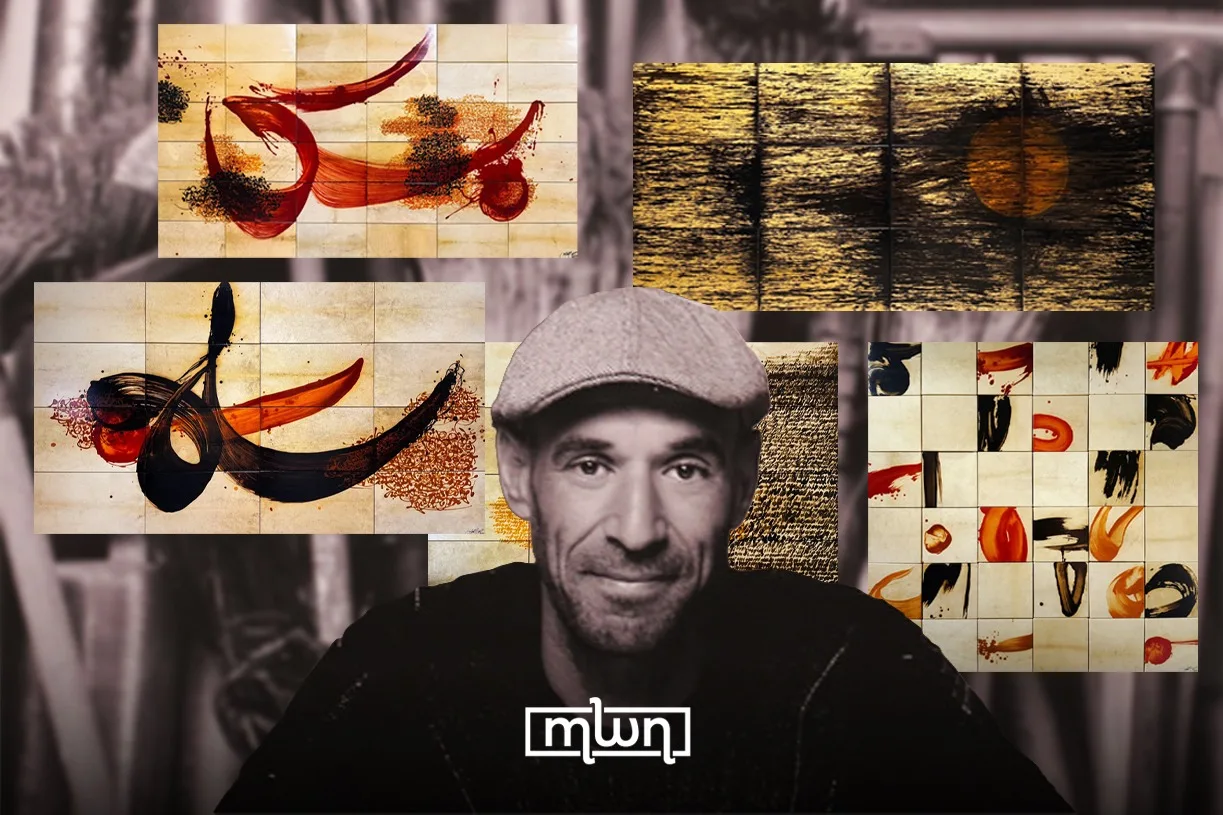
Fez — L’Atelier 21 is set to host Moroccan visual artist Larbi Cherkaoui from April 21 to May 23 for his second solo exhibition at the Casablanca gallery, titled “Une expérience-limite de la lettre” (A Limit-Experience of the Letter).
The opening is scheduled for Tuesday, April 21, at 7 p.m.
The exhibition centers on the plastic and gestural possibilities of the Arabic letter, a field Cherkaoui has explored for roughly three decades.
From calligraphy to visual disturbance
In the exhibition catalogue, Moroccan art critic Abderrahman Benhamza described three main tendencies in the new works.
The first remains closer to Cherkaoui’s established practice, with carefully shaped letterforms, a restrained palette, and surfaces that evoke old manuscripts through skin and mounted wooden supports.
The second and third directions move further away from conventional readability, dissolving the letter into clustered forms, atmospheric “clouds,” and broken fragments scattered across panel-like compositions.
That approach suggests a deeper artistic wager. Cherkaoui is not abandoning calligraphy so much as testing its limits, asking how far the letter can be stretched before it becomes texture, movement, or absence.
A long path in Moroccan contemporary art
Born in Marrakech in 1972, Cherkaoui holds a diploma in applied arts and has built a reputation for using calligraphy as both a spiritual and visual language. L’Atelier 21 notes that skin remains one of his preferred materials, with some works assembled like puzzles or rectangular fragments covered in skin and tinted with henna.
His works are now part of several public and private collections, including the Dalloul Art Foundation in Beirut, the Museum of Contemporary Art in Tunis, the Museum of Archaeology in Silves, the Fondation ONA in Morocco, Bank Al-Maghrib, Royal Mansour, and La Mamounia.
The gallery also lists “Spirit of the letter,” held in 2021, as his first solo exhibition there.
The new Casablanca show arrives as an attempt to renew a mature practice from within, proving that the Arabic letter can still generate fresh visual possibilities while remaining rooted in memory, rhythm, and gesture.