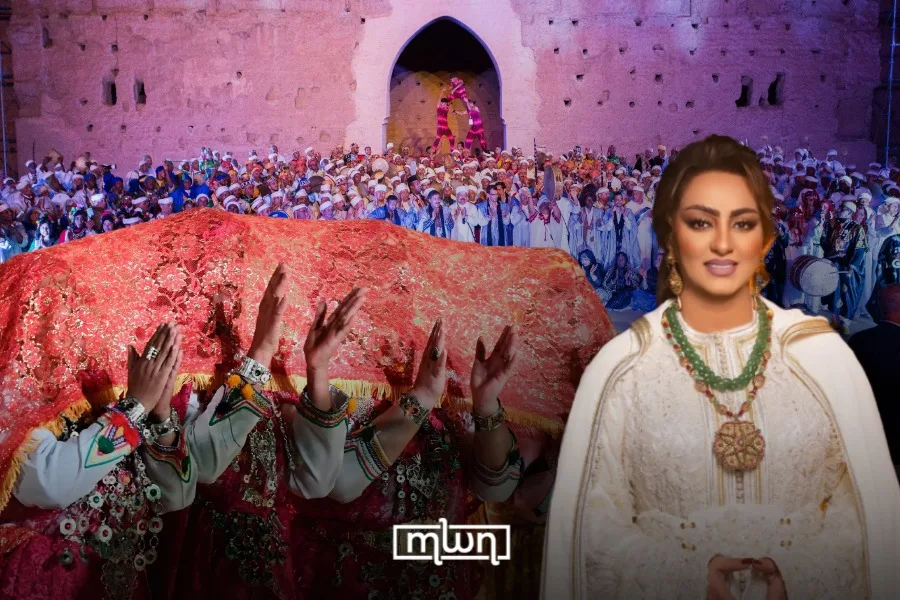
Rabat – The Festival National des Arts Populaires is scheduled to return from July 2-6, marking a new edition set within the height of summer 2026.
This year’s celebration will take place under the theme “Folk Arts, Treasures of Yesterday and Today,” a perspective that positions heritage not as a static memory, but as a living continuum, constantly renewed in the present.
In Moroccan culture, rhythm is as an original language, older than writing, older than spoken form itself.
Across regions, traditional garments carry embroidered symbols that preserve ancient worldviews, passed down through generations without fading their meaning.
Emerging from this is a clear affirmation that the past is not separate from the present, it moves within it.
Driven by intensity and breath, Moroccan popular arts exist as living energies, constantly reshaped across generations while remaining deeply anchored to their origins.
They evolve without rupture, carrying memory forward as a continuous act of renewal.
In the Atlas, Ahidous takes form as a communal choreography, where bodies move as one, like trees swayed by an evening breeze.
The Gnaoua tradition, born from sacred states of trance and rooted in African spiritual depth, pulses through the guembri, its sound resonating through the body like an inner vibration.
In Souss, Taskiwin groups lift finely carved sticks in precise rhythm, alongside drums whose cadence mirrors the human heartbeat.
“Fifty-five years. This number moves me every time I think of it, because it is a promise kept. The promise we have made, generation after generation, to those who passed down their dances, their songs, their costumes sewn with patience and love,” said Mohamed Knidiri, president of the festival.
A tribute to Zina Daoudia
Some voices don’t belong to a career. They belong to people, to the weddings, the kitchens, the summer evenings where they first found you, lodged themselves somewhere deep, and never left.
Zina Daoudia has that kind of voice, with a sound that carries the full weight of Moroccan chaâbi without ever making that weight feel like a burden.
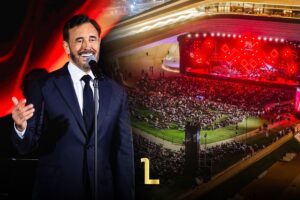
At the 55th edition of the festival, the stage will belong entirely to her. This will turn the state into an homage in the full sense: not a retrospective, not a museum piece, but a celebration with all the heat and joy she has poured into her music across a lifetime of performance.
“This year, paying tribute to Zina Daoudia is a way of saying that popular beauty is not second-tier beauty. It is the first. It is the root. And as long as this festival exists, it will be defended with everything we have, with our whole heart,” Knidiri emphasized.
Popular culture has its great women. It always has. And Zina Daoudia is one of them – both as an artist who gave everything to her art and one whose art gave everything back to the people who needed it.
El Badi Palace
The main show will take place at El Badi Palace, a palace so encrusted with gold and alabaster that ambassadors arriving from opposite ends of the known world ran out of words.
What Sultan Ahmed el-Mansour raised in the sixteenth century was, by all accounts, obscene in its splendor.
He earned his name, the Golden, not just for his military conquests but for what he built to celebrate them.
For 55 years, the stage at El Badi has been unlike any other, not built, but inherited.
Artists don’t arrive at a venue. They arrive at a verdict that history has already rendered: that this ground matters, that sound here carries differently, that an evening spent inside these walls is not entertainment so much as an encounter.
Jemaa el-Fnaa
The free outdoor stage of the festival takes place at Jemaa el-Fnaa, the First Theatre of the World.
UNESCO named it a Masterpiece of the Oral and Intangible Heritage of Humanity, an official recognition that is, in its own way, an admission of defeat: here is something we cannot preserve, only acknowledge.
The square operates on its own time. In the early morning it belongs to the light: low, amber, unhurried.
Then it begins to fill. Not all at once, but by accumulation, the way a current builds.
The halqa storytellers arrive and draw their circles, spinning narratives that hold their audiences the way a wire holds tension, taut, electric, one breath from snapping.
The bendir players lay down rhythms the body deciphers before the mind catches up.
The acrobats from Taroudant treat gravity as a suggestion, their nonchalance in the face of it bordering on the spiritual.
When the festival extends its public stage onto this ground, it isn’t borrowing a location. It’s acknowledging a lineage.