Rabat – A multidisciplinary Moroccan archaeological mission has recently concluded fieldwork at the Khenguat Akssat site, located in the commune of Jdiriya in the province of Es-Semara, marking a significant step forward in both scientific research and regional development strategy.
Conducted between March 23 and April 3 by leading academic researchers, the mission forms part of a broader initiative aimed at documenting and preserving the cultural and natural heritage of the Seguia El-Hamra basin.
This effort aligns with a long-term vision to establish a structured cultural and tourism circuit within the province, positioning the region as a destination of historical and ecological importance.
Excavations uncovered previously undocumented funerary architectures dating back to the pre-Islamic period, along with primary burials accompanied by funerary objects.
In the field of rock art, researchers documented two distinct sets of paintings: one linked to “Paleo-Amazigh” traditions, offering early traces of Amazigh writing, and another featuring human representations from the Neolithic era.
Among the most notable discoveries is the identification of a complete pigment preparation workshop.
This “technical atelier” includes a hearth and grinding tools still bearing traces of red pigment, providing rare insight into the production processes behind prehistoric artistic expression.
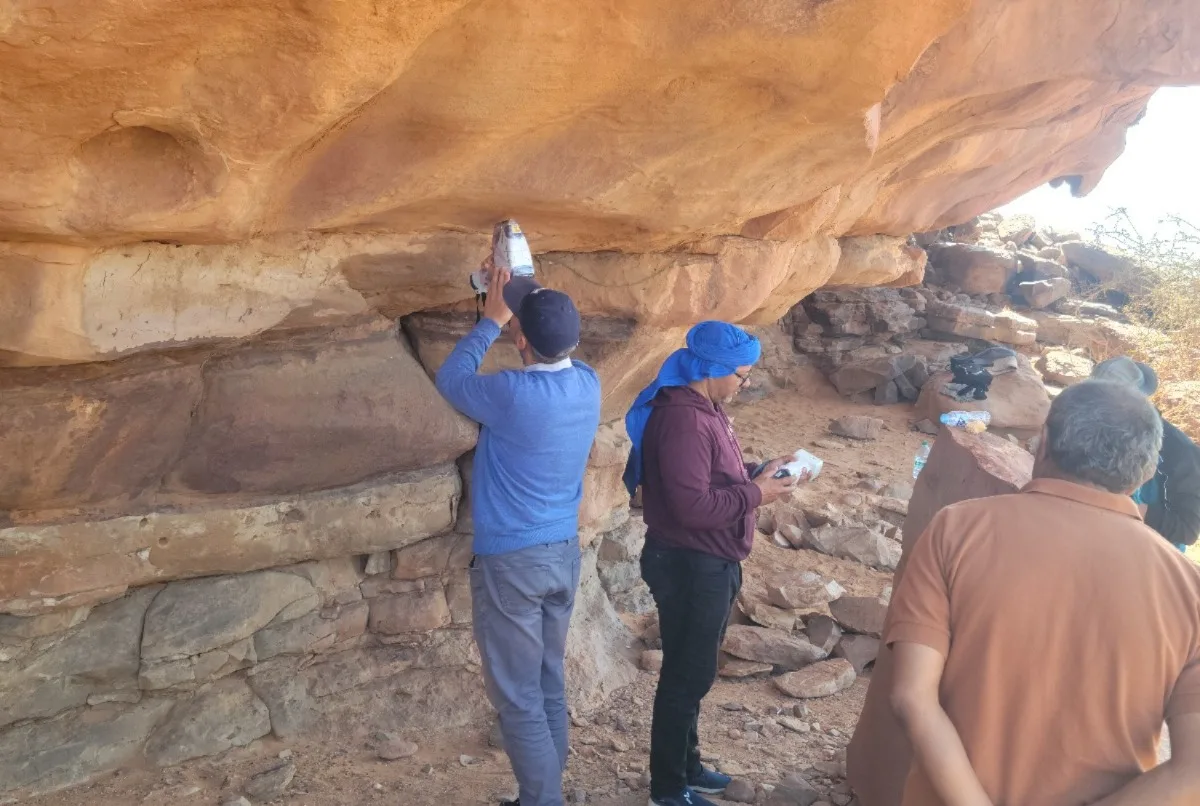
These findings were further analyzed using a mobile laboratory (MoLab) from Moulay Ismail University in Meknes, employing non-invasive, multi-instrumental techniques such as colorimetry, X-ray fluorescence (XRF), and Raman spectrometry.
A landscape of cultural and natural value
Beyond archaeology, the mission also pointed to the ecological richness of the region.
Environmental studies revealed diverse ecosystems, including the presence of argan trees and fauna well-adapted to Saharan conditions.
This natural heritage, combined with the archaeological significance of the site, reinforces its potential as a cornerstone for sustainable cultural and eco-tourism development.
The project is part of a multilateral institutional partnership led by the Miran Association for the protection of archaeological sites, with financial support from the Provincial Council and collaboration with local authorities, the Directorate of Cultural Heritage, and the Regional Human Rights Commission.
Researchers from Agadir’s Ibn Zohr University also played an active role in the mission.
Under the scientific direction of Abdelhadi Ewague and the supervision of Sidi Mohamed Mouloud Biba, representative of the National Park of Rock Art Heritage, the mission highlights the strong synergy between cultural heritage and the natural environment.
Altogether, these results position Jdiriya as a key site for scientific research and a highly promising hub for integrated cultural and environmental tourism in the Es-Semara province.