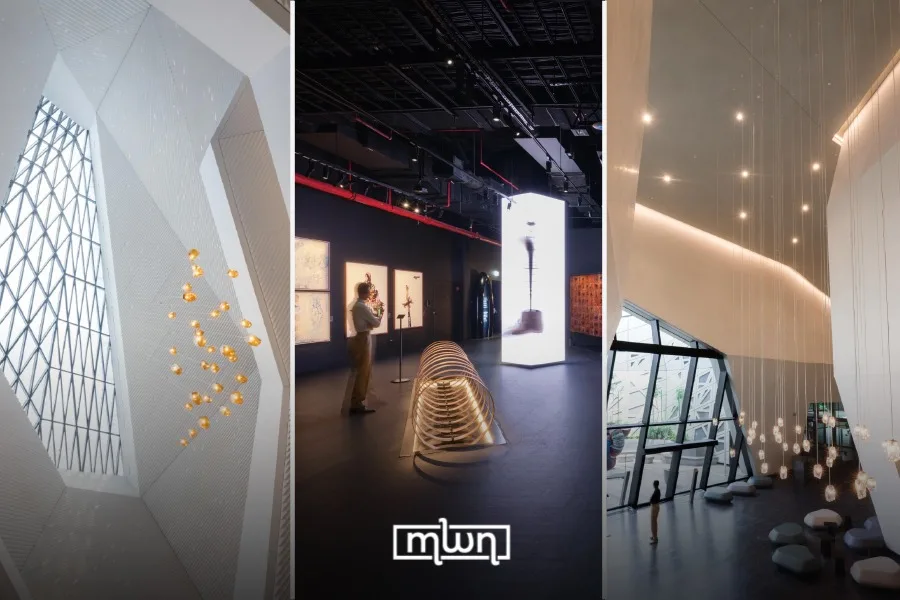
Rabat – In Riyadh, a quiet architectural transformation has turned a former research library into something far more cinematic: the Black Gold Museum.
Not the kind of museum you simply walk through. The kind you drift through, slowly, as if each room is asking you to reconsider what you thought you knew about progress, power, and the price of light.
Spanning 6,800 square metres across four levels, the Black Gold Museum is DaeWha Kang Design’s latest and most ambitious adaptive reuse project in Saudi Arabia.
Instead of building anew, the London-based studio chose to reimagine an existing icon, the Zaha Hadid-designed KAPSARC research library, into a cultural space where architecture itself becomes part of the exhibition.
And oil, that ever-present invisible character of modern life, becomes the story’s central tension.
The museum doesn’t lecture. It stages a conversation.
Across four chapters, “Encounter,” “Dreams,” “Doubts,” and “Visions,” visitors are led through a narrative that begins with origin and ends somewhere intentionally unresolved.
There are over 350 works in the permanent collection, by Saudi and international artists, each one orbiting a single question: what has oil done to us, and what might we yet do with it?
It’s less a timeline than a mood board of civilization.
The project is the result of a partnership between the Ministry of Culture’s Museums Commission and KAPSARC, supported by Saudi Arabia’s Quality of Life Program.
But beyond institutions and funding structures, it reads as something more intimate: an attempt to hold complexity without flattening it.
DaeWha Kang, who previously worked for a decade at Zaha Hadid Architects, brings that lineage into focus without imitating it.
His practice, DaeWha Kang Design, is known for treating architecture as an experience system, part geometry, part emotion, part digital precision. Here, adaptive reuse becomes not preservation, but reinvention.
There is something almost reflective about the idea: a building once dedicated to research now turned toward questioning the very systems it once served.
And maybe that’s the point.