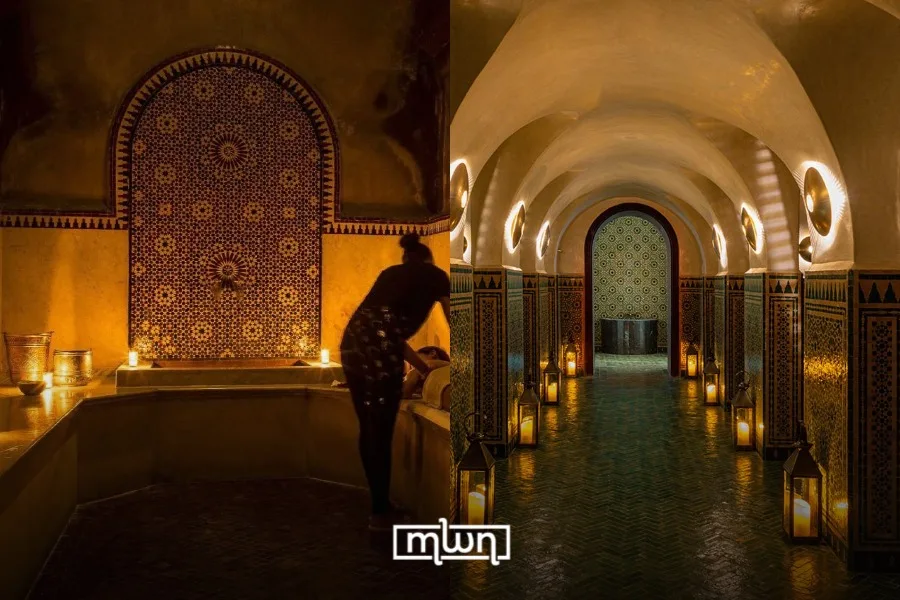
Fez — The Moroccan hammam has always been more than a place to wash. It is one of the country’s most intimate public spaces, where architecture, religion, class, gender, and daily routine meet under domed ceilings and clouds of steam.
Its history reaches back to the wider Mediterranean tradition of public bathing. The Metropolitan Museum of Art traces the hammam’s roots to Roman thermae, where bathhouses were organized around changing spaces and rooms of different temperatures. Over centuries, Islamic societies adapted that model to new ideas of purification, modesty, and urban life.
In Morocco, the hammam became a key part of the medina. It was usually discreet from the outside, tucked into dense neighborhoods near mosques, fountains, ovens, and markets. Its entrance rarely announced its importance. The real architecture began inside.
A building designed around heat
The traditional hammam follows a precise spatial rhythm. Visitors move from the changing room into progressively warmer spaces, passing from a cool or mild room to a warm room, then into the hottest chamber. This sequence echoes older Roman bathing architecture, but Morocco gave it a quieter, more inward character.
The hammam’s structure is built to control temperature, humidity, and movement. Thick walls hold the heat. Domes and vaults trap steam. Small openings in the ceiling let filtered light fall through the vapor. The result is not only functional, but almost cinematic: bodies, buckets, tiles, and steam moving in soft half-light.
In old cities such as Fez, hammams were often connected to local economies. The historic Saffarin Hammam, near Place Seffarine, is associated with the coppersmiths who worked nearby and dates to the Marinid period. Research on Fez’s hammams describes Morocco as one of the countries with a particularly high number of traditional living hammams.
Behind the bathing rooms sits the furnace, the hidden engine of the hammam. Traditionally, workers heated large cauldrons and pushed warmth beneath floors and through walls. The bathhouse depended on constant labor: the person feeding the fire, the attendants, the scrubbers, the cleaner, and the person controlling water.
A ritual of the body
The Moroccan hammam ritual is direct and physical. Bathers bring a bucket, stool, towel, black soap, and a rough exfoliating glove known as a “kessa.” The heat softens the body. Black soap loosens dead skin. The scrub can feel almost brutal to the unprepared, but that is part of the point.
The hammam does not sell softness in the modern spa sense. It strips the body back. Dirt, fatigue, and skin come off together. The final rinse feels like a reset.
For many Moroccans, the hammam has long been a weekly ritual, especially in homes without large bathrooms or reliable hot water. But even for those with modern bathrooms, the hammam offers something different: time, attention, and a kind of social permission to pause.
A social world behind closed doors
The hammam is also one of Morocco’s most important gendered spaces. Men and women usually attend at different hours or in separate sections. For women in particular, the hammam has historically offered a rare public space outside the home where privacy and community coexist.
Inside, social barriers soften. A student may sit near a grandmother. A shopkeeper may wash beside a banker. Mothers scrub daughters. Friends exchange news. Brides prepare before weddings. Women recover after childbirth. The hammam teaches more than bathing. It teaches modesty without shame, care without ceremony, and community without performance. Its culture is carried through gestures: how to pour water, when to give space, how to help someone scrub their back, how to sit, wait, rinse, and leave.
Between survival and pressure
Today, the hammam faces new pressure. Modern apartments, private bathrooms, luxury spas, and changing lifestyles have altered its role. But the deepest challenge is water.
During Morocco’s recent years of severe drought, authorities in several cities ordered hammams to close for three days a week to save water. Morocco World News (MWN) reported in 2024 that the closures affected workers and customers, while also raising questions about inequality, especially when public baths serving working-class communities faced restrictions.
That tension reveals the hammam’s real place in Moroccan life. It is heritage, but it is also infrastructure. It is culture, but it is also labor. It consumes water, but it also serves people who may not have the comfort of private alternatives.
The Moroccan hammam survives because it is useful, beautiful, and socially necessary. Its domes and hot rooms tell a history of architecture, but its true structure is human: a system of care, routine, and belonging. In a changing Morocco, the hammam remains a reminder that some traditions endure not because they are old, but because they still answer a need.