Fez — Moroccan kourdas couscous is one of those dishes that carries more than flavor. It carries winter, family memory, and an old way of preserving meat before refrigerators became part of daily life.
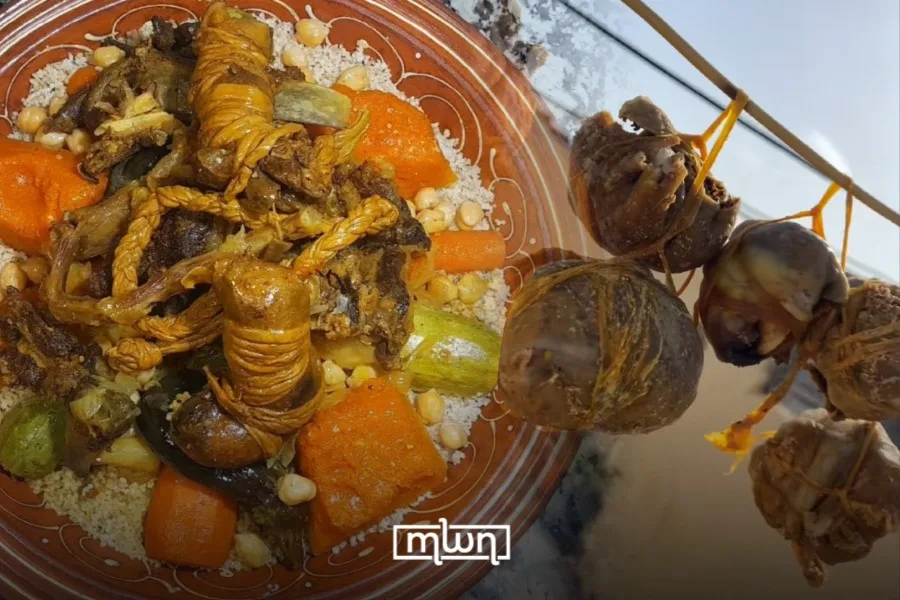
Kourdas, also written as kourdass, is a traditional Moroccan preparation made from sheep innards that are salted, seasoned, wrapped, and dried.
The Slow Food Foundation describes it as a Moroccan preserved meat product historically prepared in early winter and kept for the rainy season in spring. Its ingredients can include stomach, intestines, liver, lungs, and fat, seasoned with cumin, coriander, saffron, garlic, and salt.
When cooked with couscous, kourdas gives the dish a strong, rustic taste. It is not the light Friday couscous many people associate with vegetables and fresh meat. It is deeper, saltier, and more intense, with a flavor that reminds many Moroccans of village kitchens, Eid al-Adha preparations, and cold-season meals.
A dish built on preservation
Kourdas belongs to the same world as gueddid, Morocco’s cured and dried meat. Gueddid is usually made by marinating strips of lamb, beef, or other meat before drying them for later cooking.
Taste of Maroc notes that gueddid is not usually eaten as a snack, but cooked into dishes where its concentrated flavor seasons the sauce.
Kourdas works in a similar way. It is not only an ingredient; it is a seasoning base. A small amount can transform the broth of couscous, giving it body, fragrance, and a slightly smoky depth.
Families often cook it with onions, chickpeas, turnips, pumpkin, carrots, and sometimes dried fava beans. Some versions use barley couscous, known in Morocco as belboula, which gives the dish an even earthier character.
Couscous as shared memory
Couscous itself has long been one of the Maghreb’s most meaningful foods. UNESCO inscribed the knowledge, practices, and traditions linked to couscous on its Intangible Cultural Heritage list in 2020, recognizing its role in solidarity, hospitality, and shared meals across Morocco, Algeria, Tunisia, and Mauritania.
Kourdas couscous fits perfectly within that tradition. It is usually not a restaurant dish made for tourists. It is a home dish, prepared slowly and served generously, often to people who already understand what the smell means before the plate reaches the table.
For some, it is an acquired taste. For others, it is pure nostalgia. Its strength is exactly what makes it special: kourdas does not soften itself to modern expectations. It announces itself.
A disappearing taste worth remembering
As Moroccan eating habits modernize, dishes such as kourdas couscous risk becoming less common in urban homes. Younger generations may know couscous with chicken, lamb, or seven vegetables, but fewer have grown up with preserved offal simmering slowly in the pot.
Still, the dish remains important because it reflects a practical intelligence rooted in rural life. Nothing was wasted. Meat was preserved. Spices protected and transformed ingredients. A family meal could carry the memory of a season.