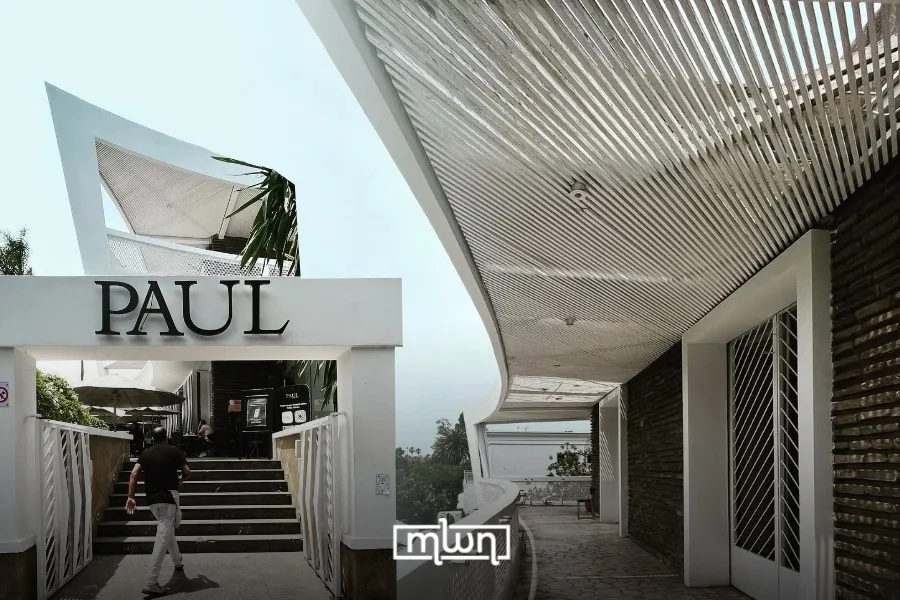
Fez — At the edge of Casablanca’s Anfa and Maârif districts, Villa Zevaco stands as one of the city’s most striking reminders that architecture can become part of everyday memory.
The building, formally known as Villa Sami Suissa, was designed in 1947 by architects Jean-François Zevaco and Paolo Messina for developer Sami Suissa, according to architectural archives and the Iconic Houses network. The same sources identify the house as one of Zevaco’s early Casablanca works, built before his later public projects made him one of Morocco’s defining modernist architects.
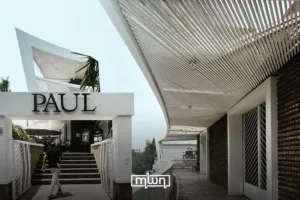
Although the villa is sometimes casually described as Art Deco, its form is better understood within Casablanca’s postwar modernist wave. Its sweeping lines, sculptural roof, and daring volumes made it feel radically contemporary when it appeared in the late 1940s. Local memory later gave it several names, including “Villa Pagode,” because of its distinctive roofline.
A villa that refused to disappear
Villa Zevaco survived not only because of its design, but also because it found a new use. After years of neglect, the building was rehabilitated in the early 2000s and converted into a public-facing food and leisure space under the Paul brand, with a bakery, tea room, and restaurant. The rehabilitation was led by architect Mounir Hargam and Andy Martin & Associates, while adapting the house from a private residence to a hospitality venue.
That transformation remains a point of debate among architecture lovers. Some see the conversion as an imperfect intervention on Zevaco’s original composition. Others view it as the reason the villa did not fall further into decay. The tension is familiar in Casablanca, where many 20th-century buildings sit between heritage value, commercial pressure, and daily urban use.
Today, the villa’s public life may be its strongest protection. People come for coffee, pastries, brunch, or shade in the garden, often without knowing that they are sitting inside a landmark of Moroccan modernism. Its survival depends partly on that ordinary popularity.
Zevaco’s Casablanca legacy
Jean-François Zevaco was born in Casablanca in 1916 and built much of his career in Morocco. After studying architecture in France, he returned to Casablanca after World War II, at a time when the city was expanding rapidly and becoming a laboratory for modern design.
Villa Suissa belongs to that early moment. It helped establish Zevaco’s reputation for bold residential architecture before he moved into larger civic, educational, and housing projects. His later work included major contributions to Agadir’s reconstruction after the 1960 earthquake, including the Courtyard Houses, which won the Aga Khan Award for Architecture in the 1978-1980 cycle.
That broader career matters because Villa Zevaco is not just a beautiful old house. It is an early sign of an architectural language Zevaco would continue to develop: white surfaces, strong shadows, sculptural concrete, and a careful relationship between interior space, garden, heat, and privacy.
A café inside a city landmark
The villa’s current identity as a café and tea house has made it more accessible than many historic buildings in Casablanca. Instead of remaining hidden behind gates or locked in private ownership, it functions as a social place, where architecture is experienced through routine rather than formal tours.
That everyday access gives the villa a rare place in the city’s urban culture. It is at once a heritage object, a restaurant, a meeting point, and a visual marker for generations of Casablancans.
Villa Zevaco’s story reflects a wider question facing Casablanca: how can the city preserve its modernist heritage without freezing it in time?
The answer may not always be perfect, but this villa shows that adaptive reuse can keep architectural memory visible, inhabited, and alive.