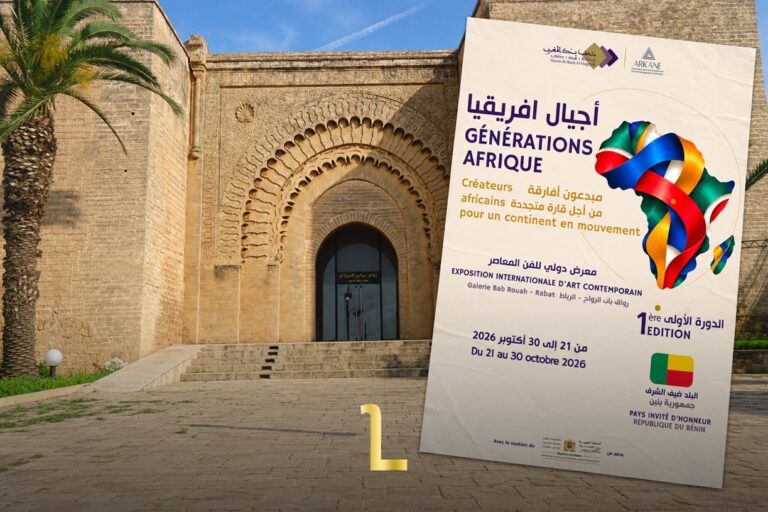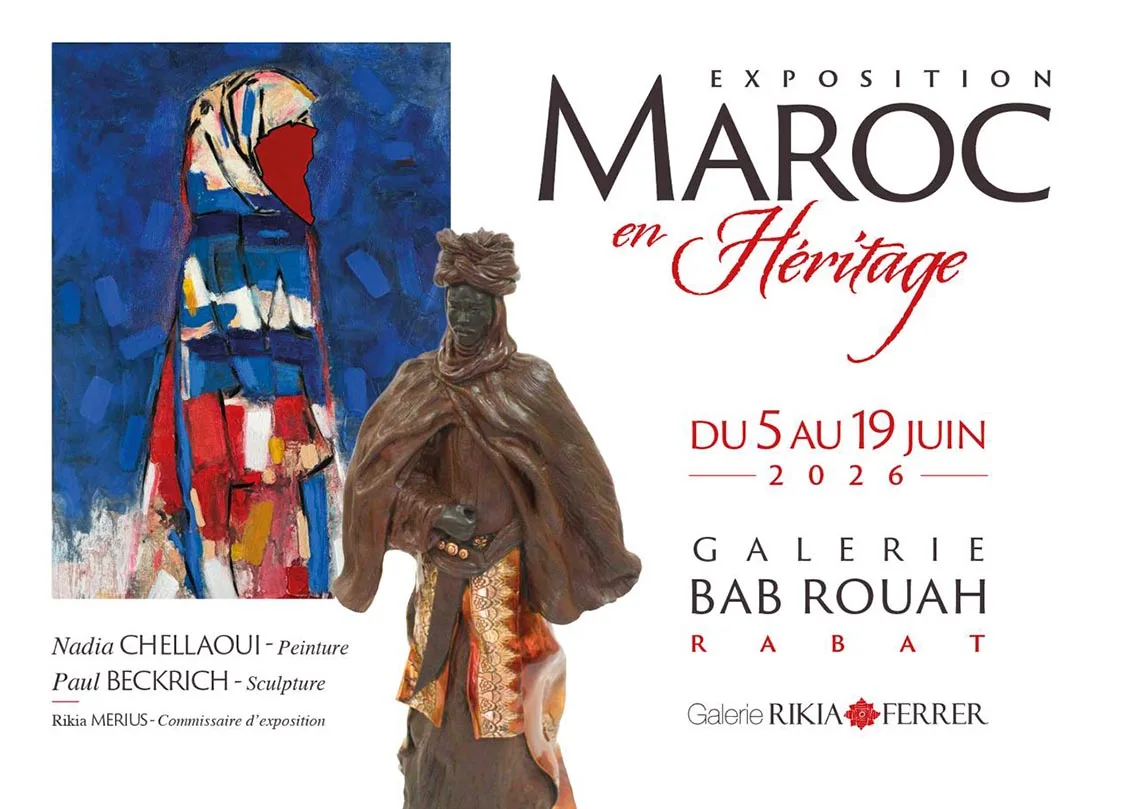
Fez — Rabat’s Galerie Bab Rouah is set to host “Maroc en Héritage” (Morocco in Heritage), an exhibition bringing together the sculpture of French artist Paul Beckrich and the painting of Moroccan artist Nadia Chellaoui from June 5-19.
Produced by Galerie Rikia Ferrer and led by gallerist Rikia Merius, the exhibition places Moroccan traditional dress at the center of a visual conversation between heritage and contemporary creation.
The project presents costume as a living cultural language shaped by memory, identity, and artistic reinvention.
Artists behind the exhibition
“Maroc en Héritage” is built around two distinct artistic approaches.
Beckrich, known for his work in raku and bronze, approaches Moroccan costume through volume, structure, and material presence.
His sculpted figures, often richly dressed, evoke a timeless atmosphere where fabric, posture, and silence become part of the same narrative.
His work draws on travel and cultural encounters, giving the exhibition an outside gaze shaped by curiosity and observation.
Chellaoui’s work moves in a more intimate direction. Born in Rabat in 1973, the Moroccan painter has developed a practice marked by contemporary expressionism, with the human figure, especially the female figure, occupying a central place in her visual world.
Through color and gesture, her paintings explore emotions such as love, solitude, and introspection. In the exhibition, this emotional language meets Beckrich’s sculptural vocabulary, creating a conversation between matter and inner life.
Bab Rouah as a symbolic setting
The choice of Galerie Bab Rouah gives the exhibition added cultural weight. Located in one of Rabat’s historic gates, the venue offers a setting that reinforces the project’s focus on memory and continuity.
For Merius, the exhibition marks both a return to cultural roots and a celebration of art’s universal reach.
By bringing Beckrich and Chellaoui together, the project proposes a renewed reading of Moroccan heritage through two different artistic sensibilities.
The exhibition also reflects a wider movement in Morocco’s contemporary art scene, where artists and curators are revisiting traditional symbols through modern forms.
Costume, architecture, gesture, and memory increasingly appear not as fixed relics, but as materials for new artistic interpretation.