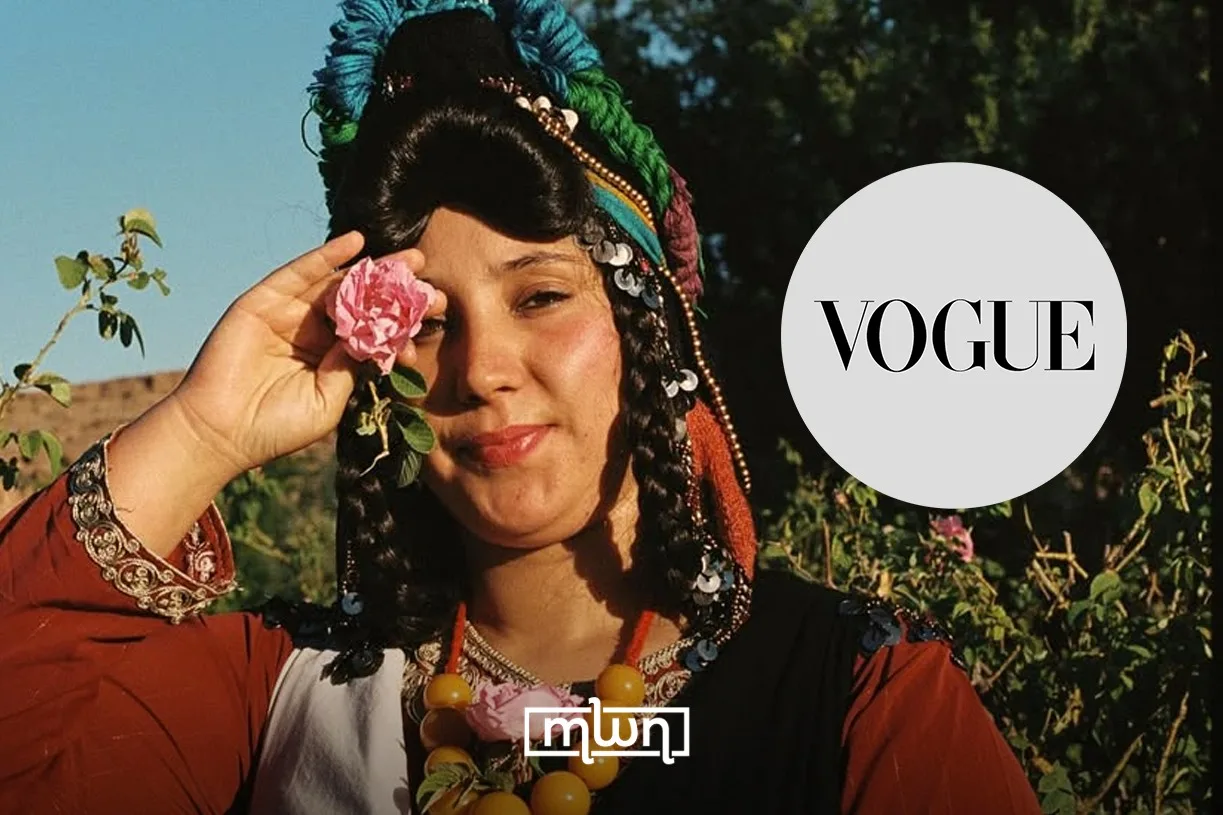
Fez — Vogue has turned its attention to Morocco’s Valley of the Roses, publishing a feature on the women working to reclaim a rose industry long shaped by female labor but historically controlled by intermediaries and export-driven structures.
The report, written by Amelia Dhuga and published on May 25, focuses on Kelâat M’gouna, a rose-growing area largely inhabited by Amazigh communities. Every spring, women gather before dawn to pick Damask roses before the heat damages the flowers.
“We wake up very early, before sunrise,” local picker Fatima Temaghrite told Vogue, describing a routine built around speed, scent, and the mountain landscape. Another line captures the intimacy of the work: “There’s something peaceful about working with nature.”
From household labor to global value
Vogue traces how roses in the Dadès and Mgoun valleys moved from domestic cultivation into a commercial industry. For generations, women picked, dried, and distilled roses within family spaces. The French Protectorate later changed the structure of production, linking Moroccan roses to perfume markets abroad.
Researcher Nacima Mohamdi told Vogue that the French perfume industry in Grasse sought a rose variety capable of producing valuable essential oil, helping formalize the sector through factories and middlemen. According to the report, women continued doing much of the work while receiving low prices for their labor.
The article also highlights the annual Festival of Roses, where music, vendors, dancers, rose products, and the crowning of a “queen of the roses” turn the harvest into one of the region’s most visible cultural celebrations.
Cooperatives shift the balance
The strongest part of Vogue’s report is its focus on women-led change. Since the 2000s, cooperatives and independent businesses have offered pickers alternatives to selling through middlemen.
Mohamdi said many cooperatives emerged after 2008 with support from “Green Morocco Plan,” creating economic openings for women facing social and financial exclusion. Temaghrite summarized the shift clearly: “We have more control and earn more fairly.”
Vogue also points to Les Femmes du Dadès, a cooperative supporting roughly 400 female pickers, many of them widowed, divorced, or supporting families. Beyond production, the cooperative provides training and educational outreach.
Entrepreneurs bring science and social impact
The feature also introduces Hafsa Chakibi, founder of the local brand Flora Sina. Chakibi launched the company in 2018 after completing a PhD specializing in petroleum, using her knowledge of distillation and extraction to produce organic rose oil.
“Our product is now completely organic,” Chakibi told Vogue, adding that the company uses sustainable practices. Flora Sina works directly with local pickers, pays above-market rates, and reinvests in community projects, including girls’ education, craft workshops, and school libraries.
Chakibi framed the mission beyond production, saying: “The aim is not only production, but long-term local empowerment.”
Through Vogue’s lens, Morocco’s rose industry is not only a beauty or tourism story. It is a story about women turning inherited knowledge into economic agency, while preserving a cultural landscape that continues to define one of Morocco’s most fragrant regions.