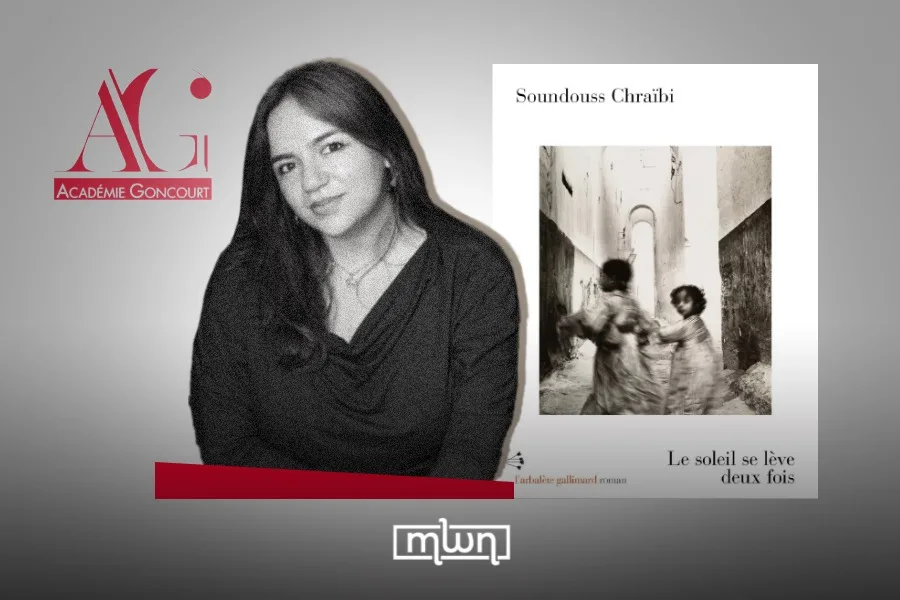
Fez — Moroccan writer Soundouss Chraïbi has earned a major literary recognition as her debut novel “Le soleil se lève deux fois” (The Sun Rises Twice) joins the Académie Goncourt’s 2026 summer reading favorites.
The book appears among ten “coups de cœur” selected by members of the Académie Goncourt, the institution behind France’s most prestigious literary prize.
The 2026 list brings together novels, essays, biographies, and literary works chosen for summer reading.
Published on February 5 by L’Arbalète/Gallimard, “Le soleil se lève deux fois” runs 256 pages and marks Chraïbi’s first novel.
A family story built around women and silence
The novel follows Layal, who returns to the family home in Tangier after learning that her grandmother, Mama Abla, is dying.
Around the grandmother’s final days, three generations of women gather under the same roof, creating an intimate closed world shaped by memory, grief, and buried truths.
The story moves through Layal’s childhood memories while questioning the silences that shaped her family’s history.
A hidden secret pushes her into the past of her mother, her aunt, and her grandmother, turning the family home into both shelter and archive.
The publisher’s presentation frames the novel as a female huis clos haunted by secrecy, exploring the hidden mechanics of a patriarchal society and paying tribute to forgotten women whose wishes were never respected.
A Moroccan voice in a French literary spotlight
Chraïbi’s selection gives the novel a wider platform beyond its initial release. The Académie Goncourt’s summer list does not carry the same weight as the main Goncourt Prize, but it still functions as an influential literary recommendation from one of France’s most visible institutions.
The recognition also places Chraïbi beside established and emerging names in French-language literature.
The list includes “Espoir” by Djaïli Amadou Amal, “Hélène et Paul Morand” by David Bonneau, “La guerre, ce sont les noms propres” by Ariane Chemin, “La dynamique de l’œuf” by Céline Curiol, “Inventaire de la basse Période” by Charles Dantzig, “DJ” by Anne F. Garréta, “Une forêt” by Jean-Yves Jouannais, “Retour à Balbec” by Renaud Meyer, and “Les habitantes” by Pauline Peyrade.
That placement matters for a debut novel. It moves “Le soleil se lève deux fois” from a promising first publication into a broader literary conversation around memory, inheritance, and women’s interior lives.
From Tangier to transmission
The novel’s Tangier setting gives the story a strong Moroccan anchor. Rather than treating the city as decoration, the book centers the family home as a charged space where generations collide, secrets remain alive, and women carry the weight of what was never spoken.
Chraïbi is a Moroccan journalist and writer trained at the Sorbonne, with cultural events in Morocco already building interest around the novel since its publication.
The Goncourt summer recognition now gives that local and regional momentum an international echo.