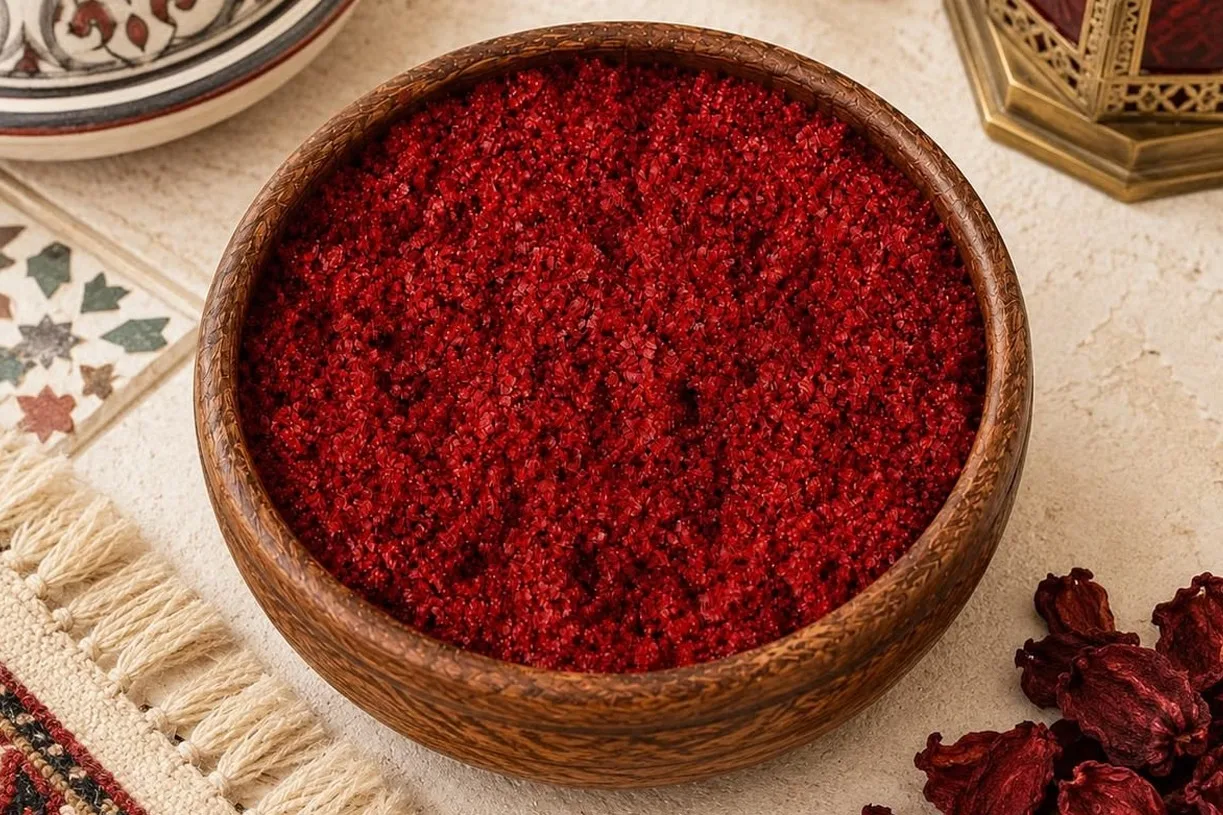
Rabat – Every fashion capital has its beauty signature. Paris has the red lip. Milan has effortless glamour. Seoul has glass skin. Morocco has Aker Fassi.
For centuries, this deep crimson pigment has occupied a unique place in Moroccan beauty culture, quietly coloring lips and cheeks while trends came and went around it.
Long before beauty brands packaged “natural flush” products in minimalist tubes and luxury compacts, Moroccan women had already mastered the art of understated color.
In a beauty industry driven by constant reinvention, Aker Fassi has remained largely unchanged.
Found in homes, beauty rituals, and bridal preparations across Morocco, it belongs to a category increasingly coveted by luxury consumers: objects that carry history.
Its appeal lies in simplicity. A touch of water, a sweep of pigment, and the skin takes on a soft, healthy warmth.
The effect is subtle rather than transformative, enhancing rather than concealing. It is beauty without excess.
Yet Aker Fassi is also unmistakably visual.
Its signature clay presentation and vivid red pigment transform a simple beauty product into an object of craftsmanship.
It is the kind of object that would not look out of place on the vanity of a fashion editor or within the carefully curated shelves of a luxury concept store.
But unlike many products that become fashionable because they photograph well, Aker Fassi’s beauty is rooted in meaning.
It tells a story about Morocco’s relationship with beauty, one shaped by rituals, craftsmanship, and generations of knowledge.
It reflects a culture where elegance has often been associated with refinement rather than extravagance, and where beauty traditions are preserved not through marketing campaigns but through everyday practice.
As fashion increasingly celebrates heritage and authenticity, Aker Fassi offers something many modern products cannot manufacture: cultural depth.
There is no need to reinvent it, modernize it, or translate it into the language of trends.
Its relevance comes precisely from the fact that it has endured without chasing them.