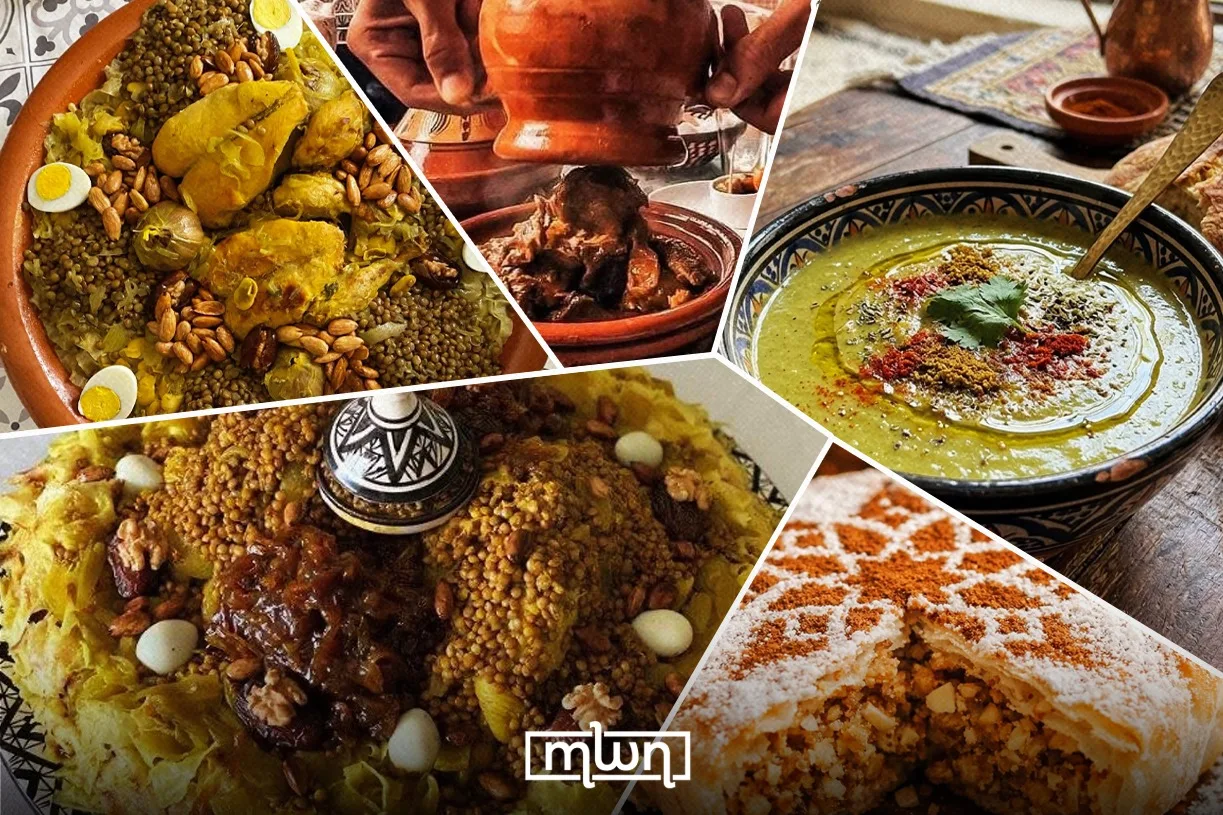
Rabat – Every city has folded its history, geography, and daily rhythm into a single dish that locals will defend as the real one.
From the walls of Marrakech to the cliffs of Tangier, every stop tells the story of Morocco’s trade routes, mountain harvests, and Atlantic tides, one unforgettable plate at a time.
Marrakech: Tanjia
Tanjia is a workaround as much as a recipe. Beef is packed into a tall clay pot with garlic, cumin, preserved lemon, and a thread of saffron, sealed, and carried down to the neighborhood hammam.
There, it’s buried in the ash and embers of the furnace that heats the bathhouse and left to cook for hours while its owner goes about his day: working, praying, sitting with friends in the souk.
By evening, the meat has gone fall-apart tender, the fat and spices reduced into something close to a savory syrup.
Fez: Pastilla
This is Morocco’s oldest imperial city, and its signature dish, pastilla, tastes like a royal kitchen showing off.
Paper-thin warka is layered around a filling of shredded chicken and mixed with toasted almonds, cinnamon, and sugar.
A separate layer of eggs, cooked slowly with saffron and onion until custardy, goes in alongside it.
The whole thing is baked until the pastry turns deep gold and shatteringly crisp, then dusted with powdered sugar and a lattice of cinnamon on top.
The genius contrast of pastilla is the argument it starts in your mouth: sweet against savory, crisp against soft, cinnamon against saffron.
Rabat: Rfissa
Morocco’s capital is a quieter, more administrative city than Marrakech or Fès, and its signature dish reflects a quieter kind of ritual, one built around care rather than celebration.
Rfissa is chicken and lentils, slow-simmered in a broth thick with fenugreek, ras el hanout, and onion, poured over shredded “trid” or “msemen” pastry until the bread has soaked up all that dark, earthy liquid.
It’s traditionally the dish made for women after childbirth, since fenugreek is believed in Moroccan households to help with recovery and milk production.
Essaouira: Seafood
Essaouira runs on wind and water.
This walled Atlantic port, all whitewashed ramparts and blue shutters, has built its food identity around whatever the fishing boats bring in that morning, and its version of a tagine is lighter and brinier than anything found inland.
It’s a dish that couldn’t exist in Marrakech or Fès. Essaouira’s whole identity is right there in the pot.
Tangier: Bissara
Tangier sits where the Mediterranean meets the Atlantic.
Its everyday staple, bissara, actually comes down from the Rif Mountains, but it’s on Tangier’s breakfast tables that it’s found its most devoted audience.
It’s cheap, it’s filling, and in the cooler, damp mornings that roll in off two seas, it’s exactly the kind of dish a working city eats before anything else.
Where pastilla and tanjia perform for an occasion, bissara doesn’t perform at all, and that honesty is its own kind of signature.
The thread that connects them
Five cities, five dishes, and every single one of them travels well beyond its own walls.
Wondering why? Because in Morocco, a recipe isn’t just something you cook; it’s something you belong to and share with your loved ones.