Fez — The Fez Festival of World Sacred Music moved into a quieter, more intimate register at Dar Adiyel on Friday morning, where two performances turned the historic medina venue into a chamber of voice, memory, movement, and stillness.
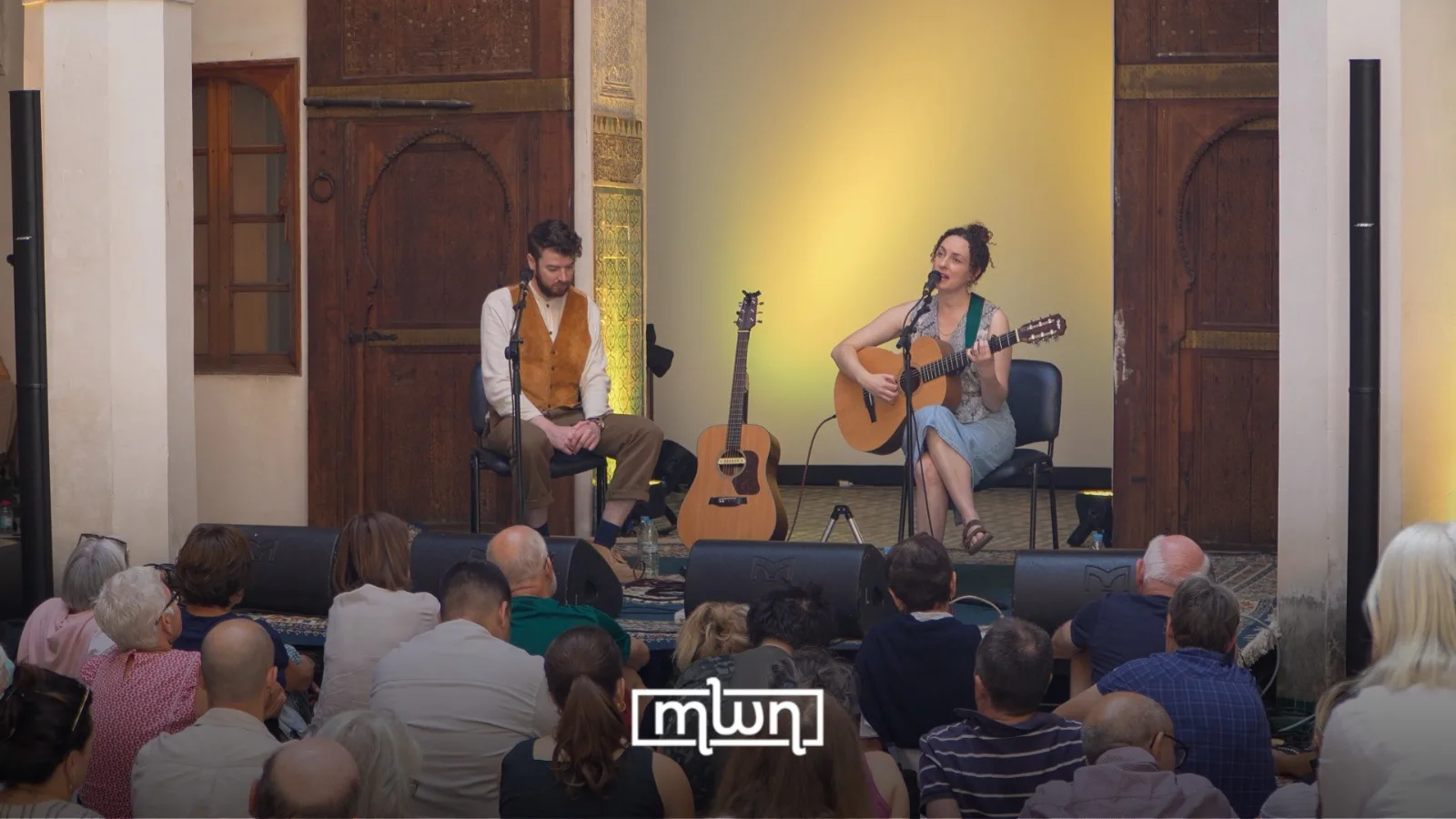
The morning began with Irish singer Niamh Bury, one of the most captivating voices of Ireland’s new folk scene. Her concert carried the warmth of Dublin’s living folk tradition into Fez, blending her own compositions with traditional Irish music inside a venue that made every note feel close to the audience. The festival program presented her as an artist shaped by storytelling, emotion, and a folk world of tales and inner landscapes.
Bury told MWN Lifestyle magazine that “The audience were really beautiful and appreciative, so it was a really lovely concert.”
Her performance created a soft contrast with the monumental opening night at Bab Makina. At Dar Adiyel, the scale was human.
The audience listened from within the house’s carved and tiled interior, where the architecture naturally pulled attention toward the voice. Bury’s songs found space in the courtyard-like intimacy of the venue, carrying Irish melancholy, tenderness, and narrative clarity into Fez’s old medina.
A venue made for close encounters
Dar Adiyel strengthened the emotional tone of both performances. The historic mansion, located in Fes el-Bali, dates to the late 17th or early 18th century and is named after Abd al-Khaliq Adiyel, a wealthy merchant and official under the Alaouite sultan Moulay Ismail. The house later became government property, served treasury functions in the 19th century, and became connected to heritage preservation under the French Protectorate before later functioning as a conservatory of Andalusian music.
Its architecture makes it one of Fez’s most atmospheric festival spaces. Built around a decorated central courtyard, with zellij, carved wood, stucco, fountains, and galleries, it gives performances a sense of enclosure and depth. The venue does not overwhelm artists. It frames them.

That intimacy also shaped “Incarnation,” presented at noon in the same space. The performance brought together Mathias Delplanque, a sound creator working between contemporary, electroacoustic, and traditional music, with Khmer classical dancers led by Chap Chamroeunmina, who holds the prestigious title of étoile dancer of the Royal Ballet of Cambodia.
The dancers shaped the choreography around Dar Adiyel’s central fountain, letting the water become part of the performance’s ambient sounds as their movements echoed the passage from stillness to life.
“Incarnation” was built around traditional choreography inspired by statues of ancient Khmer art. The performance explored the invisible dialogue between movement and sculptural memory, shifting between the inanimate and the animate, the sacred and the experimental.
In Dar Adiyel, that concept gained extra force. The dancers’ measured gestures responded to a space already marked by centuries of craft and memory.
Their controlled movement, paired with Delplanque’s sound world, turned the venue into a place where Moroccan architecture and Cambodian sacred aesthetics briefly shared the same silence.
Dar Adiyel gave both performances their deeper meaning.