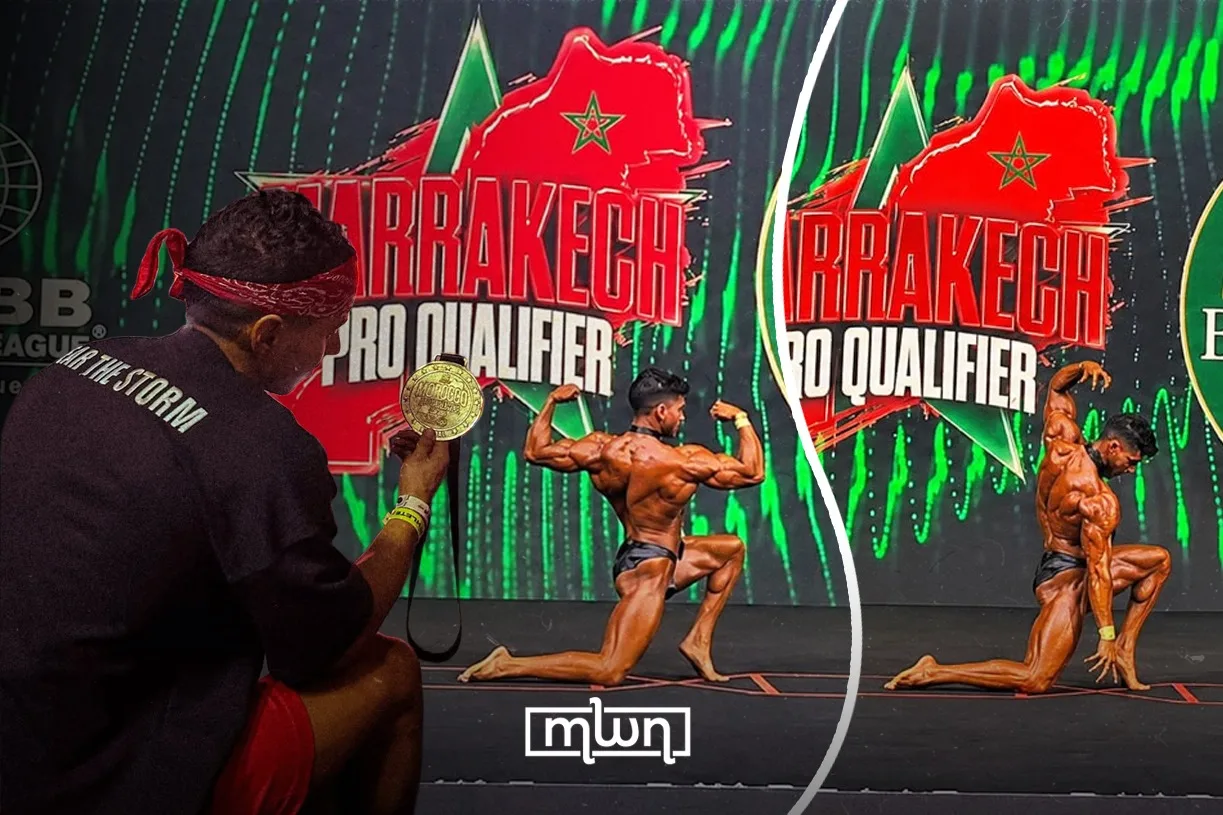
Fez — El Mehdi Seyrini does not hesitate when asked the question that follows many bodybuilders online, “natty or not?”
“Lifetime natural,” he told MWN Lifestyle magazine.
For Seyrini, the answer is not only about reputation. It is about the kind of athlete he wants to be, and the kind of message he wants young Moroccans to receive.
“My main goal is longevity and being as healthy as possible,” he said. “For a natural bodybuilder to reach a certain level, it may take 10 years, while an enhanced athlete can achieve it in less than 2 years. But that comes with a cost.”
That cost sits at the center of Seyrini’s argument. In a fitness culture shaped by social media, fast transformations, and private gym conversations, he believes young lifters are being taught to expect too much, too soon.
His own story offers a different pace. Born in 1997 in El Hajeb, Seyrini writes in his e-book “How to Become an Athlete” that he started Taekwondo at age six, entered a gym at 16, and later won 1st place in Classic Physique Novice at NPC Worldwide Morocco Marrakech 2026 at age 29.
He prepared without a coach, sponsor, or team, studying training, nutrition, posing, recovery, and peak-week strategy himself.
A slower idea of progress
Seyrini’s warning is not that teenagers should avoid ambition. It is that they should understand what natural progress looks like.
“Beginners can see respectable results in the first year because they have the advantage of youth and peak hormone production,” he emphasized.
“But to achieve a professional level like the one social media often shows, it takes many years of discipline, pain, and sacrifice.”
In other words, “no pain, no gain.”
His e-book is built around that same idea.
It explains progressive overload, nutrition, sleep, recovery, and discipline in simple terms, with the central argument that consistency matters more than motivation. In one section, he writes that “without discipline, knowledge is useless and goals remain just wishes.”
Seyrini says the only supplements he sees as truly useful for most lifters are the basics.
“The best supplements that are realistically and scientifically proven to improve performance are creatine and caffeine,” he highlighted.
“Other supplements can be a plus, but often they are not necessary. Sometimes it is simply an industry trying to make a profit.”
Creatine is among the most studied sports supplement. The International Society of Sports Nutrition described creatine monohydrate as safe and effective when used within established guidelines.
Caffeine also has evidence supporting performance benefits, according to the same organization’s review of sports nutrition research.
But Seyrini draws a hard line at enhancement drugs.
“I highly warn people against taking steroids, hormone replacements, peptides, or similar substances,” he added. “People do not realize how dangerous these substances can be. It is risky even with proper medical supervision.”
The US National Institute on Drug Abuse says anabolic-androgenic steroids are used to build muscle mass or enhance athletic performance, but their misuse can carry physical and psychological risks, including substance use disorder.
‘The situation is worrying’
Seyrini does not describe steroid culture in Morocco as an abstract problem. He says he has seen the pressure up close.
“The situation is worrying,” he said. “Many times in different gyms, young people approached me, appreciated my physique, and then asked if I am natural. When I answer, most of them do not believe that this level is attainable naturally.”
That disbelief, he argues, is part of the damage.
“Some of them even tell me they are planning to take steroids from the black market with zero knowledge or medical assistance,” he said. “Imagine the huge risk they are putting themselves in.”
The concern is not limited to Morocco. Around the world, researchers and public health officials have linked appearance and performance-enhancing drug use to pressure from body ideals, online fitness culture, and the search for rapid physical change.
But in Seyrini’s view, the Moroccan gym scene needs a more direct conversation about what is natural, what is enhanced, and what young people are risking.
Winning without a team
The strongest part of Seyrini’s story is not simply that he won. It is that he says he won alone.
“The hardest part about the whole experience is doubt,” he noted.
He described the final stage of preparation as a private grind: low energy, a strict diet, calorie deficit, heavy training, meal preparation, notes, diet adjustments, and daily checks in the mirror.
“Inside this storm of stress, doubt finds its way into your soul,” he stated. “Your body just wants to survive. Your mind starts asking: ‘Is all this suffering worth it? What if I am doing everything wrong?’”
His answer was not dramatic.
“That is when I learned that the only way through that gloomy cloud of doubt is to keep going,” he said. “Do not think too much. Stick to your plan and trust the vision.”
Then he added: “We can call it belief.”
Seyrini now wants to pursue an IFBB Professional Card as a natural athlete, a goal he admits will be difficult.
“The competition is very tough against enhanced athletes,” he highlighted. “But my main goal is to influence people in a positive way.”
From El Hajeb to a wider audience
Seyrini is also conscious of where his story begins.
“I was born and raised in El Hajeb,” he stated. “When I travel to other cities, some people do not even know my city exists.”
He said athletes from smaller cities are often underestimated by people from Morocco’s larger urban centers.
“Some people from bigger cities look at people from smaller cities as if they have less experience or are not open to the world,” he said. “But that is just a stereotype.”
His plans now are partly competitive and partly educational. He is working on YouTube content, coaching, and what he describes as an older dream: opening a gym.
“Not just to own a gym,” he said, “but to create a place where people can learn discipline, morals, wisdom, and receive guidance. Not a commercial gym, but a real athlete’s environment.”
Seyrini says he was back in the gym the Monday after competing on Saturday.
“Training is therapy for me,” he said. “It is part of my identity.”
He still cites old-school bodybuilders as influences, including Tom Platz, Kai Greene, Kevin Levrone, and Ronnie Coleman. But his message is less about copying champions than resisting shortcuts.
“When motivation fades, and by the way, it is rarely there, I just keep going,” he emphasized. “I always try to make my health a priority.”