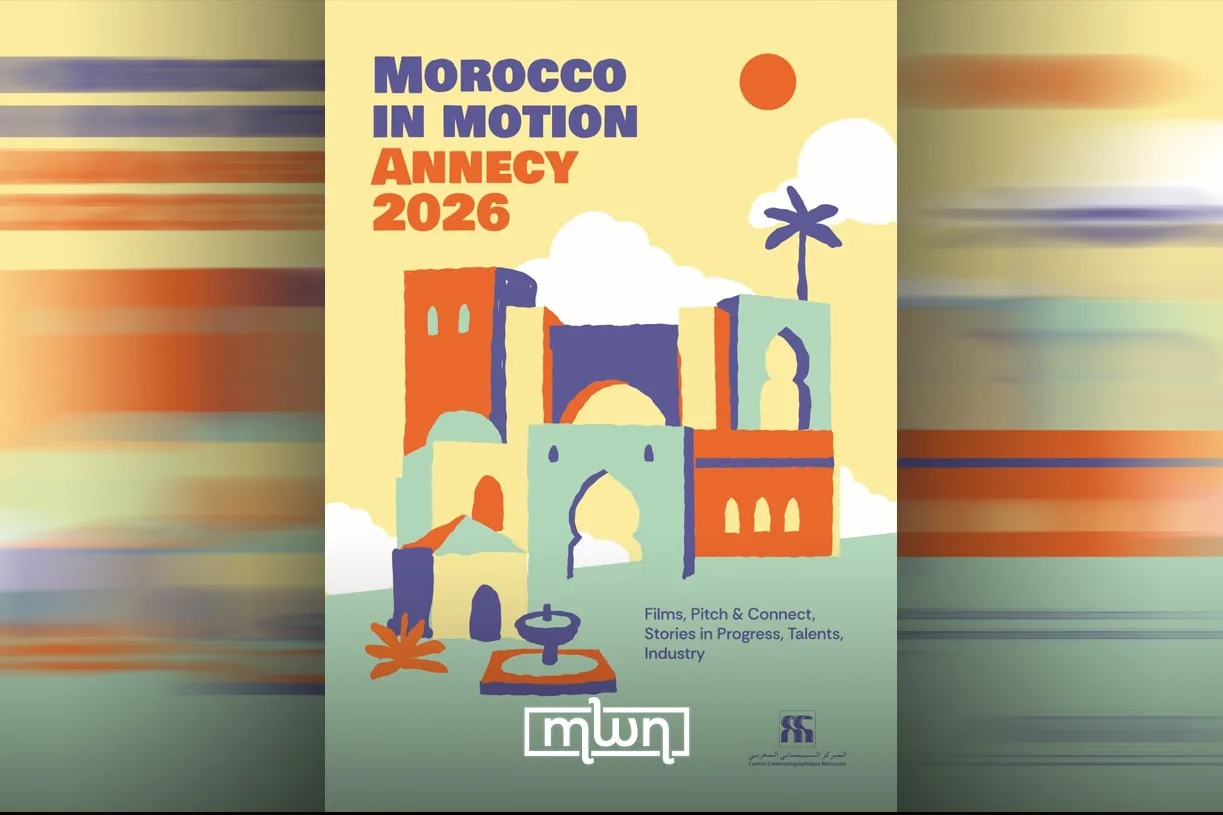
Safi – At the 2026 edition of the Marché International du Film d’Animation d’Annecy (MIFA), a leading global gathering for the animation industry, Morocco is set to underline its ambition to strengthen its international presence and showcase the richness of its creative ecosystem.
From June 23-26, Moroccan writers, directors, producers, broadcasters, and industry professionals will gather in MIFA, joining global players in one of the sector’s most influential networking platforms.
The delegation aims to promote the dynamism of Morocco’s animation industry while positioning itself as an emerging creative hub.
The Centre Cinématographique Marocain laid out the whole lineup in a catalogue introduced by director Reda Benjelloun.
One graduation film “Aicha Kandicha” made the official selection, while a slate of projects and emerging directors head to MIFA, the festival’s industry market.
The Moroccan pitch session will take place on June 23, from 11 a.m. to 12:15 p.m. in the Salon Verdi on the third floor, with Slimane Aniss as patron and Mohamed Beyoud as presenter.
Here is what Morocco is bringing, and when.
‘Aïcha Kandicha’ by Fayrouz Harmatallah Sbaï
The only Moroccan title in the official selection is a paper-cut graduation film from ENSAD in Paris, made by French-Moroccan animator Fayrouz Harmatallah Sbaï.
It draws on the figure many Moroccan children grow up fearing, the witch who devours children and turns men into goats, before suggesting a quieter possibility: that she may have been a real woman from the era of Portuguese occupation.
It runs about 23 minutes, and the catalogue bills it as drama, fantasy, and politics.
The official screening is on June 25 at 7:30 p.m. at the Petite Salle in Bonlieu, with a late show on June 26 at 10:30 p.m.
‘Fati la Poule’ by Ilias Khlifat
“Fati la Poule” is a stop-motion short from Ilias Khlifat, an ISMAC graduate whose last film, Liquid, traveled festivals in 2025.
In an isolated village, hospitality means Milouda must sacrifice one of her hens for arriving guests, and the one chosen is Fati.
When the family dog turns rabid and mauls a passing woman and her children, the quiet day forces everyone to confront sacrifice in their own way.
‘Loucham’ by Samia Zerrou
“Loucham” is the Tamazight word for tattoo, and Samia Zerrou borrows it for her feature-length animated docu-fiction.
Blending 2D animation, stop motion, and live action, she chases a vanishing practice: the Amazigh tattoos that older Moroccan women once wore, brought back to life through their own testimonies.
‘Mini Maestro’ by Yassine Lahrichi
Mini Maestro is a 3D series from Yassine Lahrichi, who spent years making video games at Ubisoft before founding NEVERSEEN Productions.
Beneath the streets of Morocco lies a miniature Jamaa el-Fna where insects make music after dark. There, a washed-up prodigy named Maestro crosses paths with Mina, a firefly who cannot glow, just as a hunter closes in on the souk.
‘Señor Braga’ by Lamisse Khairat
“Señor Braga” is a cut-out short set in Barcelona, from Lamisse Khairat, who trained in Tétouan and then Spain.
A lonely man in his seventies lets 24-hour news and his own prejudice feed his fears, which he projects onto Moroccan neighbors he never actually sees.
By the end he understands that they were the very thing keeping him alive.
‘Ziryab: Strings of Time’ by Ghita Amrati
“Ziryab: Strings of Time” is the first animated feature from Casablanca director Ghita Amrati, produced by Artcoustic Studios.
It reaches back to Ziryab, the ninth-century musician who reshaped the sound of the region.
When a teenage girl snaps a centuries-old oud, she is thrown into his era before he has finished his masterpiece, and she must help him complete it to find her way home.
The project went through the Venice Production Bridge in 2025.
Three more from the writing residency
CCM, ISMAC Foundation, and the French Institute of Morocco ran a first screenwriting residency for animated shorts in Rabat from February to May, mentored by Vanessa Chenaie.
Three of those projects travel to Annecy with their directors.
‘Achoura’ by Firdaousse Arrami
Achoura is a cut-out short about Halima, a nine-year-old who starts losing her hair to alopecia just as the Achoura holiday arrives.
Desperate to fit in, she hides under a wig, but an accident gives her away, and with her mother beside her she slowly begins to make peace with it.
‘Modif’s’ by Anas Belgazzar
Modif’s follows Amine, a 23-year-old interning at a communications agency, his childhood love of drawing long buried under a strict father.
Stuck in a dull routine and low after a breakup, he is pulled back by a small keepsake and the promise that came with it: to keep drawing.
‘Lumen’ by Ichrak Lehmouch
Lumen unfolds in a nocturnal world, where a lighthouse sweeps its beam across a river as a mother carries her child toward the tower.
Identical silhouettes gather in the dark, and when the beam settles on her, the crossing turns public and the light that once guided her begins to expose her.
The people driving the initiative
The delegation carries real weight. Parrain Slimane Aniss directed Zack Snyder’s “Twilight of the Gods” for Netflix, and Mohamed Beyoud ran Meknes’s FICAM festival from 2001 to 2025.
On the producing side, Ali Rguigue of Artcoustic Studios stands behind “Ziryab” and the stop-motion short “Harun & Mamun,” and he co-founded Flow Motion, Morocco’s first animation school.
Animation director Mustapha Swinga rounds out the group on the educational side with shows like “Dowar du Savoir.”
By the CCM’s own description, Moroccan animation went mostly unseen for years. That is harder to argue now.
Moroccan folklore, Amazigh memory, Jamaa el-Fna, Andalusian music, and a Barcelona diaspora story are all in development at once, and all of it is being shown in the room where the deals get made.