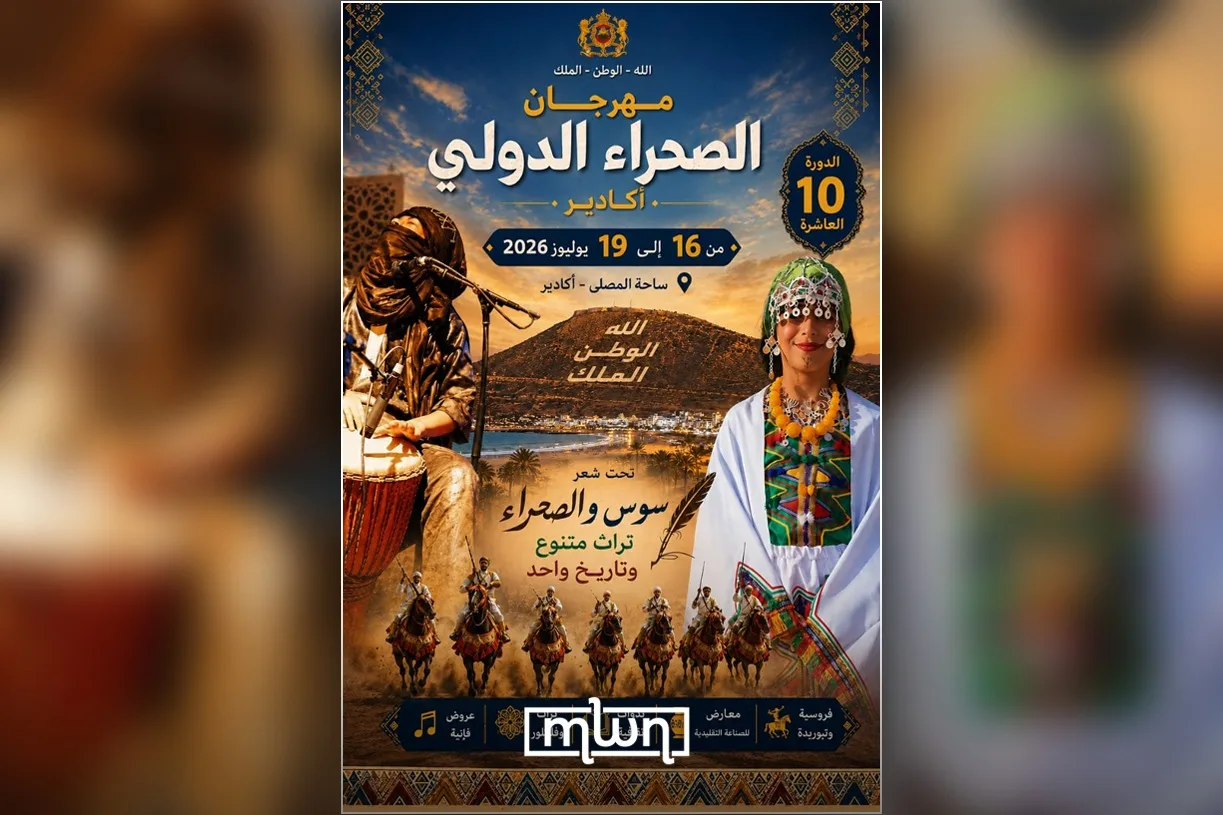
Safi –The International Sahara Festival will take place in Agadir from July 16-19 at Place Al Musalla in the city’s Hay Al Mohammadi district, marking its 10th edition under the theme “Souss and the Sahara: Diverse Heritage, One History.”
For four days, a corner of the coastal city will transform into a desert-inspired space filled with traditional tents, Hassani songs, and horsemen charging through the dust, bringing Saharan culture to the heart of Agadir.
The festival celebrates the deep historical and cultural ties between the Souss region and the Sahara, highlighting a shared heritage through music, performances, and cultural showcases.
A festival born of the South
Organized by the National Forum for Sahara Youth, the event was built by young Moroccans with Sahrawi roots, born in Agadir and Souss.
“We are a group of young people born here, but our origins are from the south, from the edges of the Sahara,”festival director Khouila Salem told MWN Lifestyle magazine.
According to him, about a century ago, their families came north from the Sahara, following pasture through years of drought and settling with their camels across Souss.
Getting this far is its own reward.
“It isn’t easy to keep a festival alive, edition after edition, until it reaches its tenth,” Salem says.
Where the Sahara meets the ocean
The organizers cast Agadir as a meeting point of Morocco’s cultures, a coast, in the festival’s words, where the sands of the Sahara meet the waves of the ocean.
For Salem, the aim is closeness.
“Instead of our Amazigh brothers traveling to the Sahara to see its culture, we brought it closer to them,” he highlighted.
The clearest example will be the poetry tent, new this year, in Ibn Zaydoun Park. A Hassani singer will perform inside a tent recreating the desert, its weddings, its dress and its children’s games. “You feel as if you are in the heart of the Sahara,” Salem said.
Four nights of music
Each night will end with a concert on the main stage. The opening evening on July 16 will bring together the Amazigh singer Ahmed Amaynou, the vocalist Aouad Meskina and an Amazigh troupe.
The second night will lean into fusion, with the Gnaoua group Bilal, an Amazigh ensemble and the singer Aziz Boulayoun.
On the third night, Sahrawi and Amazigh sounds will meet. A Mauritanian artist, the El Kdrah troupe from Guelmim and the singer Hassan Bouamarani will share the bill.
The festival will close on July 19 with the Dakka Houaria ensemble and the Souss group Ittmaten.
On the grounds
The festival will take place entirely at Place Al Musalla, which will be divided into two sections. One side will host the festival village, featuring craft tents, themed spaces recreating desert life, and the main concert stage.
The village will gather a crafts fair of around 90 stands, where artisans will show clothing and heritage from both the Amazigh and Hassani traditions.
The other half of the square will belong to Tbourida, the cavalry charge that pairs the horsemanship of Souss with that of the south, staged this year “in all its forms,” Salem says, alongside camel contests.
Away from the square, the days will be filled with book signings, conferences and photography exhibitions drawn from what the organizers call the Saharan memory.
One history, many forms
The theme carries a deliberate message. The two regions differ in dress, feast days and food, Salem says; yet share a history stretching back 12 centuries.
“We differ for the sake of diversity, and it is this history that unites us,” Salem added.
A tribute in the shadows
The festival will also hold a photography competition for the best photograph of Tbourida. The organizers have dedicated the award to Abdelaziz Abou El Mahassine, a civil society figure who guided them in the festival’s early editions.
“He worked in the shadows and never wanted to be seen,” Salem said. The prize will go to his widow in his honor.
A cultural and economic window
For Salem, the festival is as much a livelihood as a celebration. He called it “a window onto everything cultural and economic,” pointing to the artisans and vendors who will sell their work across the four days.
Its reach runs wider still. The organizers frame the event as a way to show the ties that bind the Sahara to the rest of Morocco, and Salem hopes to pass that heritage to a younger generation so the tradition continues.
A decade on, and a century after their families came north, the founders will bring the desert back to the coast, if only for four days each summer.