Fez — Hicham Abbouz does not need a famous monument to recognize a moment in Fez is worth capturing.
Sometimes, it is a person stepping into a patch of light. Other times, a gesture catches his eye. An old wall beside something unmistakably modern, a shadow, a doorway, a texture, or a quiet interaction can be enough.
The moment just has to make him stop.
That instinct has become central to the work of Abbouz, better known as 7ehsa, a Moroccan photographer, filmmaker, and visual storyteller based in Fez.
In an interview with MWN Lifestyle magazine, Abbouz described his practice as one rooted in observation.
All roads lead to Fez
Photography began as a way of documenting the world around him, eventually evolving into filmmaking, directing, editing, and documentary storytelling.
Fez remained at the center of that evolution.
The architecture matters to him, but so do the people. Its history matters, but so does what is happening this afternoon.

He is drawn to the tension between old surfaces and contemporary clothing, darkness and sudden light, heritage objects and new visual languages.
Above all, Abbouz is interested in what happens when the camera stops treating Fez as a finished image and starts seeing it as a living, evolving city.
“I think what is often missing is the life happening between the landmarks,” he told MWN Lifestyle magazine.
That sentence gets close to the heart of his photography.
A city that is still happening
Fez has been photographed endlessly through the visual shorthand of heritage: gates, alleys, fountains, rooftops, craftsmanship, religious architecture, and the labyrinthine streets of its old Medina.
There is a reason Fez holds his attention. The Medina of Fez has been on UNESCO’s World Heritage List since 1981.
UNESCO describes a historic urban fabric whose architecture and traditional skills have survived while continuing to evolve alongside modern society.
Abbouz does not reject that history. His photography depends on it.
What interests him is what happens inside it now.
For him, the danger of the postcard image is not that it is necessarily false. It is that it can be incomplete. A city represented only through its most recognizable heritage risks becoming visually frozen.
“Fez is known for its history and architecture, but it is not a museum,” he said. “People still live there, work there, grow up there, and the city keeps changing.”
So Abbouz looks between the landmarks rather than only at them.
Walking with a camera, he pays attention to details that do not arrive with an established cultural importance. A monument already announces itself as significant. An ordinary scene does not.
That difference fascinates him.
A passing figure can become more interesting than a celebrated building because the meaning of that figure has not already been decided for the viewer.
His PhotoVogue portfolio reflects that approach. PhotoVogue identifies 7ehsa as a visual storyteller from Fez whose photography and film explore everyday urban life and overlooked stories across Morocco and Africa.
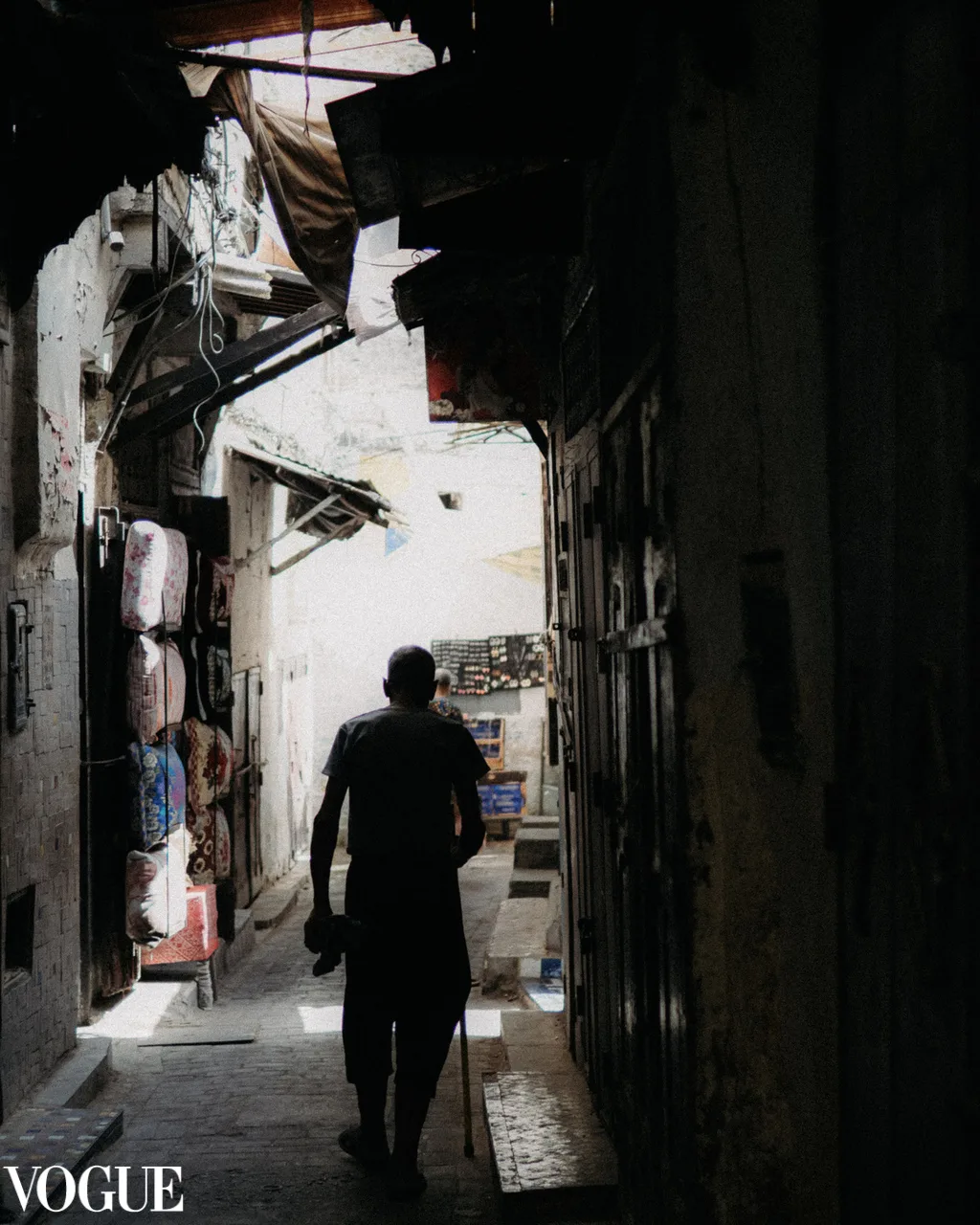
The same impulse runs through “Fez in the Light”, where place and identity meet without turning the city into a decorative background.
His Fez is recognizable, but never frozen in time. It breathes, moves, and changes with the people who call it home.
Fez taught him to look
Abbouz does not describe the city merely as one of his subjects. He describes it as something that trained his eye.
“I think Fez shaped my eye before I was even conscious of it,” he said.
Much of that education came from the Medina itself.
Its physical structure creates abrupt shifts in atmosphere. Someone can move through a narrow, shadowed passage and suddenly step into intense light, as bodies, old architecture, handmade objects, clothing, color, and weathered surfaces collide within just a few meters.
Abbouz grew accustomed to seeing those layers together.
Long before he formulated a photographic style around contrast, he was living inside one, which explains why he resists separating heritage from contemporary creativity.
The two already coexist in the city he knows.
One of his projects is centered on the Fassi tarbouche, making that position particularly clear.
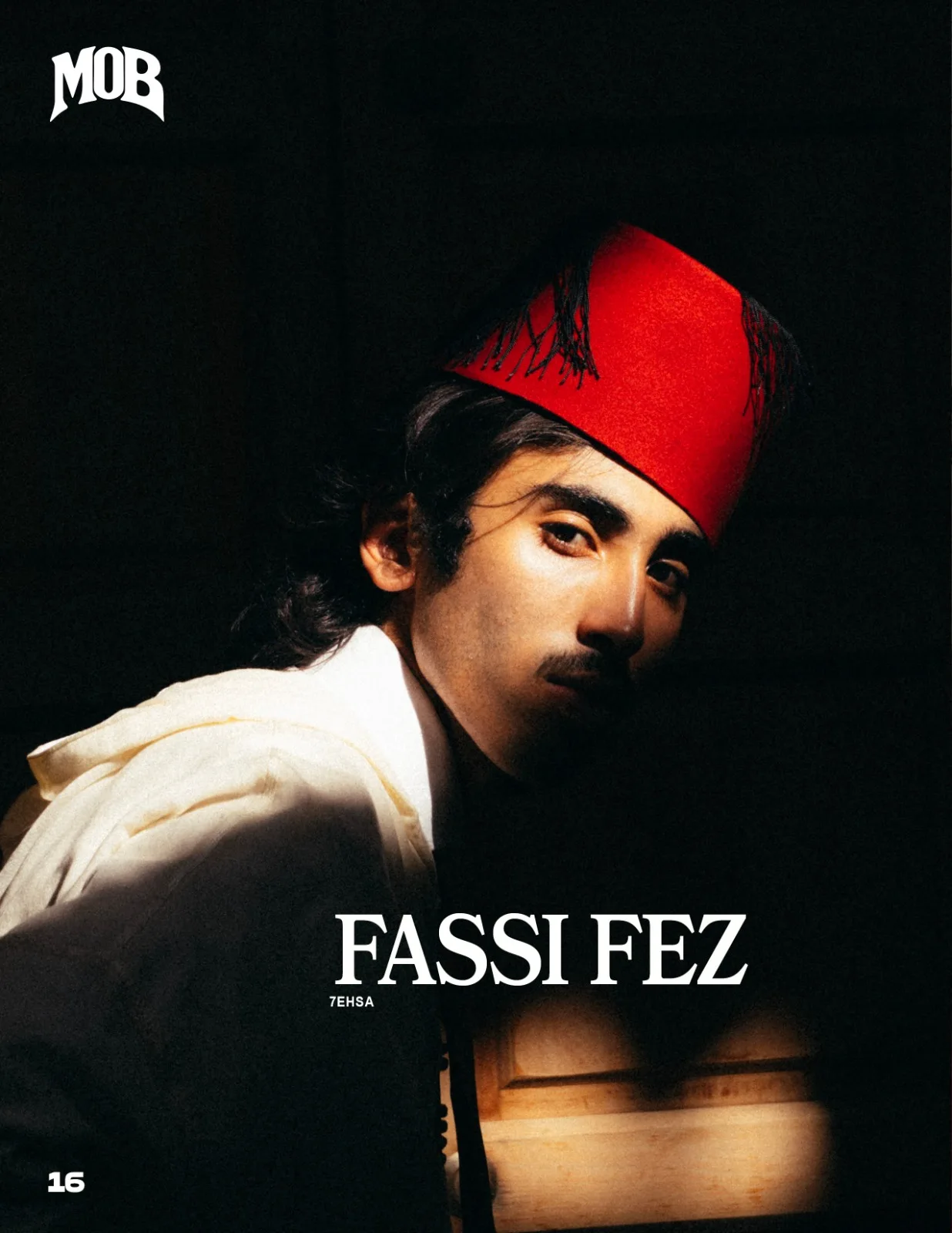
The tarbouche carries an immediate association with tradition and Fassi cultural identity.
Abbouz, however, was never interested in treating Fez as though its story had already been written.
Instead, he placed the object within a contemporary visual treatment, worn by a man at the prime of his youth.
“I was not interested in treating the tarbouche only as an object from the past,” he explained.
The project, which he said also appeared in MOB Journal, allowed him to take a symbol intimately connected with Fez and move it into another visual register.

The approach reveals something larger about how Abbouz understands tradition.
He does not believe an artist has to choose between preserving a cultural reference and transforming the way audiences see it.
“I do not see tradition and contemporary creativity as opposites,” he said. “For me, they can exist naturally inside the same frame.”
Learning to notice what others pass
If some of Abbouz’s photographs feel quiet, that is deliberate.
He is drawn to scenes whose importance is not immediately obvious.
That attraction shapes projects such as “Movement in Silence”, which was credited to lhaddy and 7ehsa in Figgi Magazine’s archive.
For Abbouz, there is a particular freedom in photographing something ordinary.
A landmark already carries centuries of history and accumulated meaning. Photographers approach it knowing why people care.
The smaller moments ask more from the person behind the camera.
“With an ordinary scene, you have to actually look and discover why it matters,” he said.
That process is intuitive rather than systematic.
He does not walk through Fez carrying a formula for what qualifies as a photograph. The deciding element might be light. It might be the expression or position of a person. It could be the relationship between several otherwise unrelated details inside the frame.
“There simply has to be something that makes me stop,” he said.
The line also describes what he wants the eventual viewer to experience.
His visual language takes things that have become familiar to him through daily life and asks whether a different composition, angle, contrast, or fragment can make somebody unfamiliar with that world stop as well.
The objective is not to manufacture importance.
It is to notice importance before it disappears.
Making contemporary work from Fez
There is another argument running through Abbouz’s work, and it reaches beyond photography.
He wants Fez to be understood not simply as a place artists photograph, but as a place from which artists create.
That distinction matters to him.
“For me, the goal is not only to photograph Fez, but to show that contemporary work can be created from Fez,” he said.
Morocco’s larger cities can offer denser professional networks and more visible creative opportunities. Abbouz is keenly aware of that imbalance.
His answer has been to treat geography as a challenge rather than a verdict.
He wants the work to circulate outside Fez without having to disguise where it came from.
“I want the work to travel while still being clearly rooted in where I come from,” he said.
That philosophy becomes even clearer in his filmmaking.
Photography remains strongly connected with Fez and particularly with the Medina. Film has given Abbouz room to move outward into other emotional territories.
He has worked on projects including a dance film made in 24 hours, “THE 12TH LION”, and “After Her”, a film dealing with grief and losing someone.
He has also explored panic attacks through a short film, pushing his work further into interior experiences that a street photograph cannot necessarily hold in the same way.
For Abbouz, the difference between photography and filmmaking is partly a question of time.
A still image isolates an instant. The viewer is left to imagine what happened immediately before it and what happened afterward.
Film lets him remain with the emotion.
Sound, silence, movement, facial expression, and rhythm give him tools that do not exist in a single frame.
But moving into film does not mean Abbouz feels every story needs to carry an unmistakable visual stamp of Fez.
That would simply create another kind of limitation.
“For me, being a filmmaker from Fez does not mean that every film has to be about Fez or the Medina,” he said. “What matters to me is that these projects can be created from Fez.”
Not waiting for the door to open
That idea might be the strongest link between Abbouz the photographer and Abbouz the filmmaker.
Both are concerned with what can emerge from a place others might overlook.
In photography, he searches for the scene people walk past.
Through his career, he is trying to demonstrate that creative production does not have to wait for permission from Morocco’s larger cultural centers.
Limited resources inevitably complicate that ambition. But Abbouz also believes limitation can force artists toward collaboration and experimentation.
Sometimes, he said, having fewer opportunities pushes creatives to make their own rather than “waiting for someone to open a door.”
It is an idea that mirrors his photography almost perfectly.
What seems obvious is not always the whole story. A city can reveal more than its familiar image, just as an artist can find their way into an industry without following the expected path.
Fez gave Abbouz the contrasts that shaped his eye. Now, his work is asking viewers to see those contrasts without reducing them to nostalgia.
Through 7ehsa’s lens, Fez is not interesting because time stopped there. It is interesting because it did not.