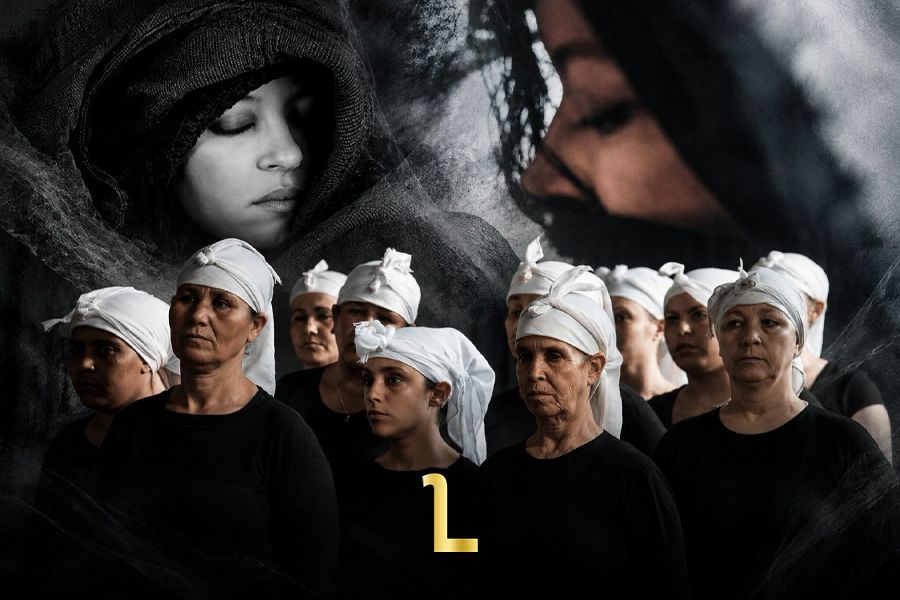
Fez — Moroccan choreographer and dancer Bouchra Ouizguen is preparing to unveil her latest creation, “Qunfudh,” at the Festival d’Automne in France, with four performances scheduled from October 22 to 25.
The production will make its world premiere at MC93, the Maison de la Culture de Seine-Saint-Denis in Bobigny, just outside Paris, as part of the festival’s 2026 program.
For the Marrakech-based artist, the hour-long performance represents a personal exploration of memory, identity, and the tensions between exposing oneself and seeking protection.
A hedgehog as a symbol of vulnerability
The title “Qunfudh,” meaning hedgehog in Arabic, refers to an animal capable of opening itself to its surroundings while instinctively retreating when threatened.
Ouizguen uses this contrast as the foundation for a performance that places her alone onstage, confronting the boundaries between visibility and concealment.
According to the Festival d’Automne’s official presentation, the choreography combines movement, music, singing, and silence to explore the memories that accompany an individual throughout life.
The production draws inspiration from childhood experiences in the desert, journeys across different landscapes, and stories passed down through generations.
Its soundscape incorporates musical traditions from several regions, including songs from the Amazigh mountains, Portuguese cante alentejano, and music associated with pearl divers in the Middle East.
Through these influences, Ouizguen explores the relationship between personal memory and collective cultural heritage.
The work also addresses borders and restrictions on movement, themes that have appeared throughout the choreographer’s artistic career.
Bringing Moroccan choreography to international stages
Born in Ouarzazate in 1980, Ouizguen has contributed to the development of contemporary dance in Marrakech since the late 1990s.
A self-taught dancer, she founded Compagnie O in 2010 after years of working with performers from different artistic backgrounds.
Her practice frequently draws on Moroccan popular traditions, particularly the experiences of female singers and dancers associated with the Aïta tradition.
Among her previous productions are “Madame Plaza,” “Ha!,” “Corbeaux,” and “Jerada,” works that have introduced her choreography to audiences across Europe and beyond.
Her performances have appeared at international institutions including London’s Tate Modern, New York’s Brooklyn Museum, and the Centre Pompidou in Paris.
In 2010, her work on “Madame Plaza” earned recognition from France’s Society of Dramatic Authors and Composers (SACD).
With “Qunfudh,” Ouizguen continues her international artistic journey while bringing the performance closer to her own experiences and memories.
The premiere forms part of the 2026 Mediterranean Season, which highlights artistic exchanges between France and countries across the Mediterranean.
The production receives support from the Fondation d’entreprise Hermès, while the Festival d’Automne serves as a co-producer.
Performances are scheduled at MC93 on October 22 and 23 at 7:30 p.m., October 24 at 6:30 p.m., and October 25 at 5:30 p.m.