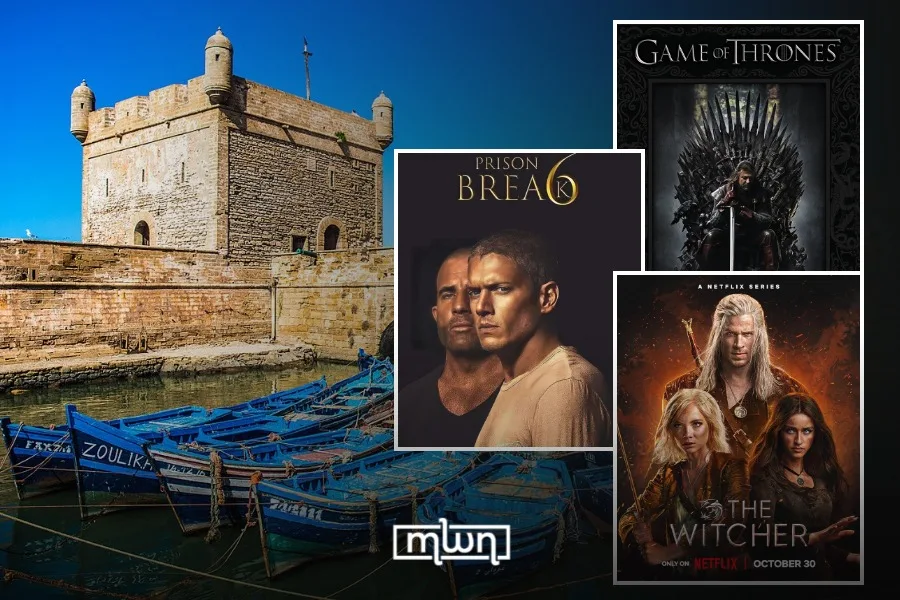
Rabat – Beyond “The Odyssey,” Morocco’s diverse landscapes, historic architecture and renowned film studios have stood in for fictional cities, war zones and faraway deserts in some of the world’s biggest TV productions.
The country has long been one of the world’s favorite filming destinations, and some of television’s most recognizable fictional worlds have been brought to life against its landscapes.
‘Game of Thrones’
Few productions have showcased Morocco as memorably as HBO’s “Game of Thrones.”
When the series returned to Morocco for its third season, several Moroccan locations became part of Daenerys Targaryen’s journey through Essos.
The historic ksar of Aït Ben Haddou, near Ouarzazate, was used as Yunkai, one of the slave cities of Slaver’s Bay.
The distinctive earthen architecture appears throughout Daenerys’ storyline, including the scenes following her victory over the city.
Meanwhile, Essaouira became Astapor, the city where Daenerys encounters the Unsullied.
The city’s historic ramparts, particularly the Skala de la Ville, were used for scenes involving Daenerys’ negotiations with the slave masters and her acquisition of the Unsullied army.
Not every Astapor scene was filmed in Essaouira. The production also used sets near Ouarzazate for parts of Astapor, including the city’s destruction.
Morocco had already appeared in the series’ unaired pilot, while Ouarzazate also served as Pentos in the first season.
‘The Witcher’
Morocco also became part of Netflix’s fantasy universe in Season 3 of “The Witcher.”
The season was filmed across several countries, including Morocco, and the country’s landscapes were used for Ciri’s journey through the Korath Desert.
The desert storyline is one of the season’s most important chapters. After being transported away from her allies, Ciri finds herself alone in Korath, where she struggles to survive and confronts both the harsh environment and her own identity.
Netflix’s Tudum confirmed that the production filmed the desert material in Morocco, while Freya Allan, who plays Ciri, discussed filming the sequence there and working with the horse that portrayed her unusual companion, Little Horse.
‘Prison Break’
Morocco also played a major role in the fifth season of “Prison Break.”
Production took place in Rabat, Casablanca and Ouarzazate, with the Moroccan locations standing in for parts of the show’s fictional Middle Eastern setting.
One of the most striking examples was the fictional Ogygia prison in Yemen, where Michael Scofield is imprisoned at the beginning of the season.
The exterior of Ogygia was filmed at the Ibn Al Haytham Technical High School boarding facility in Ouarzazate.
The production transformed the existing location into the prison seen on screen, while the surrounding environment and imagery were altered to fit the fictional setting of Yemen.
‘Homeland’
Another major television production to use Morocco as a stand-in for the Middle East was “Homeland.”
The show’s eighth and final season was set in Afghanistan, but the production was actually filmed in Morocco, with the North African country standing in for Afghanistan.
This was not the first time “Homeland” had used another country to recreate Afghanistan.
The fourth season had also been set there but was filmed in Cape Town, South Africa.
For the final season, however, Morocco provided the landscapes and locations needed to represent the Afghan setting.
The series is another example of Morocco’s ability to provide productions with locations that can convincingly represent places far beyond North Africa.
Why Morocco keeps appearing on screen
The appeal is easy to understand. Morocco offers an unusually diverse range of filming environments within relatively close proximity: Atlantic coastal cities, historic medinas, fortified ksour, mountains, arid landscapes, and desert terrain.
Then there is Ouarzazate, often associated with Morocco’s film industry and its long history as a production hub.
Its surrounding landscapes and studio infrastructure have attracted major international productions for decades.
For filmmakers, Morocco can therefore offer something particularly valuable: the ability to make one country look like many different parts of the world.