Fez — Tetouan is attracting fresh attention as a destination that combines a UNESCO-listed medina, Mediterranean beaches, and the rugged landscapes of the Rif Mountains.
A recent feature published by “National Geographic Traveller” on August 21 highlighted the northern Moroccan city as a potential new getaway destination, pointing to improved air connectivity and the rapid development of nearby Tamuda Bay.
The article presents Tetouan as an alternative to Morocco’s more established tourist destinations, where travelers can move between historic streets, Mediterranean beaches, and mountain trails within a relatively small area.
A whitewashed city shaped by Spain
Tetouan’s identity is deeply connected to northern Morocco’s history and its relationship with the Iberian Peninsula.
The Amazigh name Titawin, meaning “the eyes,” refers to the city’s long-standing position overlooking the Mediterranean. Tetouan later became an important base for maritime activity before serving as the capital of Morocco’s Spanish protectorate from 1913 to 1956.
Its UNESCO-listed medina remains the heart of the city. Built largely by Muslim and Jewish refugees who arrived from Spain at the end of the 15th century, the historic center preserves a strong Andalusian character.
Whitewashed buildings, artisan workshops, narrow souks, and traditional architecture give the medina a distinct appearance, while the adjoining Ensanche reflects the city’s Spanish-era development.
From medina to Mediterranean
The biggest change in Tetouan’s tourism proposition is happening outside the historic center.
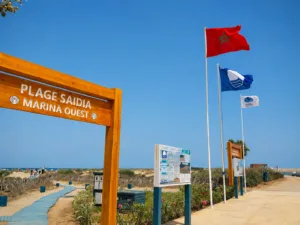
Tamuda Bay, located around 30 minutes north of the city, has developed into a growing Mediterranean resort destination. Its beaches and relatively calm waters offer a different experience from Morocco’s Atlantic coastline.
The opening of Royal Mansour Tamuda Bay in 2024 added a major luxury property to the area and strengthened the connection between Tetouan’s cultural attractions and the coast.
That combination allows visitors to explore the medina in the morning and spend the afternoon swimming, kayaking, or paddleboarding along the Mediterranean.
The Rif Mountains add another draw
The coastline is only part of the region’s appeal.
The Rif Mountains rise behind Tetouan, offering hiking routes through a landscape of steep granite peaks, highland pastures, and relatively quiet trails.
Among the areas highlighted by “National Geographic Traveller” is Fahs Lamhar, where visitors can complete a four- to five-and-a-half-mile loop through the mountain landscape.
The proximity of the mountains gives Tetouan an advantage over destinations built primarily around either beaches or urban sightseeing. Travelers can combine the two within the same short trip.
New flights open the door
Improved connectivity could be crucial to turning that potential into sustained tourism growth.
The United Kingdom gained its first direct flights to Tetouan from London Gatwick in March 2026, with Royal Air Maroc operating the route twice weekly.
The city is also accessible from Tangier, which already has direct connections with several European cities. Tetouan can therefore function both as a standalone destination and as part of a wider northern Morocco itinerary.
For international travelers, easier access removes one of the barriers that has historically kept Tetouan behind Tangier and Chefchaouen in terms of visibility.
A different kind of Moroccan getaway
Tetouan’s emerging appeal lies less in a single landmark than in the proximity of several distinct experiences.
Its medina offers centuries of Andalusian and Moroccan history. Tamuda Bay provides a Mediterranean beach escape, while the Rif Mountains offer hiking and rural landscapes just beyond the city.
That combination gives northern Morocco a tourism proposition that differs from the country’s established circuits.
As international travel coverage increasingly turns toward destinations beyond Morocco’s biggest tourist centers, Tetouan is gaining an opportunity to redefine itself.
The city has long had the ingredients for a major getaway destination. With new flights, expanding coastal development, and renewed international attention, it may finally be getting the visibility needed to turn those ingredients into momentum.