Fez — The Marrakech Short Film Festival is entering its sixth edition with a program that reflects both its international ambitions and its roots in Morocco.
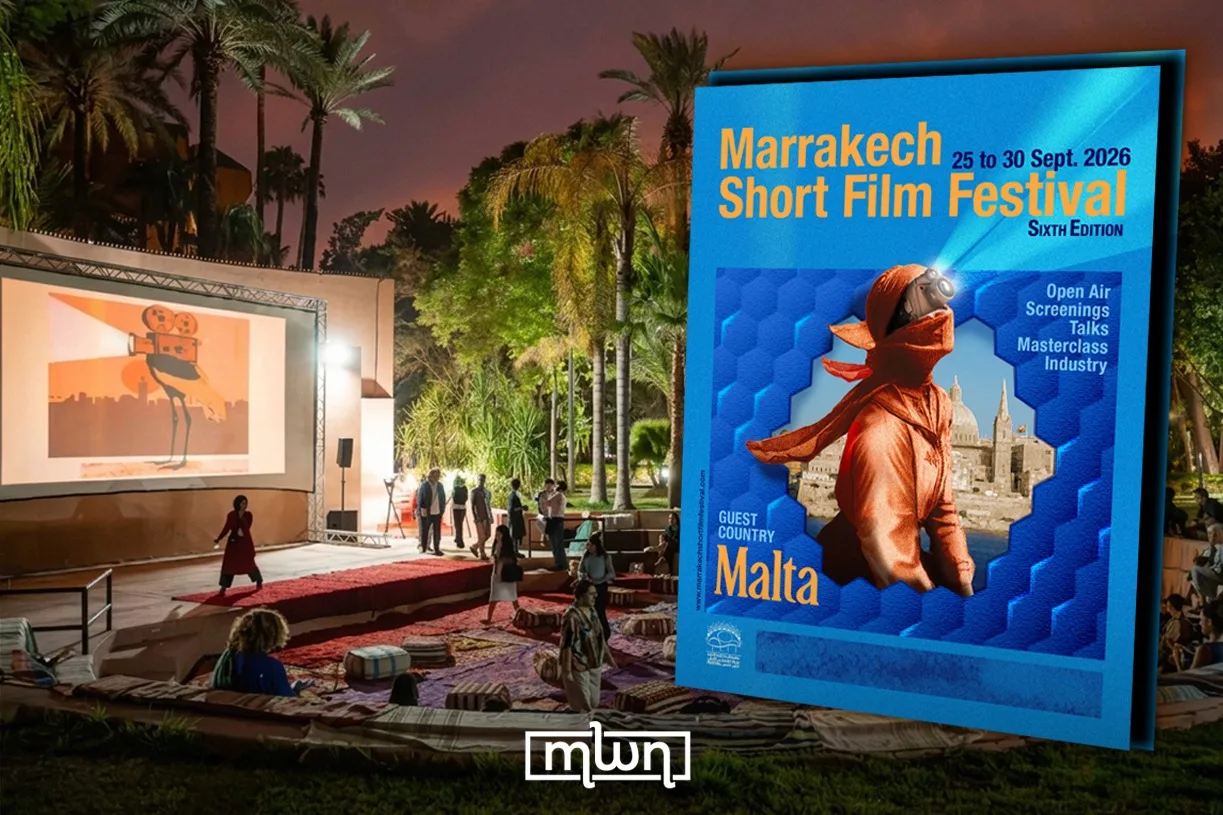
Known as MARRAKECHsFF, the festival will run from September 25 to 30 across several venues in Marrakech. It will bring together Moroccan and international short films, professional programs, masterclasses, and a special country program dedicated to Malta.
Founded and led by President-Founder Ramia Beladel, the festival has spent six years developing a platform for emerging filmmakers while arguing for short cinema as a serious artistic form.
This year’s edition also extends beyond Marrakech. A three-day “Best Of” showcase is scheduled at the Arab World Institute in Paris from November 13 to 15, continuing the festival’s effort to make its films travel.
A sixth edition built around competition and discovery
The 2026 Marrakech Short Film Festival received more than 400 submissions from over 90 countries, according to festival materials, underscoring the event’s growing international reach.
The official program includes Moroccan and international competitions, alongside “Bridges of Reality,” a documentary section focused on films connected to Africa. Malta will serve as the festival’s Country of Honour.
The Moroccan selection highlights contemporary local filmmakers. Its awards include the Nakhil Prize for Best Picture, the Belarj Prize for Best Director, the Bahja Prize for Best Actor or Actress, and other recognitions from international professional guests.
The international competition focuses on filmmakers from around the world. It includes the Nakhil Prize for Best Picture, the Belarj Prize for Best Director, and a Coup de Cœur Award.
Among the Moroccan titles in this year’s selection are “Fading Candle” by Ismail Ait Lahcen, “Aicha” by Sanaa El Alaoui, “Two Ways” by Yassine Iguenfer, “Mesk Ellil” by Adnane Rami, and “Behind the Curtain’s Edge” by Kacem Skalli.
Other Moroccan films include “Paradise Garden” by Sonia Terrab, “Phone Breaker” by Aziz Hattab, “Les Liens Invisibles” by Sandia Tajdine, and “65 Days” by Mohamed Ben Seltana.
The international selection reaches from Italy, Iraq, China, Portugal, Australia, Albania, Lebanon, Kazakhstan, Egypt, Spain, the UK, South Korea, and Japan.
Selected titles include “The Bridge” by Giacomo Bendotti, “Where the Balloon Led Me” by Yasmeen Waleed, “The Wind in Ash” by Kun Sun, “Dog Alone” by Marta Reis Andrade, and “Trading Cards” by Radheya Jang.
The program also includes “The Experiment” by Maxim Akbarov, “My Brother, My Brother” by Saad Dnewar and Abdelrahman Dnewar, “Ciao!” by Iván Melguizo Martín, “Dessert Is Served” by Leyla Hattabi, “A Scream on the Roof” by Jun Cordon, and “A Very Straight Neck” by Neo Sora.
The festival will distribute screenings across Marrakech, including Palais Badii, Cyber Park, The Folk, the Institut français de Marrakech (French Institute of Marrakech), and other cultural spaces. The program’s open-air format is central to the festival’s effort to make short cinema part of the city’s public life.
Malta brings a cultural bridge to Marrakech
Malta will serve as the Guest Country of the sixth Marrakech Short Film Festival, presenting nine films across drama, animation, and documentary.
The Consul General of the Republic of Malta in Morocco, Ivan Vassallo, described the partnership as “a new effort to build stronger cultural ties, awareness and friendship between Malta and the Kingdom of Morocco.”
Malta and Morocco established diplomatic relations in 1974, while Malta opened its Consulate General in Casablanca in 2021. The new cultural partnership adds another layer to those bilateral ties.
The program also highlights Malta’s distinctive linguistic heritage, with films in Maltese and English. “Maltese, our national language, has its roots in a dialect of North African Arabic,” the Consul General said, noting that it is “the only language of the Semitic family which is an official language of the European Union.”
The selection explores Maltese culture through different genres. The dramas “Unur, Fama u Gloria,” “The Chain,” “My Dearest Mother,” and “Bark” examine sport, family, identity, and unexpected encounters.
Animation titles include “Mr Teddy Is Angry,” “Filfla,” “Karamellu,” and “Somewhere.” Finally the movie “Cookiebox” by Polish filmmaker resident in Malta Adam Zurawiecki discusses themes related to migration, domestic violence and social integration.
The Consul General said cinema could strengthen Malta’s role between the two regions, adding that even short films can help “bring together Malta and Morocco.”
From Marrakech to Paris
The festival’s expansion is not limited to its September program.
Its “Best Of” initiative has been designed to extend the life of films selected during previous editions and create new encounters between filmmakers and audiences.
That journey has already included stops in several territories before reaching Paris. In June, MARRAKECHsFF presented a special screening at Cinéma Grand Action featuring films from previous editions, including “Beneath a Mother’s Feet,” “Milk Brothers,” “Lady of the Graves,” and “The Crawling Birds.” The festival described the Paris event as the concluding stop of that particular traveling journey.
The November Paris showcase represents a further step in that model. According to the festival’s planned program, 18 films from previous editions — five Moroccan and 13 international — will screen at the Institut du Monde Arabe from November 13 to 15.
The program is also expected to include round tables, masterclasses, and Q&As with directors.
The Moroccan selection includes “Darhome” by Salma El Belgiti, “Pour moi” by Intissar El Azhari, “Mesk Ellil” by Adnane Rami, “Les Jardins du Paradis” by Sonia Terrab, and “Chikha” by Ayoub Layoussifi and Zhaoua Raji.
The international program brings together films connected to Palestine, Qatar, Egypt, Lebanon, Tunisia, Saudi Arabia, Jordan, Bahrain, and a France-Egypt-Germany co-production.
Among the titles are “A Short Film About Kids” by Ibrahim Handal, “Sanad” by Nour Al-Nasr, and “What If They Bomb Here Tonight?” by Samir Syriani.
A festival built to make films travel
The two events reveal a strategy that goes beyond simply making the Marrakech festival larger.
MARRAKECHsFF is using Marrakech as its creative and competitive center while developing a circuit through which selected films can reach audiences elsewhere.
That matters particularly for short films. Unlike feature films, many shorts have limited commercial distribution and depend heavily on festivals to find audiences and industry attention.
The festival’s “Best Of” model attempts to keep that journey going after the original screening.
The approach also gives the Marrakech Short Film Festival a distinct identity. It remains anchored in the city while using international partnerships to connect Moroccan filmmakers with wider cinematic networks.
Beladel has described that ambition through a simple phrase: “Marrakech rencontre Paris. Le court-métrage voyage.” Marrakech meets Paris. The short film travels.
Six editions into the festival’s development, that idea is becoming more than a slogan. The sixth edition will bring international cinema into Marrakech, while the Paris extension will send films from the festival back into the world. Together, the two cities illustrate an emerging model for a Moroccan film festival that is locally rooted but increasingly international in reach.