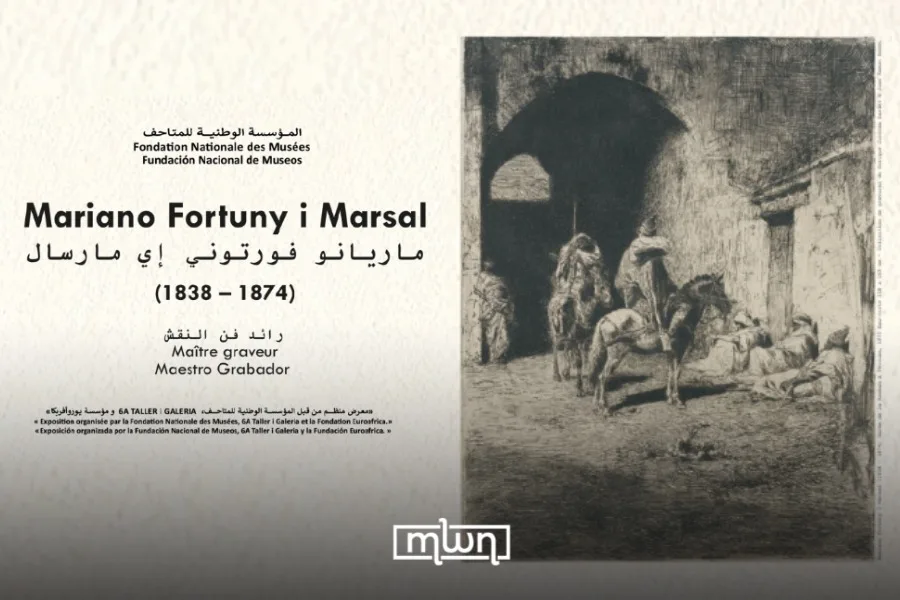
Fez — Dar Niaba, Musée des Artistes Voyageurs (Museum of Traveling Artists) in Tangier is set to open a new temporary exhibition in Tangier, titled “Mariano Fortuny i Marsal (1838–1874) – Maître graveur,” running from April 21 to August 21.
Organizers have also scheduled the inauguration for April 21, with invitations indicating a late-afternoon opening at the museum.
The exhibition is centered around Mariano Fortuny i Marsal, the Spanish painter, draughtsman, and engraver widely regarded as one of the major artistic figures of the 19th century.
Major museum references describe him as a cosmopolitan artist whose career moved between Rome, Paris, London, Madrid, Andalusia, and Morocco before his early death at age 36.
A Tangier exhibition with a Moroccan thread
Fortuny’s link to Morocco gives the Tangier show particular weight. The Museo del Prado says the artist was sent to Morocco in 1860, where he followed the Spanish-Moroccan War and later painted “The Battle of Wad-Ras.”
In fact, his travels in Morocco helped shape his artistic language beyond conventional Orientalist fantasy.
This connection makes Dar Niaba a fitting venue. The museum, operated under the National Foundation of Museums, presents itself as a space dedicated to artists and travelers who engaged visually with Morocco.
According to their official website, Dar Niaba is among the foundation’s open museums in Tangier.
A museum built for cross-cultural memory
Located in Tangier’s medina, Dar Niaba already carries strong diplomatic and historical symbolism.
Its programming has increasingly blended Morocco’s own history with exhibitions tied to foreign artists whose work intersected with the country’s landscapes, people, and architecture.
In that sense, a Fortuny exhibition feels less like a one-off import and more like a continuation of the museum’s broader curatorial direction.
Organized by the National Foundation of Museums alongside 6A Taller i Galeria and the Fundación Euroárabe, the exhibition reinforces Tangier’s role as a crossroads of Moroccan history and Mediterranean cultural exchange.