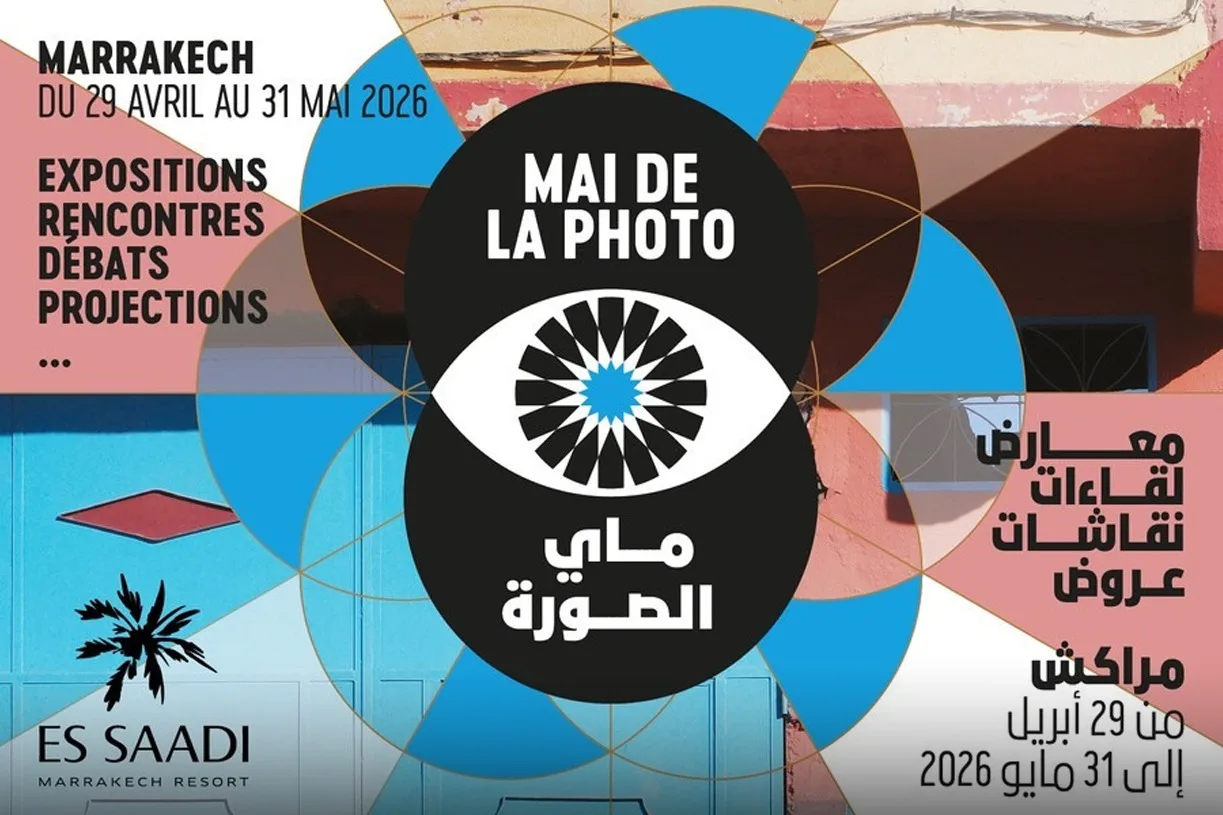
Rabat – From April 29 to May 31, Marrakech becomes both subject and storyteller. The third edition of Le Mai de la Photo unfolds across the city with an ambitious, city-wide program that explores photography not just as an art form, but as a tool for memory, transmission, and reflection.
This year’s theme, “Memory(s)”, signals a deliberate shift toward plurality.
Rather than a single narrative, the festival embraces overlapping histories, fragmented recollections, and competing perspectives, whether preserved in formal archives or passed down through everyday gestures, family stories, and urban life.
At the heart of the program lies Le Lieu commun, anchored at the Institut français de Marrakech.
Conceived as a shared exhibition space, it brings together a cross-section of artists and cultural actors, setting the tone for an edition that is both collaborative and exploratory.
Around it, a constellation of exhibitions, screenings, talks, and workshops stretches across neighborhoods, from the Medina to Gueliz and Hivernage, turning the city itself into an open-air cultural map.
Marrakech plays a central role in shaping the festival’s narrative. Its dual identity, as a global tourist destination and a rapidly evolving urban space, creates a layered relationship to imagery.
There, photography oscillates between fantasy and documentation, between projection and lived reality.
The festival leans into this tension, inviting artists and audiences alike to question how the city is seen, remembered, and represented.
The program reflects this diversity of approaches. Highlights include Delphine Warin’s “La Chance qui danse,” Leila Alaoui’s “Made in India,” and Cédric Gatillon’s “Monsieur Sidriss aime les objets,” all presented within the central hub.
Elsewhere, institutions such as MACAAL host projects like Ismail Alaoui Fdili’s “Under Destruction,” while Fondation Montresso expands the dialogue through exhibitions and workshops, including Celia Bougdal’s participatory project “You can see me but I can’t.”
Historical and media archives also find their place in the lineup, notably with “Les Unes de la Tribune” de Marrakech 2007–2026 by Jean-Jacques Fourny, alongside retrospectives that revisit the city’s past through photography.
Talks such as “How We Remember” bring together artists to reflect on the mechanisms of memory-making, further reinforcing the festival’s discursive dimension.
Rooted in the legacy of the early 2000s “Mois de la Photo” initiated by Sakina Rharib, and revived in 2024 through a broader network of partners, Le Mai de la Photo continues to evolve as a collective platform.
Its structure remains intentionally open, inviting independent spaces, institutions, and emerging voices to contribute to a shared narrative.