Rabat – Jidar Street Art Festival is built on a simple ambition: to make street art visible, accessible, and part of everyday urban life in Rabat.
This year alone, ten new murals by eleven artists from eight countries join that growing open-air collection.
Among them are three distinct voices, Samir Toumi, Jurena Muñoz, and muralist Keya Tamme, each approaching the city as both canvas and conversation.
For Marrakech-based Samir Toumi, Jidar is a space to question and reconstruct meaning.
“I work around Moroccan identity, on identity itself,” he told MWN Lifestyle.
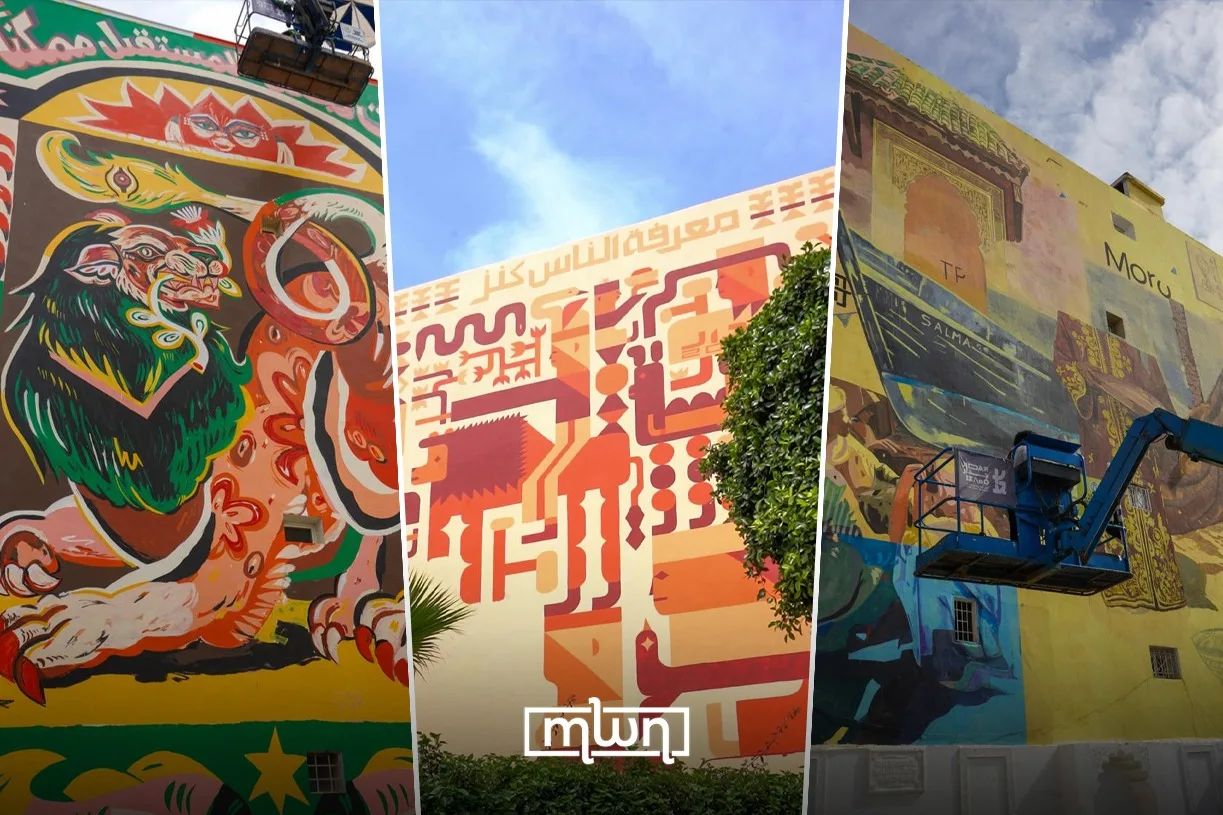
His mural brings together fragments of history that do not usually sit side by side: the Fassi caftan, Moroccan geometric arches, the word “Morocco” written in Chinese, the archaic term “Moro,” which is an old way to say “Moroccan,” and even the head of Juba II, the Amazigh king from the Roman era.
“They are not necessarily connected, but they form the fabric of our national identity,” he said.
Identity in his work is layered, fragmented, and constantly reassembled.
For Jurena Muñoz, the starting point is research translated into form.
Drawing from Moroccan stamps, symbolism, and natural motifs, she constructs a large-scale mural that invites pause within the rhythm of the city.
For her Jidar piece, Morocco itself became the starting point. “I love to get inspired by the culture where I paint,” she explained.
Her research led her to old Moroccan stamps: rich with flowers, palm trees, animals, and symbolic imagery. The lion, a recurring emblem, finds its place in the final mural.
For Muñoz, Jidar is “diversity and empowering.” A space where international and local artists meet, exchange, and build something that goes beyond art, into connection.
RTo her, color is structure and language opens interpretation rather than closing it.
Rather than interruption, her approach is more about explanation – a visual break in the urban flow.
Keyatama, a South African muralist based in New York, brings another register rooted in community and connection.
His work draws on Moroccan visual culture, particularly mosaic and tile patterns, which he links to broader historical exchanges across continents. “Knowing people is a treasure,” read the Arabic phrase at the top of her mural, framing a work that extends into themes of care, environment, and shared space.
Positioned opposite a preschool, the piece has already become part of children’s daily imagination, something she describes as central to its meaning.
Across these three approaches, different languages of art emerge: identity as construction, symbols as interruption, and community as continuity.
Yet they all operate within the same ecosystem that defines Jidar today.
Because beyond individual works, Jidar is also a long-term cultural structure.
The festival not only provides walls, but builds a living environment where artists work side by side, exchange methods, and engage directly with the public.
Over two weeks, emerging and established voices share the same space, shaping a scene that is both local and international, spontaneous and carefully sustained.