Fez — Mustapha Zemmouri’s story begins far from the lands he would later cross. Born around 1500 in Azemmour, on Morocco’s Atlantic coast, he entered history under several names: Mustapha al-Zemmouri, Estevanico, Estebanico, Esteban de Dorantes, and “the Moor.”
Historical accounts describe him as a native of Azemmour who was enslaved and later became the property of Spanish nobleman Andrés Dorantes de Carranza.
By 1527, Zemmouri had joined the Pánfilo de Narváez expedition, a Spanish mission that sailed from Spain with the goal of conquering and exploring Florida and the Gulf of Mexico.
From Azemmour to the unknown
The expedition landed near present-day Tampa Bay in 1528, but it quickly collapsed. Storms, disease, hunger, and conflict destroyed the mission, turning an imperial project into a desperate survival journey.
Zemmouri was one of only four survivors, alongside Álvar Núñez Cabeza de Vaca, Andrés Dorantes, and Alonso del Castillo Maldonado. Their route remains debated by historians, partly because Cabeza de Vaca wrote his account years later and with gaps in distance and chronology.
What is clear is that the survivors crossed immense stretches of territory, moving through parts of present-day Florida, Texas, northern Mexico, and the American Southwest. Their journey lasted years and forced them to depend on Indigenous communities, local knowledge, and their ability to adapt.
A guide between worlds
Zemmouri’s role grew during this long crossing. He became known as a mediator, scout, and interpreter, moving between different communities and helping the survivors navigate unfamiliar lands.
Accounts of the journey describe the group living among Native peoples, at times as captives and later as healers and traders. Zemmouri’s mobility, language skills, and ability to communicate made him especially valuable in a world where survival depended on diplomacy as much as endurance.
By the time the survivors reached Spanish settlements in Mexico in 1536, their story had already become extraordinary. They had crossed landscapes that Spanish authorities knew little about, carrying reports of northern lands that would soon fuel further expeditions.
The search for Cíbola
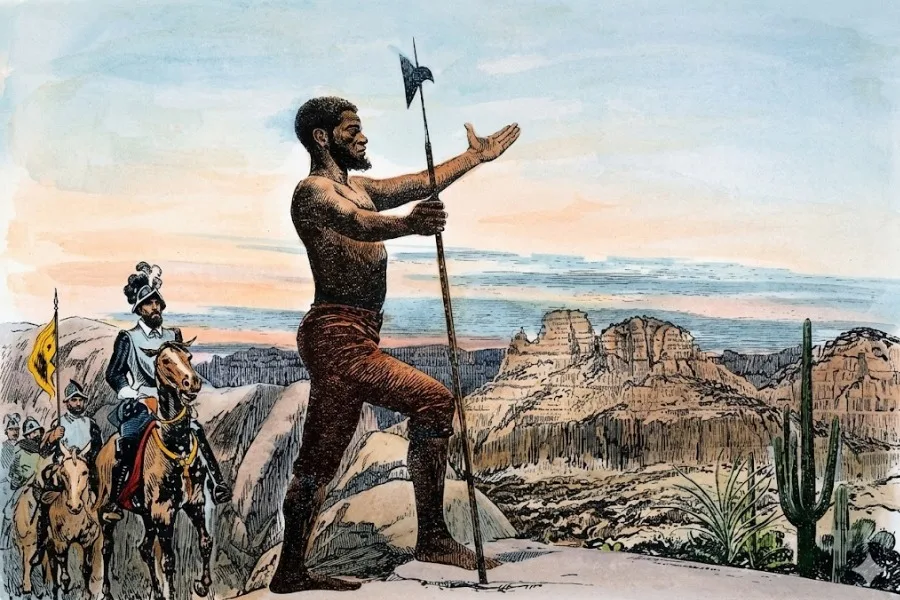
Zemmouri’s experience made him central to a new mission. In 1539, Antonio de Mendoza, the first viceroy of New Spain, authorized a reconnaissance expedition northward under Franciscan friar Marcos de Niza. Zemmouri was appointed as guide and interpreter in the search for the legendary Seven Cities of Cíbola.
He traveled ahead of the main party, reportedly sending back crosses as signals about what he found. The larger the cross, the more important the discovery was believed to be.
This made Zemmouri more than a survivor. He became a leading figure in one of the earliest Spanish attempts to understand the American Southwest, including areas linked today to Arizona and New Mexico.
A mysterious ending
Zemmouri’s final journey ended near Hawikuh, a Zuni settlement in present-day New Mexico. Historical accounts say he disappeared or was killed there in 1539, though the exact circumstances remain uncertain.
His death did not end his legend. Instead, it turned him into a symbol of a forgotten Moroccan presence in the earliest written histories of the Americas.
A Moroccan legacy across the Atlantic
Mustapha Zemmouri’s life was shaped by captivity, empire, survival, and exploration. Yet reducing him to a footnote in Spanish expeditions misses the scale of his story.
He crossed worlds that were divided by language, faith, geography, and power. He moved from Morocco to Spain, from the Caribbean to Florida, from the Gulf Coast to Mexico, and then toward the American Southwest.