Fez — Every year, when videos of Boujloud start spreading online, the same comparison returns: Is this Morocco’s Halloween?
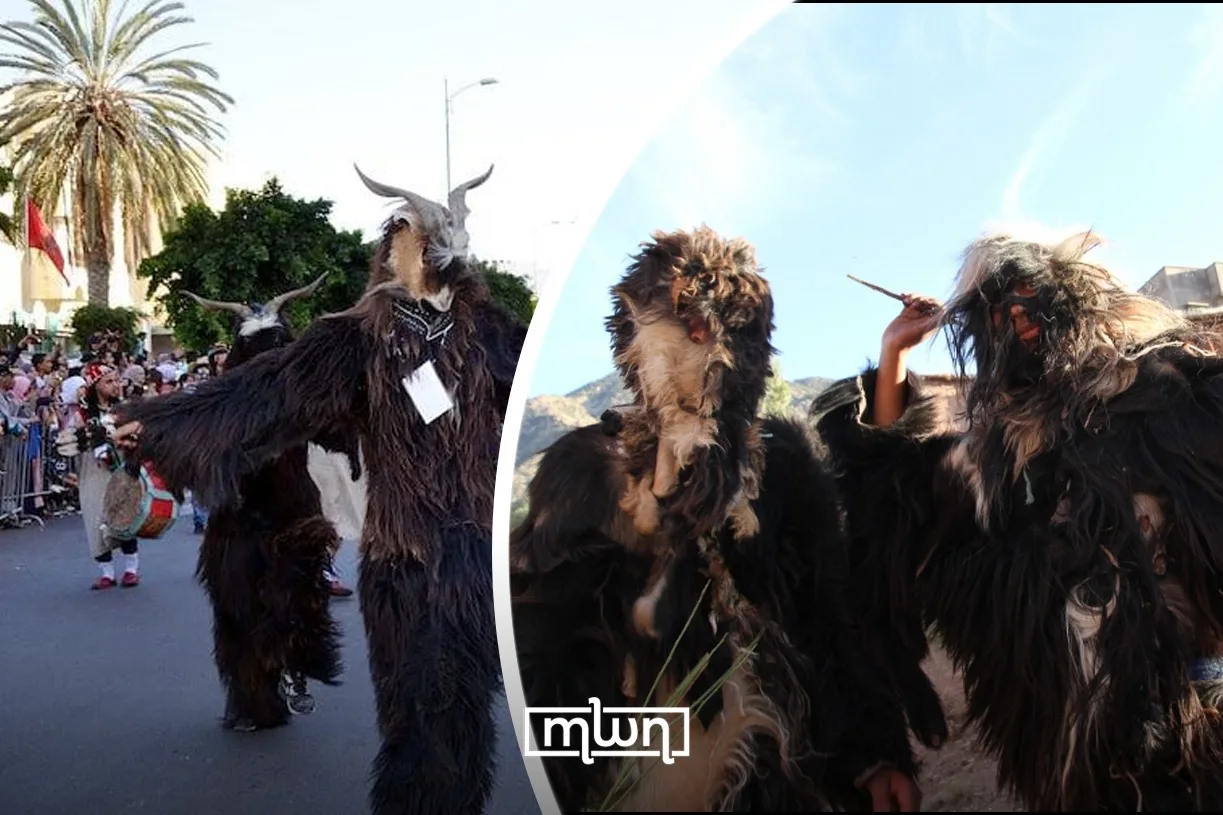
At first glance, the question makes sense. There are masks, animal skins, wild costumes, crowds, children running away in half-fear and half-laughter, and a public mood that allows the strange to take over the street. In some towns, especially in the Souss region and around Agadir, Boujloud, also known as Bilmawn or Bilmawen, can look like a Moroccan answer to Halloween’s theater of fright.
That feeling has been especially visible in clips circulating online in recent days. One Reddit post on r/Morocco titled “Agadir Boujloud” shows the celebration through a more contemporary lens, with comments describing the scene as “cool and creative” with modern cosplay-style costumes while others debate whether it still reflects inherited tradition. The same thread also shows the split in public reaction, with some users calling it “Moroccan Halloween” and others defending it as Amazigh heritage.
But the comparison only works on the surface.
Halloween comes from a different seasonal and religious history, now largely globalized through costumes, candy, horror imagery, and pop culture. Boujloud is tied to Eid al-Adha, the Muslim feast of sacrifice, and usually begins in the days after the Eid, when participants wear the skins of sacrificed sheep or goats and move through neighborhoods in dance, noise, and play.
A ritual born from sacrifice
The most important difference is timing. Boujloud is not an autumn festival, and it does not belong to October. It follows Eid al-Adha, which moves through the solar calendar because it is based on the Islamic lunar calendar.
That makes Boujloud inseparable from the sacrificial atmosphere that comes before it. The animal skins are not Halloween props bought from a store. They come from the Eid itself. They carry the smell, weight, and symbolism of the sacrifice.
Moroccan anthropologist Abdellah Hammoudi’s study “The Victim and Its Masks: An Essay on Sacrifice and Masquerade in the Maghreb” treats the sacrifice and the masquerade as part of one ritual process, not as unrelated events. The book focuses on how a solemn religious sacrifice can be followed by a chaotic masquerade that seems to overturn the order the sacrifice affirmed.
That tension is the heart of Boujloud. The Eid brings order, family, prayer, and ritual discipline. Boujloud brings noise, masks, animal transformation, joking, chasing, and temporary social disorder.
In simple terms, Halloween says: let us play with fear.
Boujloud says something deeper: after sacrifice, let the village release what has been contained.
The man of skins
The name itself explains part of the ritual. Boujloud is commonly understood as “the one with skins” or “father of skins,” while Bilmawn in Amazigh also refers to skins. Public descriptions of the celebration identify it as an Amazigh folk tradition in which people wear the pelts of sacrificed livestock after Eid al-Adha.
The figure of Boujloud is not simply a monster. He is comic, frightening, ugly, playful, and sometimes protective. He can chase children, tease adults, dance with musicians, and turn a normal street into a temporary stage.
That is why reducing Boujloud to “Moroccan Halloween” feels too easy. Halloween costumes often let people become superheroes, ghosts, celebrities, or villains. Boujloud is more specific. It turns the participant into a creature between human and animal, between discipline and wildness, between the religious feast and the older rhythms of rural performance.
It is not just dressing up;. it is transformation.
From animal skins to anime silhouettes
What has changed, however, is the costume language around the festival.
The recent Agadir videos circulating online show a version of Boujloud that does not rely only on the traditional skin-covered figure. Some young participants appear in highly creative outfits that feel closer to cosplay, anime conventions, fantasy characters, and internet costume culture than the older image of Boujloud as “the man of skins.”
That shift is exactly why the Halloween comparison keeps coming back. The street still belongs to Boujloud, but the costumes now sometimes speak in a global visual language. Young people are not only inheriting a ritual; they are remixing it.
This does not necessarily mean the tradition is disappearing. It may mean the opposite. Boujloud is absorbing the images available to a new generation. For young Moroccans raised on anime, gaming, TikTok edits, cosplay pages, and global fan culture, a costume festival naturally becomes a place to experiment.
In that sense, Agadir’s Boujloud is not becoming Halloween as much as it is becoming a local carnival with global references. The skins, drums, street procession, and Amazigh memory remain the foundation. But the surface has widened. It can now hold horned masks, fantasy robes, exaggerated silhouettes, painted faces, and anime-inspired looks.
The result is messy, colorful, and sometimes controversial. It also feels alive.
Why people call it Halloween anyway
Still, the Halloween label is not completely useless. For audiences outside Morocco, it gives a quick entry point. Boujloud has masks. Halloween has masks. Boujloud can scare children. Halloween plays with fear. Boujloud fills streets with strange figures. Halloween does the same in many cities.
That comparison also helps explain why Boujloud is so visually powerful online. A masked person wrapped in skins, moving through crowds to drums and music, immediately reads as something cinematic. It feels ancient, unsettling, and festive all at once.
In Agadir, Boujloud has also taken on a more organized carnival form. The city’s celebrations are mainly about singing, dancing, masquerading, and public street festivities during the Eid al-Adha period.
That shift makes the Halloween comparison even more tempting. Once a ritual becomes a carnival, it becomes easier to photograph, promote, package, and compare with global festivals.
But something is lost if the label becomes too dominant.
Between heritage and controversy
Boujloud also remains controversial. Some Moroccans see it as joyful heritage and a rare survival of Amazigh expressive culture. Others view it with suspicion, especially because of its animal imagery, its wildness, and claims that it carries pre-Islamic or pagan traces.
The Reddit discussion around the recent Agadir video captures that divide clearly. Some commenters defend the celebration as part of Moroccan and Amazigh culture, while others question its religious meaning, its modern costumes, or its distance from what they consider traditional practice.
Those debates are not new. Anthropologists have long argued over how to interpret the masquerade. Hammoudi’s work is important because it resists treating Boujloud as a leftover from some disconnected ancient past. Instead, it places the masquerade inside Moroccan religious and social life, especially in relation to Eid sacrifice.
That matters because Moroccan traditions are often layered. A single ritual can hold Amazigh memory, Islamic timing, village humor, social release, and modern carnival politics at the same time.
Boujloud is not clean or simple. That is exactly why it survives.
More than Morocco’s Halloween
So, is Boujloud Morocco’s Halloween?
The honest answer is: only if we are speaking loosely.
It is Morocco’s masked season. It is Morocco’s post-Eid street theater. It is Morocco’s man of skins, Morocco’s village carnival, and now, in places like Agadir, also a stage for youth costume culture and internet-era creativity.
It shares Halloween’s visual language of masks and fright, but its emotional and cultural grammar is different. Halloween is about visiting fear for fun. Boujloud is about letting the strange return to the community, briefly and loudly, after one of the most solemn moments in the Muslim calendar.
That is why Boujloud should not need Halloween to make sense. The comparison may help outsiders look, but Morocco’s tradition deserves to be understood on its own terms.
In the end, Boujloud is not Morocco copying Halloween, and it is not a Moroccan version of an imported holiday. It is a local ritual with its own timing, smell, noise, memory, and now, perhaps, anime-colored imagination.