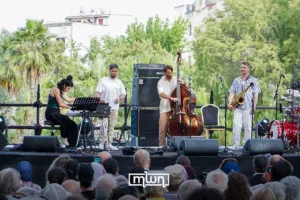
Fez — Léon Phal brought a different kind of sacred energy to the Fez Festival of World Sacred Music on Saturday evening, turning Jnan Sbil into an open-air jazz club where conversation mattered as much as sound.
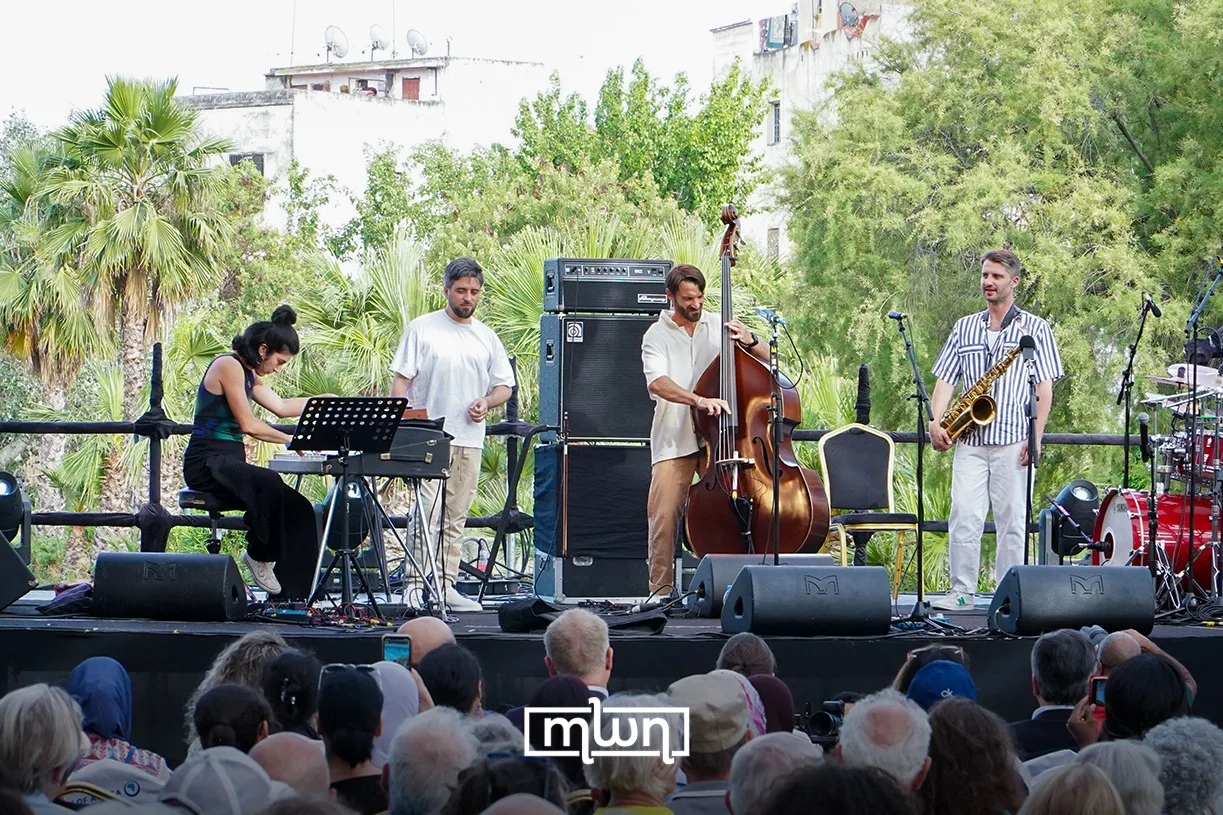
The Franco-Swiss saxophonist performed with drummer Arthur Alard, upright bassist Rémi Bouyssière, trumpeter Zacharie Ksyk, and keyboardist Maya Cros, offering a set rooted in jazz but constantly moving through funk, soul, electro, house, drum’n’bass energy, and softer melodic passages.

The concert drew from Phal’s “Stress Killer” universe, with tracks such as “Vibing in Ay,” “Idylla” (an homage to J Dilla), and “Stress Killer” carrying the band’s restless rhythm and club-facing jazz identity. The album “Stress Killer” was released in 2023 through Heavenly Sweetness and includes “Vibing in Ay,” “Idylla,” and the title track among its core songs.
Jazz as sacred exchange
Phal’s set worked because it never treated improvisation as distance from the audience.
The quintet delivered one of the strongest contemporary jazz moments Jnan Sbil has hosted.
Phal and Ksyk shared a beautiful chemistry, trading sharp, lyrical lines that pushed the set’s momentum forward, while Bouyssière and Alard locked into a steady groove that suddenly opened into odd-time surprises without losing the audience. Cros layered the atmosphere with a strong command of synth textures and electronic color, giving the garden a floating, modern edge. Together, they played with the confidence of virtuosos and the warmth of a real band with strong chemistry, offering some of the best of what contemporary jazz can be: groovy, inventive, accessible, and deeply spiritual.
Even when the arrangements became complex, the groove stayed open, clear, and physically inviting. “Still Waiting” became one of the evening’s strongest moments, with a structure that felt layered but accessible, giving each musician room to stretch without losing the crowd.

Phal told MWN Lifestyle magazine that “Jazz is a music, it is a conversation for several. And we know very well that conversations are sacred.”

That idea shaped the full performance. The band did not simply play over rhythm; it built conversations through saxophone, trumpet, keys, bass, and drums. One phrase opened a door, another answered it, and the audience followed the exchange with the quiet concentration that Jnan Sbil naturally encourages.

The musician described the evening as emotionally charged. “It was very magnificent, it was emotional to see so much beauty,” he said.
For Phal, the beauty of the setting pushed the musicians deeper into the music. “It inspired us with melodies, it inspired us with improvisation, and it gave us a lot of courage,” he said.
Jnan Sbil was not only a venue; it performed in its own way. The trees, evening air, open paths, and garden shadows softened the sharper edges of the band’s trance-like passages. When the rhythm section leaned into house or drum’n’bass textures, the garden absorbed the pulse without making it feel aggressive.
Jnan Sbil is one of Fez’s most historic green spaces, located between Fes el-Jdid and Fes el-Bali. The garden was created in the 19th century under Sultan Moulay Hassan I, later opened fully to the public in 1917, and restored between 2006 and 2010 before reopening in 2011.
That history gave the concert a special atmosphere. A garden once linked to royal space became a shared public stage for a contemporary jazz language built on openness, movement, and collective listening.
Phal built “Stress Killer” as a personal map of the sounds that shaped him before jazz became his main language. The album carries the pulse of hip-hop, the movement of electro, the warmth of groove, and the bebop spirit that first drew him toward the saxophone.

“I wanted to put all the music that influenced me, let’s say, in my childhood,” Phal told MWN Lifestyle Magazine. “There’s inevitably hip-hop, electro, bebop too, because I was a big fan of Sonny Rollins. It was Sonny Rollins who made me want to play the saxophone.”
For Phal, that openness is the point. “Sharing is the key word of my music,” he said. “When the energy circulates, it’s easier for the audience to get into the energy.”
The audience responded warmly because the performance did not ask listeners to choose between sophistication and pleasure. It gave them both. “No matter where you come from, music is something that is shared in all countries,” Phal told MWN Lifestyle magazine.