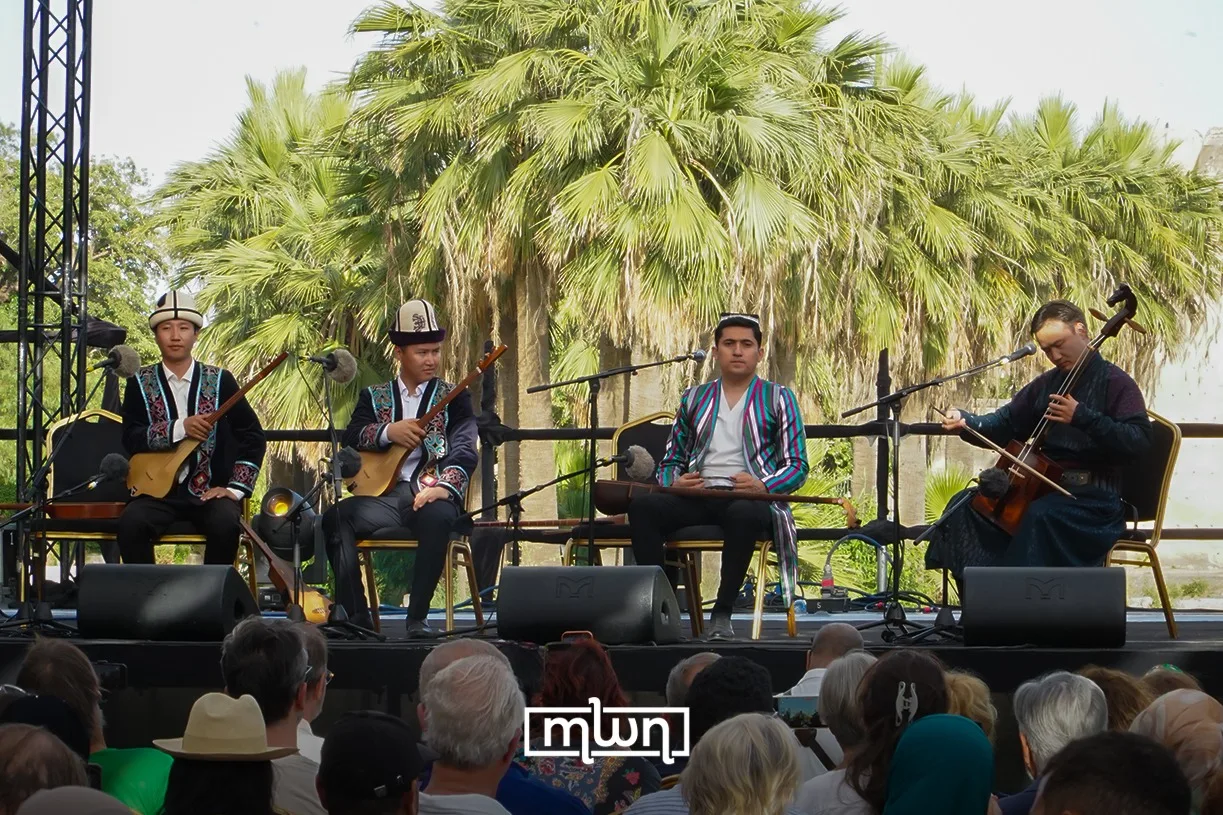
Fez — The final day of the 29th Fez Festival of World Sacred Music carried one of its most memorable moments before the closing night, as “Songs of Mountains and Steppes” filled Jnan Sbil with Central Asian sound, nomadic memory, and rare audience excitement.
Staged on June 7 before sunset, the performance brought together three traditions linked to the Silk Road and the wider musical imagination of the steppes.
In the warm early summer light, Jnan Sbil gave the show its own rhythm. Birds moved through the soundscape, water flowed nearby, and a soft breeze crossed the garden as the musicians played. At moments, even the frogs seemed to answer in time, turning the venue into more than a stage. It became part of the performance.
A Silk Road dialogue in the garden
The concert brought together Eleman and Kamuz Aibek Kanybekov from Kyrgyzstan, Mandaakhai Daansuren from Mongolia, and Ilyos Arabov from Uzbekistan. The program centered on the Kyrgyz komuz lute, Mongolian Urtyn Duu long song and morin khuur horsehead fiddle, and Uzbek shashmaqom traditions through the dotar and sato.

What made the evening stand out was not only the rarity of the traditions, but the chemistry between the artists. The elegance of the Uzbek section with its intricate melodies, the virtuosity of the Kyrgyz brothers, and the entrancing strumming style of the lutes created a show that felt both precise, deeply alive, and even theatrical.

Mandaakhai Daansuren gave the performance its most striking cultural center, explaining how the morin khuur and Huumii throat singing carry Mongolia’s nomadic memory. “The horse, for the Mongols, is a very, very important animal,” he told MWN Lifestyle magazine, describing the horsehead fiddle as an instrument built around that bond. “We put the horse’s head on the strings and on the bow,” he continued, before explaining the vocal technique that fascinated the audience. “In Mongolian, we say Huumii,” he said. “I sing very, very low. At the same time, I sing very high, two or three voices at the same time.”

Dorothy Max Prior, an artist, writer, performer, theatrical all-rounder, and former post-punk drummer, captured the audience’s feeling after the show. She said, “The Mongolian throat singing is really extraordinary.”

Prior also pointed to the wider strength of the festival, where the venue and the music often work together. “I really love being in this garden,” she said, praising the outdoor setting, the ambient sound of birds, and the unexpected “collaboration with the frogs.”
That mixture explained why the show worked so well. It did not feel like a formal demonstration of three separate traditions. It felt like a meeting. The artists listened to each other, found shared movement, and allowed their differences to shape the performance rather than compete inside it.