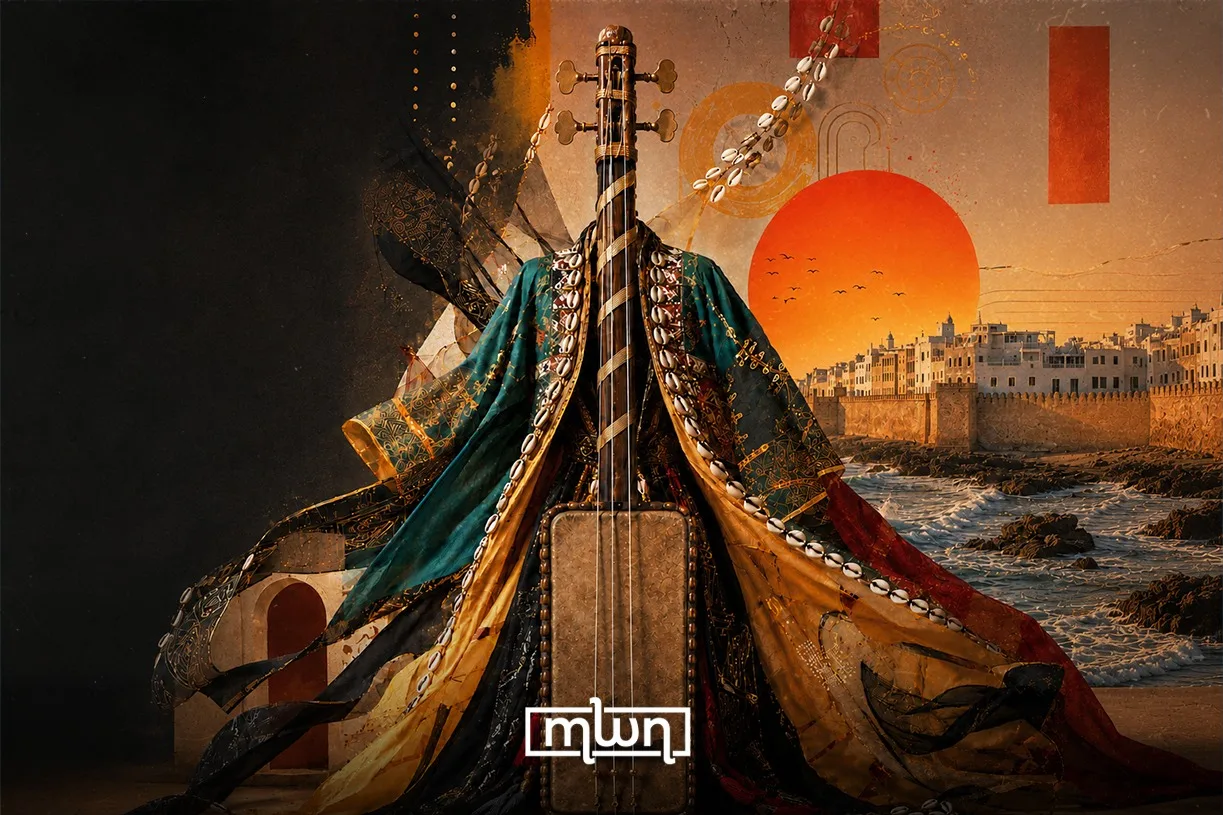
Casablanca – Fashion steps into the world of Gnaoua music through “Habiller la Transe,” a new artistic collaboration between Moroccan designer Mao Lakhdar and Gnaoua Maâlem Khalil Mounji, tied to the 2026 Gnaoua and World Music Festival in Essaouira.
At its core, the project is a meeting between two forms of cultural expression that have long carried Moroccan heritage in different ways: clothing and music.
The collaboration will extend into the festival through “Lila d’Lghaba – La Forêt des Mlouks,” the upcoming stage creation by Khalil Mounji in Essaouira, where the project naturally finds its live expression.
While one is worn and the other performed, both serve as vessels of memory, identity, and transmission.
The collaboration arrives at a moment when Gnaoua culture continues to expand beyond its traditional spaces.
Once closely associated with lila ceremonies and oral traditions, it now resonates on international stages while remaining deeply connected to its spiritual and cultural roots.
Clothing is part of the story
Rather than creating a simple stage outfit, Lakhdar approaches the project as a reflection on how heritage evolves.
For Lakhdar, the goal was never to just design performance wear, but to tell a deeper story. He views Gnaoua attire as a living canvas heavy with centuries of memory, travel, and cultural blending, seeing his current role as simply stretching that historical narrative into the world of modern design.
Drawing inspiration from the visual language of the Gnaoua tradition, its symbols, movements, colors, and spiritual dimension, the designer proposes a contemporary interpretation that engages with the present while remaining anchored in history.
The project also shines a light on an often-overlooked aspect of Gnaoua culture: its aesthetic evolution.
As the music has travelled and transformed over the years, so too have the garments associated with it. From traditional attire to the distinctive stage looks worn by Maâlems today, clothing has become part of the story itself.
Mounji points out that Gnaoua culture has always been fluid, noting that their instruments, songs, locations, and audiences have constantly shifted over time while keeping the core spirit intact.
For him, this creative partnership is the perfect way to figure out how to keep this incredible heritage alive for the next generation without turning it into a rigid museum piece.
Together, the collaboration sits at the intersection of sound and silhouette, where Gnaoua is not only performed but also seen, reinterpreted, and felt in new ways.
It’s also a reminder that heritage does not only live in preservation, but also in movement, in how each generation chooses to carry it forward while giving it a new form.
Read also: Gnaoua Festival 2026 Turns Essaouira Into Global Music Capital