Fez — The Moroccan Sahara is usually imagined through heat, stone, dunes, silence, and distance. It is not the kind of place people associate with small faces, oversized ears, soft paws, and animals that look like they wandered out of a children’s book.
Yet some of the Sahara’s most memorable survivors are exactly that: strangely cute, almost fragile-looking creatures built for an environment that forgives nothing.
They are not decorative animals. They are not desert mascots. Their softness is only the surface. Under it sits some of the smartest survival design in nature.
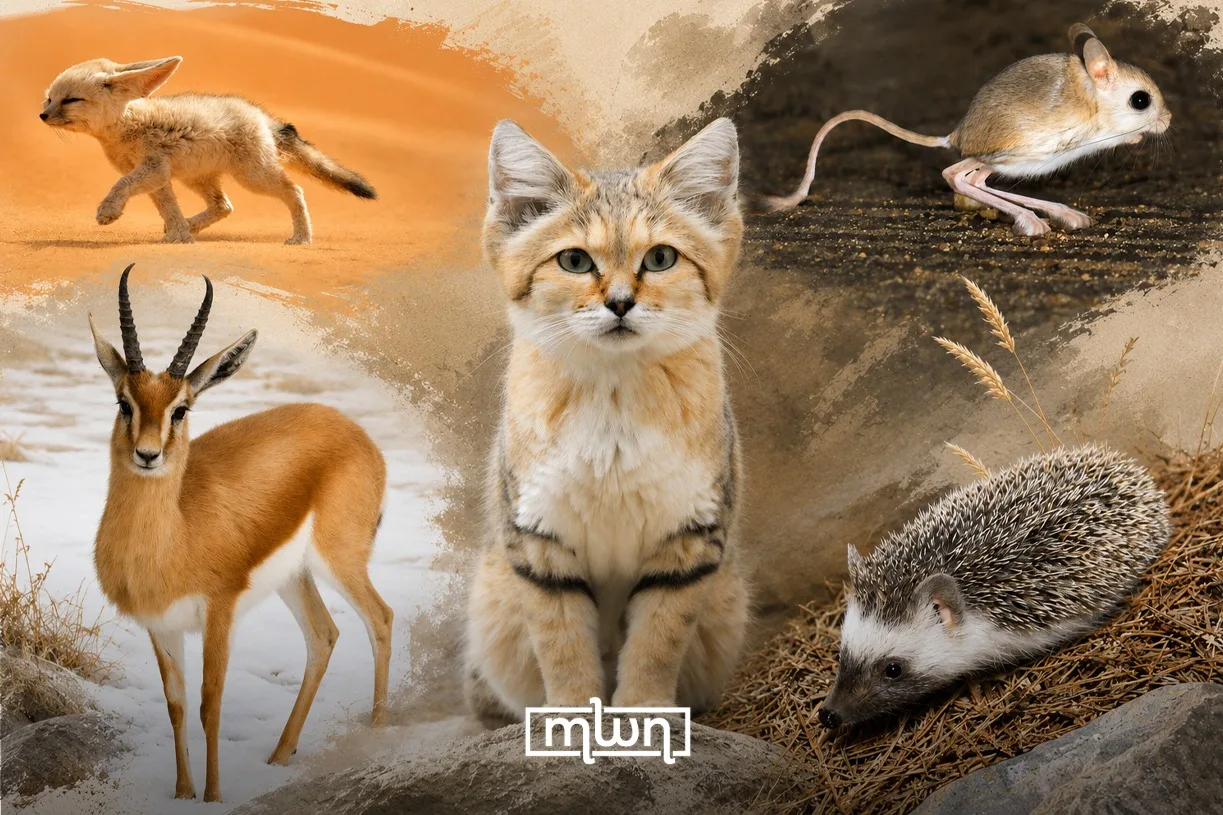
The fennec fox looks harmless and lives like a specialist
The fennec fox is the obvious star.
Tiny body. Huge ears. Sand-colored fur. A face that looks permanently surprised.
It is also one of the Sahara’s best desert engineers. Fennec foxes live across North Africa, from the central Sahara to Morocco’s coasts, using sandy habitats where they burrow during the day and hunt at night. Their oversized ears help release heat and detect prey underground.
That is what makes the animal so visually strange. Everything that looks cute has a job. The ears are cooling systems. The pale coat is camouflage. The small body helps it survive where food and water are scarce.
The fennec looks too soft for the Sahara, but the Sahara shaped every inch of it.
The sand cat is cute in the most dangerous way
The sand cat may be even more deceptive.
It looks like a house cat drawn from memory by someone who wanted it rounder, flatter, and softer. Wide face. Low ears. Calm eyes. Small body.
But it is a real desert predator.
The sand cat lives in dry habitats across parts of North Africa and Asia, with a marginal presence in Western Sahara. The species has been recorded in desert regions around Algeria, Mauritania, and other Saharan zones, while wildlife observers in the Dakhla region have also documented sand cats along with fennec foxes and other nocturnal species.
Its paws are protected by fur that helps it move over hot sand. Its low ears reduce heat exposure and help it listen for small prey. It survives mostly out of sight, moving at night and vanishing before most people ever know it was there.
The sand cat does not need to look fierce. It already is.
The jerboa is basically a desert cartoon
Then there is the lesser Egyptian jerboa, one of the most ridiculous-looking animals of the desert.
It has a tiny body, long back legs, oversized feet, big eyes, and a tail built for balance. It moves like a miniature kangaroo that got lost in the Sahara.
The species occurs across North Africa, including Morocco, and inhabits sandy or rocky desert areas. Research on southern Morocco’s Atlantic Sahara confirmed lesser Egyptian jerboa activity in the region.
Its cuteness comes from proportions that look almost wrong. But those long legs are not for charm. They let the jerboa jump quickly across open ground, escape predators, and cover distance at night while searching for seeds, grasses, insects, and other desert food.
It looks funny because survival made it efficient.
The desert hedgehog brings small chaos to the sand
The desert hedgehog feels like it belongs in a garden, not a landscape of heat and rock.
Small, spiky, shy, and round when threatened, it survives across the Sahara from Mauritania to Egypt and across Arabian desert regions.
The image is almost comic: a little hedgehog moving through an environment built for snakes, foxes, and heat. But its spines, nocturnal habits, and ability to handle dry conditions make it far tougher than it looks.
It is cute in the way many desert animals are cute: accidentally.
The Dorcas gazelle is softness under pressure
The Dorcas gazelle brings a different kind of beauty.
It is small, slender, and light on its feet, with large eyes that make it look almost too gentle for the desert. In Morocco, the Dorcas gazelle remains present in Souss Massa and the Moroccan Sahara, while conservation spaces also help protect Saharan fauna such as addax, oryx, ostriches, and gazelles.
Its delicate appearance hides a desert body built for heat and limited water. Dorcas gazelles can draw much of their needed moisture from plants, a crucial advantage in arid habitats.
That is the strange beauty of the Sahara. The animals that look most breakable are often the ones that learned the hardest lessons.
The fennec, sand cat, jerboa, desert hedgehog, and Dorcas gazelle prove that the Moroccan Sahara is not empty or lifeless. It is full of small, quiet survivors that look too cute for the desert, until you realize the desert made them that way.