Fez — Nearly four decades of Moroccan painter Mohamed Mourabiti’s artistic journey will come together in Casablanca this October, tracing how the familiar landscapes of Marrakech evolved into a distinctive language of signs, colors, and abstraction.
Titled “Paraboles, La Rétrospective” (Paraboles, The Retrospective), the exhibition will open at La Galerie 38 in Casablanca on October 15, with an opening reception beginning at 7 p.m.
The gallery announced that the exhibition will bring together works created between 1988 and 2026, offering an overview of the artist’s evolving approach to painting.
Rather than following a strictly chronological narrative, the retrospective explores how Mourabiti transforms elements of everyday life into symbols that reflect memory, identity, and the relationship between the visible and invisible worlds.
From Marrakech’s rooftops to abstraction
Born in Marrakech in 1968, Mourabiti developed his artistic language through close observation of his surroundings.
The narrow streets, textured walls, architectural forms, and changing light of his hometown became recurring sources of inspiration.
One object in particular would come to define much of his work: the satellite dish.
Commonly found on Moroccan rooftops, these dishes became more than familiar urban objects in Mourabiti’s paintings.
Through repetition, simplification, and abstraction, the artist gradually transformed their shapes into signs that invite different interpretations.
The French word “parabole” also carries a double meaning, referring both to a satellite dish and to a parable, or allegorical story.
That ambiguity reflects Mourabiti’s interest in communication, symbolism, and the search for meaning beyond visible forms.
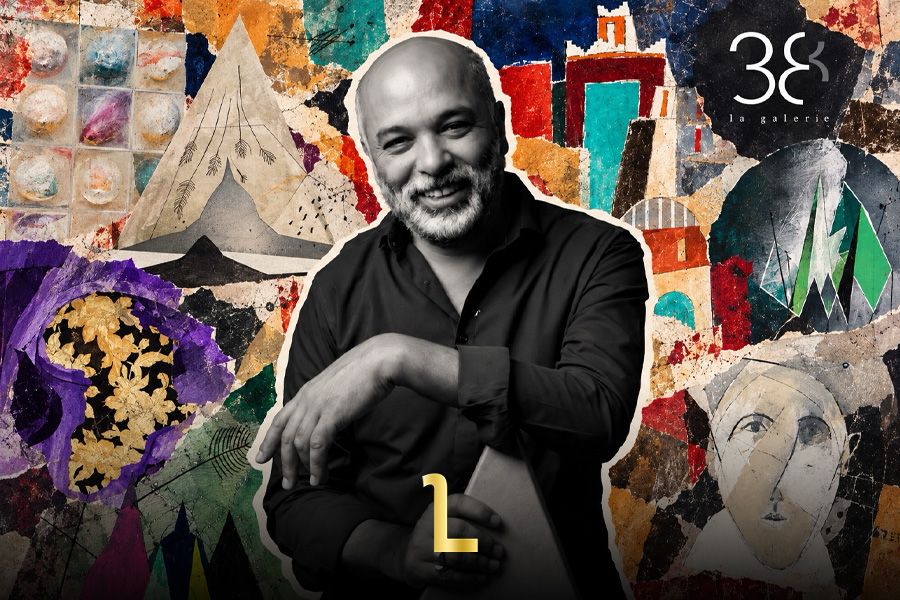
His paintings also feature domes, mausoleums, circles, and architectural fragments, often reduced to their essential shapes.
The exhibition catalogue traces this evolution through works ranging from small mixed-media compositions to monumental canvases.
An untitled painting from 2006, reproduced on the exhibition invitation, combines blue, black, white, and ochre forms with textured surfaces and architectural suggestions.
It offers an example of how recognizable structures can gradually dissolve into abstraction.
Earth, memory, and spirituality
Mourabiti’s move to Tahannaout, near the Atlas Mountains, further shaped his artistic practice.
The surrounding landscape introduced new textures, colors, and materials into his work, including earth, pigments, tar, fabrics, and collage.
His compositions often feature layers of paint that have been scratched, covered, or partially erased, allowing traces of earlier gestures to remain visible.
In the exhibition catalogue, French novelist Jean-Noël Pancrazi describes Mourabiti’s work as a continuous journey from material exploration toward spiritual reflection.
The artist’s interest in spirituality also developed through his engagement with the writings and legacy of Ibn Arabi, the influential Sufi thinker.
A journey to Damascus, where Ibn Arabi is buried, became particularly important to his artistic research.
Mausoleums and domed structures subsequently acquired a deeper symbolic presence in his paintings, connecting architectural forms with questions of faith, memory, and transcendence.
Moroccan writer Edmond Amran El Maleh, who wrote extensively about Mourabiti’s work, described his approach as a search for artistic freedom beyond conventional representation.
A career shaped by artistic encounters
Mourabiti’s career developed largely outside traditional academic training, shaped instead by experimentation and exchanges with artists, writers, and intellectuals.
In 2008, he founded “Al Maqam” in Tahannaout, an artistic space combining exhibitions, residencies, and cultural gatherings.
The venue became a meeting place for painters, poets, and thinkers, reflecting his belief that artistic creation also develops through dialogue.
His collaborations have included projects with writers and poets such as Michel Butor, Mustapha Nissabouri, Adil Haji, and Abdelhak Serhane.
His work has also appeared in exhibitions in Morocco and internationally, including presentations in Paris, London, Berlin, and São Paulo.
The retrospective catalogue brings together reflections from several writers and cultural figures, including Pancrazi, El Maleh, Mahi Binebine, and Salima Naji.
Nearly four decades of artistic evolution
The exhibition also examines Mourabiti’s more recent experiments with circles, maps, and large-scale compositions.
These works extend his earlier interest in architecture and territory while moving toward increasingly simplified forms.
Some of the latest paintings date from 2026, including mixed-media works on wood and large canvases that continue his exploration of texture, color, and spatial relationships.
Across these different periods, recurring motifs take on new meanings without entirely losing their connection to their original surroundings.
The exhibition offers Casablanca audiences an opportunity to revisit an artistic practice shaped by Morocco’s landscapes, cultural traditions, and spiritual heritage.
From satellite dishes overlooking Marrakech to abstract compositions inspired by the Atlas Mountains, Mourabiti’s work reflects nearly 40 years of transforming familiar spaces into a personal artistic language.
“Paraboles” ultimately brings those different periods together, highlighting how an artist rooted in his immediate environment has continued to explore questions extending beyond geography, material, and time.