Trailblazer in Diplomacy and Human Rights: The Legacy of Halima Elouarzazi
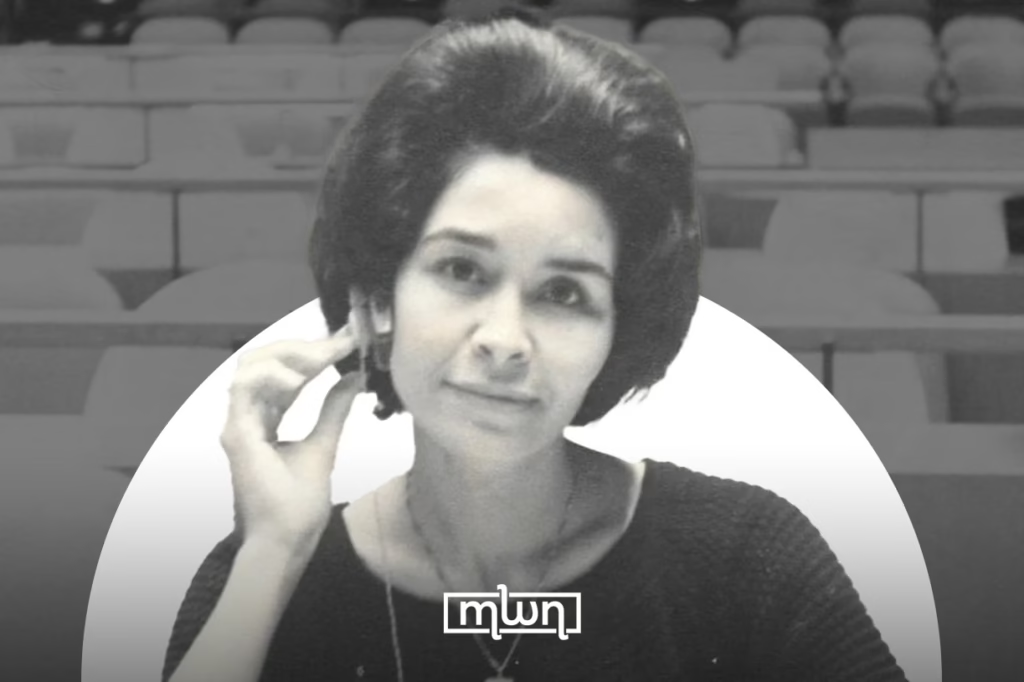
Diplomat, pioneer, and fearless voice for justice, Halima Elouarzazi lived history by changing it. Fez – Halima Elouarzazi was born on April 17, 1933, in Casablanca, at a time when Moroccan women weren’t expected to step onto the world stage, let alone shape it. But Elouarzazi was never one to play small. She studied literature at Cairo University and soon after became one of the first Moroccan women to hold a diplomatic post. Between 1959 and 1967, she served as a cultural attache at the Moroccan Embassy in Washington, quietly paving the way for generations of women in foreign service. Her rise didn’t stop there. In 1973, she joined the United Nations Sub-Commission on the Prevention of Discrimination and Protection of Minorities. That same year, she became an expert member of the UN Committee on the Elimination of Apartheid and Racial Discrimination, decades before “diversity and inclusion” became corporate buzzwords. Throughout the 1980s and 1990s, Elouarzazi’s name was attached to every major human rights initiative at the UN. She chaired working groups, led special commissions, and in 1985, was appointed Special Rapporteur for a task force investigating harmful traditional practices against women and children. That wasn’t just paperwork, it was about confronting taboos and pushing for global accountability. By 1989, she had returned to Morocco as Director of International Organizations at the Ministry of Foreign Affairs and Cooperation. But she kept one foot firmly in the international arena. In 1992, she chaired the third preparatory committee for the World Conference on Human Rights. That same year, she was re-elected to the UN Sub-Commission and led a working group on emerging forms of racism. Her influence was anything but symbolic. In 1997, she was unanimously elected Vice-President of the Sub-Commission. This was a fitting recognition for someone who had spent decades confronting racism, discrimination, and silence. In 2008, at the age of 75, she was still going strong, elected to the Advisory Committee of the UN Human Rights Council in Geneva. Elouarzazi didn’t just represent Morocco. She represented what it means to commit a lifetime to human dignity, diplomacy, and the kind of change that doesn’t make headlines, but moves history. Read also: A Sacred Hilltown: Inside Moulay Idriss Zerhoun, Morocco’s First Islamic City
Mohammed Ben Hadou Attar: The Moroccan Diplomat Who Impressed the English Court
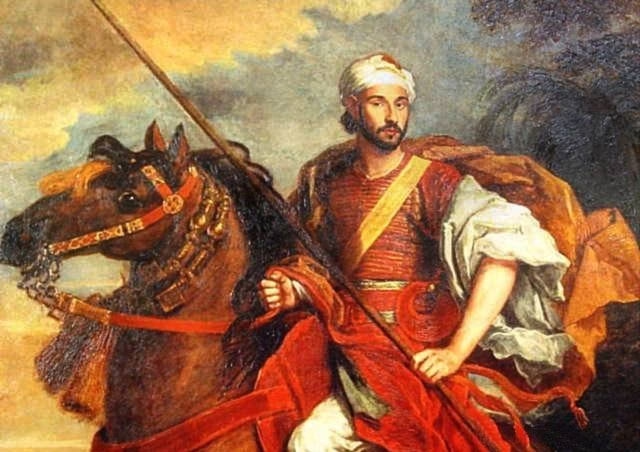
Mohammed Ben Hadou went to negotiate peace, but what he really did was start a one-man cultural revolution in London. Fez – Let’s rewind the clocks to the late 17th century, when diplomacy meant caftans, curved sabers, and making royal impressions without ever bowing your head. Meet Mohammed Ben Hadou Attar: Moroccan diplomat, polyglot, gentleman, and the unlikely star of London high society, until politics did what politics always does. Ben Hadou wasn’t just another envoy; he was the handpicked ambassador of Sultan Moulay Ismail. In 1681, at the height of tension over English-occupied Tangier, Ben Hadou was sent to London to negotiate peace and trade. But before we get into his British tour, let’s go back to his roots. Born into a family that had long served Moroccan dynasties, from the Saadians to the Alaouites, Ben Hadou came preloaded with political savvy. His father and grandfather worked closely with European envoys. Meanwhile, his mother was a foreigner, possibly European. This gave him a certain ease when dealing with the “Franj” (foreigners). Perhaps most intriguingly, he came from the Attar family of Souss, a line known for holding serious power across southern Morocco. When Ben Hadou arrived in London in late 1681, he didn’t just clock in as a bureaucrat. The man made an entrance. Dressed head-to-toe in fine Moroccan attire: colorful caftans, silk sashes, and a majestic white haik, he captivated the English elite. On January 11, 1682, he was officially received by King Charles II at Whitehall Palace. English diarist John Evelyn couldn’t stop writing about him. “He didn’t bow. He didn’t kneel. He just stood there, proud as ever,” Evelyn noted, clearly both impressed and slightly scandalized. Read also: Inside Morocco’s Buzzing Bee Museum The Moroccan entourage didn’t spend their days cooped up either. They visited Hyde Park on horseback, attended comedy plays, and even dined at Cambridge University. At one royal banquet hosted by the king’s French mistress (the drama!), Ben Hadou reportedly outclassed every guest in manners and mystique. Compared to the Russian ambassador, Evelyn described him as “the civilized one.” And it didn’t stop at tea and theatre. Ben Hadou was inducted into the Royal Society in April 1682 – yes, “that” Royal Society. His name was even written in Arabic in their registry. Diplomatically, he negotiated a draft treaty of peace and trade with England, a potential landmark agreement. But, alas, it was never signed. Why? Politics. Court rivalries. Suspicion. Sultan Moulay Ismail felt Ben Hadou may have gotten too friendly with the Brits. A competing courtier accused him of being soft. The Sultan wasn’t pleased, and Ben Hadou was nearly punished, possibly fatally. Still, the English did end up withdrawing from Tangier in 1684. Eventually, Ben Hadou clawed his way back into the Sultan’s inner circle. By the 1720s, he was once again Morocco’s go-to guy for European affairs, before quietly vanishing from the records, his legacy partly swallowed by time. But for one glorious stretch of six months, London was charmed, the English were wowed, and Moroccan diplomacy had its moment in the British spotlight.