Louvre Heist: The Stolen Jewels and the Glittering Stories Behind Them

A brazen daytime raid on October 19 stripped the Louvre’s Galerie d’Apollon of eight historic jewels tied to the Bonaparte and Orléans courts.
The Louvre Invites 100 Artists to Copy Its Masterpieces in an Exhibition
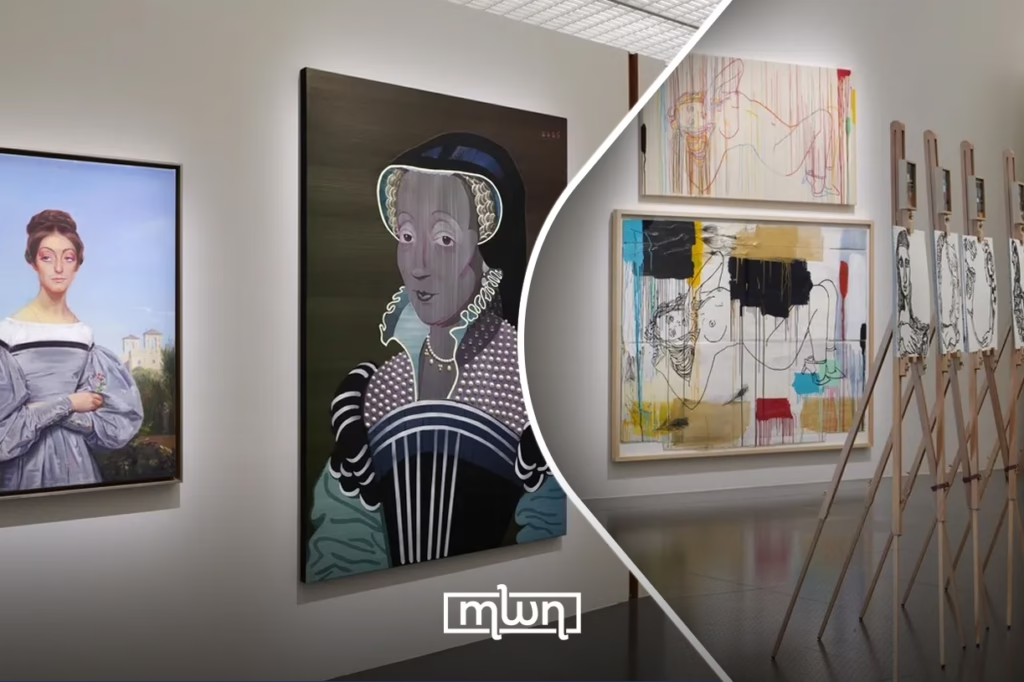
A remarkable exhibition titled “Copyists” is rewriting the rules of homage, originality, and artistic memory. Fez- In partnership with the Louvre, at the Pompidou Center Metz, the show brings together 100 contemporary artists, all tasked with the same deceptively simple challenge to choose a work from the Louvre’s vast collection and imagine your own “copy.” Except, the invitation wasn’t about imitation. It was a conceptual open door. The artists could reproduce, reinterpret, subvert or even abandon the traditional idea of a copy altogether. And that freedom produced a kaleidoscope of works ranging from exact replicas to radical reimaginings, sculptures inspired by paintings, videos born from oil portraits, and even sound pieces referencing forgotten canvases. Curators Chiara Parisi and Donatien Grau deliberately avoided framing the exhibition as thematic. Their selection of artists was instinctive rather than strategic, grounded in admiration, not in uniformity. “We chose artists we admire, regardless of style, generation or medium,” they explained, according to Smithsonian Magazine. The result is a beautifully unpredictable show that foregrounded individuality, while maintaining a quiet dialogue with the past. The title “Copyists” itself nods to a long-standing art tradition, one that’s especially rooted in the Louvre. Since its founding in 1793, the museum has welcomed artists to sit in its halls and copy the masters, a practice once seen as essential training. But as modernism took hold, the act of copying became unfashionable. The avant-garde rejected continuity in favor of rupture. Abstraction replaced figuration. Innovation meant breaking up with the past.. But did it really? The exhibition raises an important question: can we ever fully escape the influence of what came before us? For many of these artists, the answer is no, and that’s not a problem, but a source of inspiration. Take Mohamed Bourouissa, the Algerian-born French photographer who began his creative journey copying superhero comics. For “Copyists”, he reinterprets “Study of Hands” by Nicolas de Largillierre using UV print on plexiglas, aluminum, and steel, transforming an 18th-century oil painting into a contemporary, industrial object. Others used the opportunity to question art’s historical narratives. Madeleine Roger-Lacan revisited Ingres’ “The Turkish Bath”, replacing the passive nude women with passive nude men, a clever and pointed inversion. Meanwhile, artist Georges Adéagbo responded to Delacroix with a layered collage mixing French Romanticism and West African iconography. “Delacroix has his path, and I have mine,” he said. “I don’t know how to copy him.” In contrast, Jean-Philippe Delhomme painted a faithful oil-on-canvas version of Goya’s “Portrait of the Marquise de la Solana”, proving that fidelity can still hold creative weight. As Cézanne once wrote, “The Louvre is the book from which we learn to read.” But even he believed that to truly understand art, one must eventually write their own chapter. That’s precisely what “Copyists” celebrates. The exhibition runs until February 2, 2026, promising a rare and compelling look at how the past still speaks, and how contemporary artists are answering back. Read also: Joel Arthur Rosenthal: The Greatest Living Jeweller
Louvre Museum Shuts Down in Protest Against Overtourism
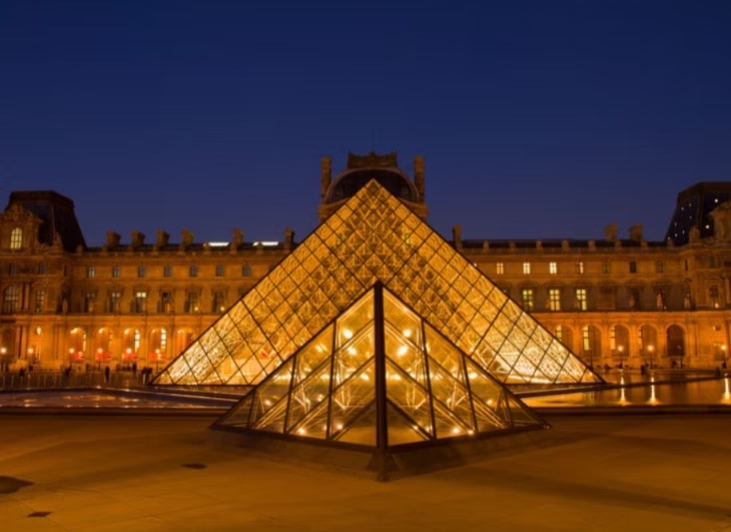
The Louvre is tired, and so are the people who run it. Fez– The Louvre didn’t close its doors yesterday because of war, a strike, or a bomb threat. It shut down because the people inside, those tasked with preserving one of the world’s greatest collections of art, have had enough. Not of art, but of the overwhelming wave of tourists flooding its galleries every single day. The most visited museum in the world, home to the Mona Lisa and some 35,000 other works of genius, was left paralyzed, not by outside forces, but by its own popularity. According to La Repubblica, it’s not just the paintings that are under pressure. It’s the staff, the system, the structure. And they’re beginning to collapse. Kevin Ward, a 62-year-old staff member, summed it up with both frustration and poetic irony: “It’s the Mona Lisa’s lament here. Thousands are waiting, no communication, no explanation. I think even she needs a day off.” Ward isn’t exaggerating. In recent years, the Louvre has become a global symbol of overtourism, where crowds aren’t simply inconvenient, they’re existentially threatening to the institution. From Venice’s fragile canals to the crumbling stones of the Acropolis, major cultural sites are struggling to cope. The Louvre, the crown jewel of them all, is reaching its tipping point. In response, the museum is introducing a sharp ticket price hike for non-EU visitors starting January 1, 2026. Entry will rise from €22 to €30 (around $35). The new pricing will apply to all visitors from outside the European Union, including neighbors like the UK, Norway, and Switzerland. EU citizens, however, won’t be affected. Thanks to EU regulations on equal access to public museums, they’ll continue paying the standard rate. But for millions of other travelers, especially those arriving during high season, the Louvre just got more expensive, and the experience more uncertain. This move is more than just about money. It’s a signal. France, like other tourism-heavy countries, is rethinking how to manage cultural access in an age of global mobility and post-pandemic travel rebounds. It’s not alone. Last year, Mark Jones, former head of the British Museum and the Victoria and Albert Museum, suggested the UK adopt a similar model to generate extra income from the nearly 40 million foreign visitors it hosts annually. The Louvre’s sudden closure is a reminder that culture, no matter how ancient or revered, still needs care, and boundaries. When the people who keep the art alive are overwhelmed, maybe it’s time we all pause and ask: who is tourism serving, and what is it costing? Read also: American-Iraqi Film ‘The Eagle’ Wraps Filming in Marrakech
The Mamluks Take Over the Louvre: A Forgotten Golden Age Brought Back to Life
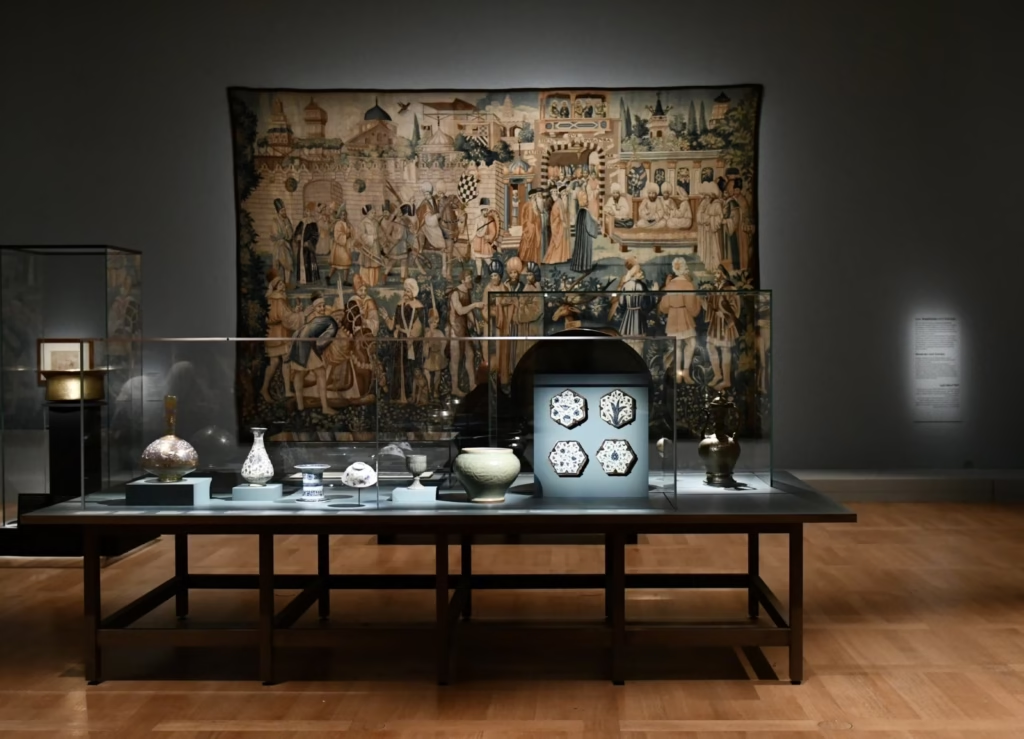
Step into the Louvre and out of everything you thought you knew about Islamic history. Fez – The Louvre is stepping into new historical territory. For the first time in Europe, the Parisian institution is shining a spotlight on one of the most fascinating and misunderstood chapters of Islamic history: the Mamluk Empire. Titled “The Mamluks, 1250–1517,” the exhibition runs until July 28 and promises an immersive journey into an era where former enslaved soldiers ruled over a vast Egyptian-Syrian empire and fostered a cultural renaissance that stretched from Cairo to Damascus, Aleppo, Jerusalem, and Tripoli. The Mamluks, originally military slaves from Central Asia and the Caucasus, rose through the ranks to become rulers, scholars, patrons of the arts, and shapers of major cities. As explained by Souraya Noujaim and Karine Goehvan, curators of the Louvre’s Islamic Arts Department, the exhibition aims to reclaim this era from historical obscurity and present it as a flourishing crossroads of East and West. With more than 260 artifacts spread across five themed sections, the exhibition combines dazzling craftsmanship with careful curation. Expect rare manuscripts, textiles, intricately carved ivory, decorative woodwork, enameled glass, and stone ornamentation. Each section dives into a specific facet of Mamluk society, offering a rare window into a world where sultans, merchants, and mystics coexisted, and where aesthetics were deeply tied to identity, politics, and power. One standout piece is a rare carpet on loan from the Louvre Abu Dhabi, featuring the iconic three-medallion pattern associated with Mamluk design. The exhibition also includes illustrated pilgrimage manuscripts that read like medieval travel diaries, and scientific marvels like an astrolabe believed to prefigure Copernican thought. Goehvan points out how Mamluk rulers transformed urban planning in major Middle Eastern cities. Cairo and Damascus weren’t just political capitals, they were the beating hearts of this cosmopolitan empire. The Mamluks also controlled vital trade routes connecting Asia and Europe via the Red Sea, dealing in spices, coral, silk, and furs. Women’s lives are also part of the story. While legal texts paint a limited picture, the reality was far more layered. Some women built mausoleums, ran businesses, and amassed serious wealth, like Sitt Hadak, an enslaved woman turned successful entrepreneur. And then there’s Shajarat al-Durr, the only woman to rule the Mamluk state (briefly), even minting coins in her own name. The exhibition also tracks how the Mamluks captured European imagination in the 19th century. Their cavalry inspired Napoleon during his Egyptian campaign and even appeared in Romantic-era art, such as a painting by François-André Vincent, now on view. A rich public program complements the exhibition, including lectures and a workshop on Mamluk-era excavations in Aleppo, scheduled for May 15. This is more than a history lesson, it’s a reclamation of a glittering, complex chapter in Islamic civilization. The Mamluks are back in the spotlight, and this time, they’re not here to conquer; they’re here to enchant. Read also: How Sci-Fi Books and Movies Inspired Real-Life Scientific Inventions