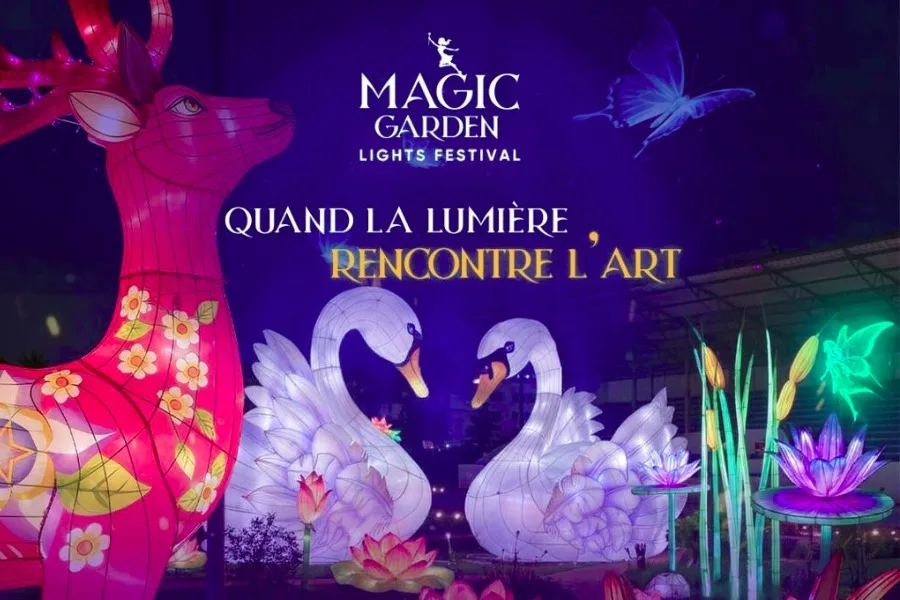
Fez — Casablanca’s evenings have taken on a new glow with the launch of the first “Magic Garden Light Festival,” an immersive light event now underway at the Vélodrome d’Anfa.
Presented as a first-of-its-kind experience in Morocco, the festival opened on March 27 and is scheduled to run until May 10, with nightly access from 8 p.m. to midnight.
Organizers say the event is an initiative of “Go Vélodrome” and is designed as a large-scale luminous promenade inside one of Casablanca’s most recognizable urban sites.
Rather than positioning itself as a conventional show, “Magic Garden” is described as a walk-through experience.
The official event site describes it as an immersive light festival at the heart of the Vélodrome, while ticketing and promotional pages present it as a 60- to 90-minute route meant to blend visual installations, atmosphere, and family leisure.
It is the first immersive light festival in Morocco, proving the event’s attempt to introduce a format more commonly associated with major international cities into Casablanca’s cultural calendar.
The festival’s wider ambition is closely tied to the Vélodrome itself. By staging the event there, organizers are effectively turning a heritage site into an active cultural venue, using light-based installations as a way to reanimate public space rather than simply decorate it. That approach fits the public branding of “Go Vélodrome,” whose social media presence presents the site as a lifestyle and event destination in Casablanca.
In that sense, “Magic Garden” is not only about visual enchantment. It is also part of a broader effort to give the Vélodrome a new place in the city’s contemporary cultural life.
The practical setup also reflects an effort to reach a broad public. The official website lists children’s pricing, group offers, and open nightly access during the spring period, suggesting that the event is being pitched not only to art audiences but also to families, schools, and casual evening visitors.
Organizers say more than 50,000 visitors are expected over the run, a figure that points to the scale of the project and to Casablanca’s growing appetite for immersive leisure formats.
What makes the festival notable is less the promise of fantasy alone than the context in which it appears.
Casablanca is not short on energy, but it has often struggled to match that energy with a coherent image as a cultural destination. “Magic Garden Light Festival” seems to be trying to answer that gap by combining spectacle, accessibility, and urban symbolism in one place.
Whether it becomes a recurring fixture remains to be seen, but its first edition already signals a clear ambition: to make nighttime culture in Casablanca feel more immersive, more visible, and more deliberately staged.