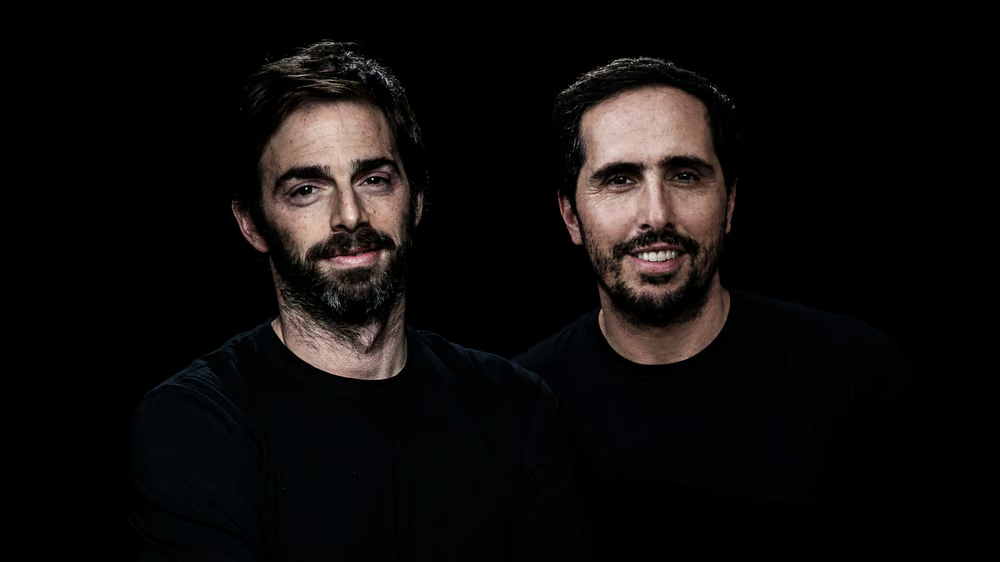
Fez — French entrepreneurs Emmanuel Lipszyc and Thomas Cohen have launched “IPFC,” a Paris-based startup that aims to protect and monetize creative identities in the age of generative AI.
The company is arriving just ahead of the Cannes Film Festival, where debates over artificial intelligence, authorship, and creative ownership are expected to remain central to the film industry’s concerns. The 79th Cannes Film Festival is scheduled to run from May 12 to 23.
“IPFC” describes itself as a protection standard built into AI generation, saying it monitors, protects, and monetizes the intellectual property of artists and brands. Its LinkedIn profile lists the company as founded in 2025, based in Paris, and employing Emmanuel Lipszyc and Thomas Cohen.
Managing identity, not only works
The startup’s model draws inspiration from rights-management organizations such as “SACEM” (Society of Authors, Composers, and Publishers of Music), the French body that collects and distributes royalties for creators and publishers. “SACEM” says its work includes collecting and distributing royalties, defending creators’ rights, and supporting members’ projects.
But “IPFC” is attempting to solve a different problem. Traditional rights systems usually begin with a work: a song, film, photograph, or book. AI systems complicate that model because generated content can absorb, remix, and imitate creative elements without leaving an obvious trace of a single original work.
Lipszyc argues that this shift requires a new entry point.
“The name is the only marker that allows you to know, with certainty, that a creative universe has been used,” he said, according to Variety. “It’s the only reliable entry point for protection and remuneration.”
That idea places identity at the center of the system. Instead of focusing only on finished works, “IPFC” wants creators, brands, athletes, influencers, and public figures to register their name, image, voice, visual identity, and other defining attributes.
A one-stop shop for AI rights
The company is positioning itself as a “one-stop shop” for rights management across film, music, publishing, sports, and influencer talent. It also plans to expand into luxury and fashion before opening the model more broadly in 2027.
Once a person or brand registers key attributes, “IPFC” says it can monitor AI-generated and social media content, flag possible infringements, and help trigger takedowns or pre-litigation action.
The company frames the problem as urgent. In a recent post, “IPFC” argued that the current intellectual property system was built to manage finished works, while generative technologies consume patterns, voices, images, performances, and styles at scale.
Lipszyc described the current moment as chaotic, saying creators and creative industries have lost control over their image. The startup’s goal, he said, is to “restore clear rules in a system that currently has none.”
Cohen added that the company wants to create infrastructure that protects creators while giving AI platforms a legal route to use creative identities.
“A licensed product is always going to be more attractive than something operating in a legal gray zone,” he said.
The ‘Napster moment’ for AI
Cohen compared today’s AI rights debate to the music industry’s early file-sharing crisis, when unlicensed digital use forced the sector to rethink distribution and payment.
“We’re in a Napster moment,” he said. “Unregulated use can’t last. What comes next is a regulated ecosystem, like Spotify was for music.”
“”IPFC” says it is already in advanced talks with one of the world’s leading AI platforms, though no deal has been finalized.