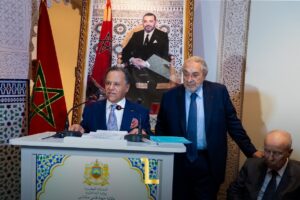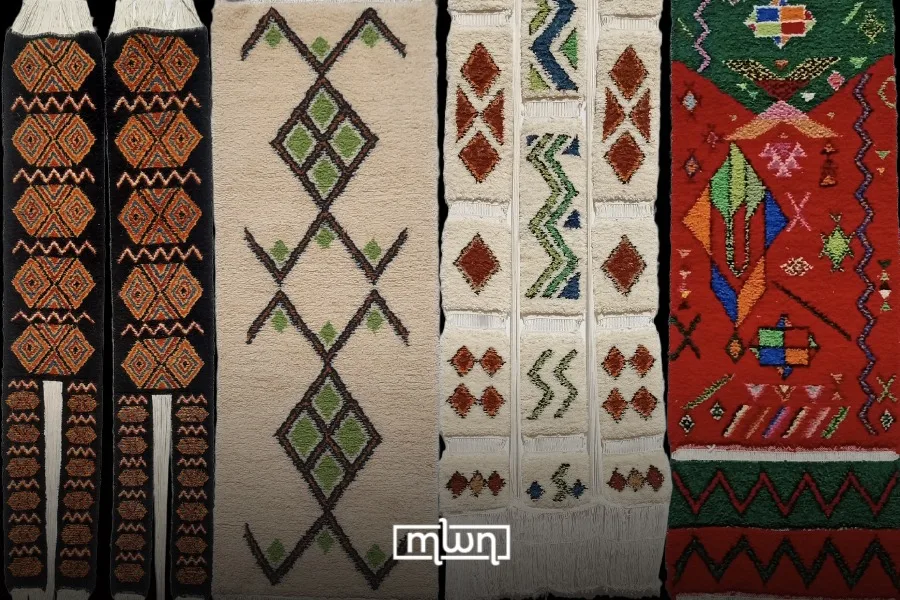
Fez — Moroccan artist Houcine Htoutou is placing the Amazigh carpet at the center of contemporary art with his solo exhibition “Nœud, couleur et esprit” (Knot, Color, and Spirit) at the Zéphyr Art Gallery in Ifrane.
The exhibition, organized by the Mohammed VI Foundation for the Promotion of Social Works in Education and Trainin, opened the gallery’s 2026 cultural season and will run until June 30.
Official Zéphyr programming lists the show from May 6 to June 30, presenting Htoutou’s work as a dialogue between heritage and modernity.
The carpet as a poem
Htoutou is not treating the carpet as a decorative object. His work lifts it out of its usual domestic frame and presents it as a complete artistic language.
A painter, poet, designer, and visual arts teacher from the Khénifra-Zayane region, Htoutou builds his pieces around the symbolic power of the knot, the emotion of color, and the spiritual weight of inherited craft. Zéphyr describes his creations as “tapis-tableaux,” or carpet-paintings, where textile fiber becomes a form of high artistic expression.
Khénifra in every thread
The exhibition is deeply rooted in the Middle Atlas. Htoutou draws from the colors, landscapes, sunlight, and poppy flowers of Khénifra, the region where his visual memory first formed.
The work is also collaborative. Htoutou paid tribute to Mbarka, a skilled traditional weaver with whom he works, describing her as an artisan whose contribution deserves recognition. Her absence from the opening, due to health reasons, became part of the exhibition’s human story: the artist may design the vision, but the craft still depends on the hands that know the loom.
From family workshop to gallery wall
Htoutou’s relationship with the Zayane carpet is not academic. It is inherited. He said his mother wove the carpets that filled the family home, while his grandfather was an “amezday,” a weaver who worked for the tribe.
That family history gives the exhibition its strongest emotional line. The loom is not only an artistic tool; it is a childhood space, a family archive, and a bridge between generations.
Through “Nœud, couleur et esprit” (“Knot, Color, and Spirit”), Htoutou is also defending what he calls a new school in carpet art. He places Taznakht, Marmoucha, and Zayane carpets within a broader Moroccan identity, while pushing the form toward contemporary creation.