Fez– Amid discussions on craftsmanship, creativity, and cultural transmission at the Forum of the Fez Festival of World Sacred Music, one intervention moved beyond the realm of art and into the territory of philosophy.
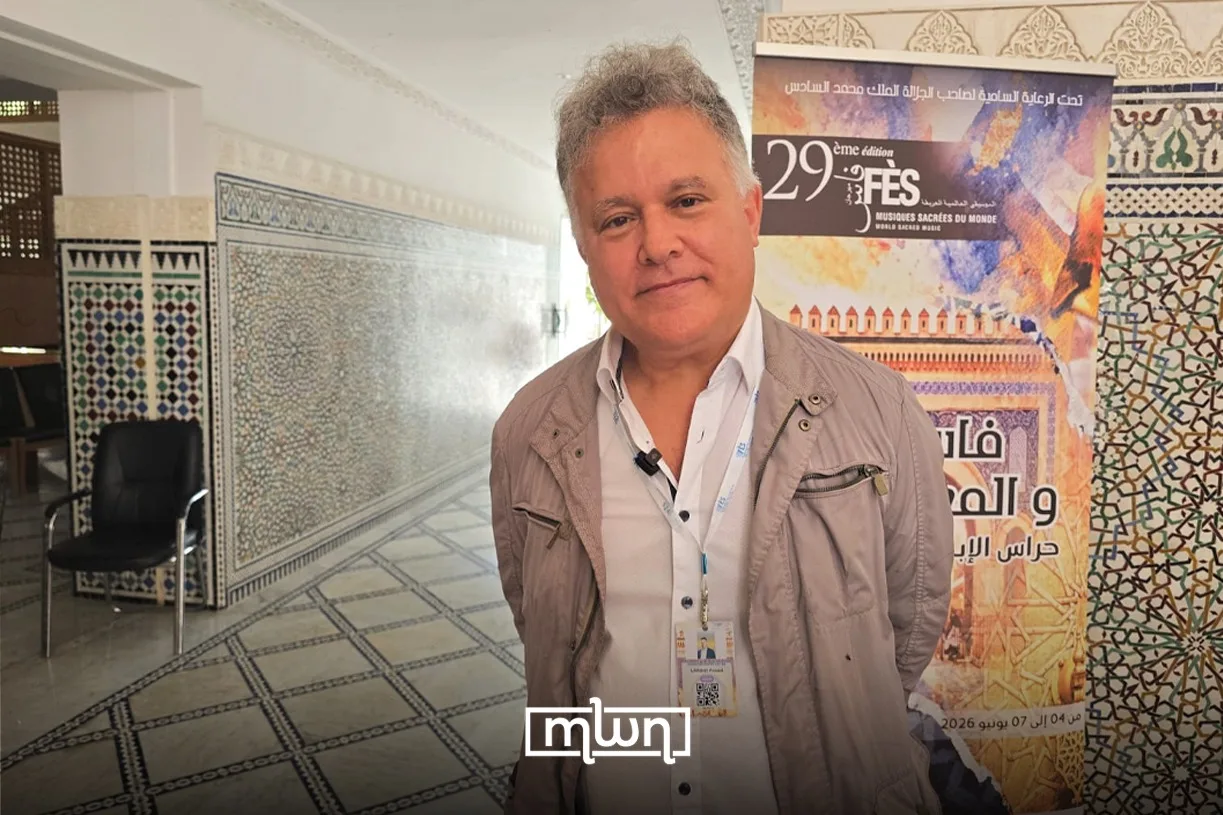
Speaking to MWN Lifestyle magazine at the Palais des Congrès, acclaimed Moroccan novelist and essayist Fouad Laroui turned attention toward a question that has accompanied him throughout his literary career: what does it mean to be human?
The Forum, which brought together leading intellectuals including Tahar Ben Jelloun, Mustapha Ijjaali, Nabil Rahmouni and master artisans from Fez, explored the delicate relationship between creation and reproduction, the role of the “maâlem” as a guardian of knowledge, and the tensions artisans face in a market-driven world.
Yet Laroui’s reflections widened the conversation, connecting the challenges of artistic creation to broader questions of freedom, individuality and human existence.
Asked about the questions Morocco continues to postpone, Laroui declined to enter what he described as territory that is often too sensitive, too complex, or too controversial for public discussion.
Instead, he redirected the conversation toward what he believes deserves greater attention: the place of the individual in contemporary society.
According to Laroui, modern societies too often encourage people to think and act as members of groups rather than as independent individuals.
Whether through social pressures, ideological currents, or collective movements, the tendency to follow the crowd can come at the expense of personal reflection.
“What we need,” he suggested, “is more modernity, more individuality.”
For the celebrated writer, freedom begins not with politics or institutions but with the capacity to think independently.
The right to question, doubt, and arrive at one’s own conclusions remains essential to both personal fulfillment and intellectual progress.
In this sense, individuality is not a rejection of community, but a prerequisite for meaningful participation within it.
The idea resonates deeply with Laroui’s body of work, which has long explored questions of identity, belonging, reason, and cultural complexity.
Throughout novels, essays and public interventions, he has repeatedly returned to the tension between collective narratives and personal freedom, examining how individuals navigate the expectations imposed by society while searching for their own truth.
At the heart of that search lies a question Laroui considers fundamentally philosophical: what does it mean to be human?
Rather than offering a definitive answer, he views the question itself as one that every person must confront.
Human existence, in his view, cannot be reduced to a single doctrine, ideology or certainty.
Each individual must construct their own understanding through experience, reflection and choice.
It is a perspective that has evolved significantly over the course of his life.
Laroui revealed that one of the questions that has changed most dramatically for him is the question of life’s meaning.
Earlier assumptions, he explained, gradually gave way to a more sober realization: that life may not possess an inherent or predetermined purpose.
Yet his conclusion is far from pessimistic.
If there is no universal meaning waiting to be discovered, he argues, there remains the possibility of creating a life that is worth living.
Happiness, kindness and respect for others become guiding principles not because they reveal some grand cosmic truth, but because they allow human beings to coexist with dignity.
“Try to be happy,” he said. “Try not to disturb the universe as it is. Try not to be mean to people.”
The simplicity of the statement carried particular weight within the context of the Festival of World Sacred Music, an event dedicated to dialogue across cultures, traditions and spiritual perspectives.
While the festival often explores humanity’s search for transcendence, Laroui’s remarks offered a complementary reflection rooted in ethics rather than certainty, and in personal responsibility rather than doctrine.
As the Forum examined the transmission of artisanal knowledge from one generation to the next, Laroui’s intervention served as a reminder that cultural heritage is not only preserved through techniques and traditions, but also through ideas.
Creativity, whether expressed through craftsmanship, literature or philosophy, ultimately depends on individuals who are willing to think freely and question inherited assumptions.
In a gathering devoted to the value of creation, Fouad Laroui’s contribution stood out as an invitation to preserve something equally fragile: the freedom of the human mind.
And in an era increasingly shaped by collective noise, for him individuality remains one of the most essential forms of creativity.