Rabat – Every wedding season, the same thing happens. Somewhere between the henna night and the second course, the playlist stops pretending to be cool, and someone finally puts on Stati, or Daoudi, or Zina Daoudia, and the whole hall loses it.
It should be said plainly. Chaabi, and the “aïta” tradition it grew out of, does more for the Moroccan soul than much of what dominates today’s streaming charts.
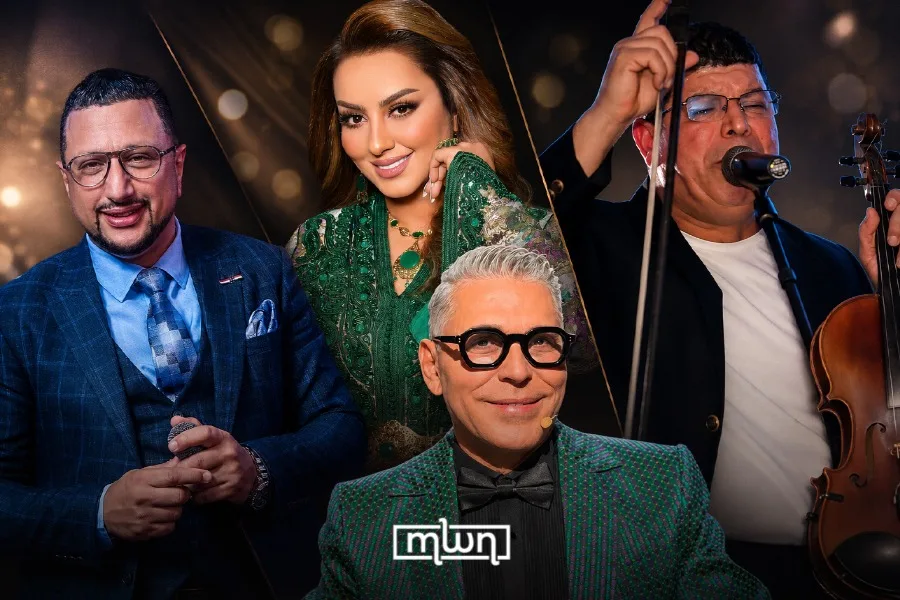
Among the artists carrying that tradition forward are Hajib, Daoudi, Zina Daoudia, Said Ould El Houate, and Abdelaziz Stati. They deserve far more recognition than they receive.
Hajib proved chaabi could be glamorous without losing its roots
Hajib built a career on pure showmanship through his signature satin shirts, commanding stage presence, and that impossibly high voice. It would be easy to write him off as style and spectacle.
Instead, Hajib took a serious, rural art form and made it glamorous enough for television audiences without hollowing it out.
Now, after nearly four decades, he’s stepping back and making room for younger voices, a rare act of grace in an industry that often clings to the spotlight.
Daoudi is the proof that chaabi rewards patience, not virality
Daoudi has never needed spectacle to hold a room. His appeal is in his voice itself: controlled, emotional, and built for the kind of songs that make people close their eyes and sing along under their breath.
Where some chaabi stars perform with sheer energy, Daoudi performs with depth, and that’s exactly why tracks like “Galo liya ghie nsaha,” “Mansit chajra,” and “Blad lghorba” have remained staples at Moroccan gatherings instead of fading with the next trend.
His catalog moves comfortably between both worlds, a big part of why he’s stayed relevant across different generations. He’s proof that chaabi doesn’t have to shout to be unforgettable.
Zina Daoudia: The one who turns a room into a party
If there’s one artist on this list who can transform a room’s energy the moment she steps on stage, it’s Zina Daoudia.
She doesn’t ease a crowd in. She arrives at full volume, violin in hand, and the audience has no choice but to catch up.
With Daoudia, every performance feels like an event rather than background music. Songs like “Aatini Saki,” “3lach,” and “Bara Bara” work just as well blasting from a car stereo as they do live, but it’s on stage where she truly shines.
She moves effortlessly between the playfulness of raï and intensity of chaabi within the same set, sometimes the same song.
Few chaabi artists turn a performance into a full spectacle the way she does, and that’s exactly why her name on a lineup still guarantees a packed dance floor.
Stati: The heartbeat of Moroccan chaabi
No one commands a crowd quite like Stati. His violin lines are instantly recognizable with that scratchy, urgent “kamanja” sound that cuts through a packed hall before he even starts singing.
His catalog reads like the soundtrack to Moroccan wedding season itself. From “El ghaba” to “T3ali Day Day,” each song is capable of getting an entire room moving within seconds.
That’s really the point about Stati. His appeal has never been confined to one corner of Moroccan society.
Whether he’s headlining a major festival stage or performing at a family wedding, the crowds at both prove that his music resonates across generations, regions, and backgrounds.
Said Ould Lhouwat: The guardian of a musical tradition
If chaabi has a conscience, it’s Ouled Lhouwat. In a scene increasingly flooded with auto-tuned productions chasing trends, there’s something almost defiant about an artist who continues to draw from older, rougher styles of “aïta” and bringing them back to life.
His sound, grainy vocals, scratchy violin, and percussion that refuses to sit quietly in the pocket feel less polished than many of his peers, and that’s precisely what sets him apart.
And that’s exactly why his fans see him less like a pop star and more like a guardian of a musical tradition worth protecting.
Read also: Everything You Wish Someone Told You About Moroccan Weddings