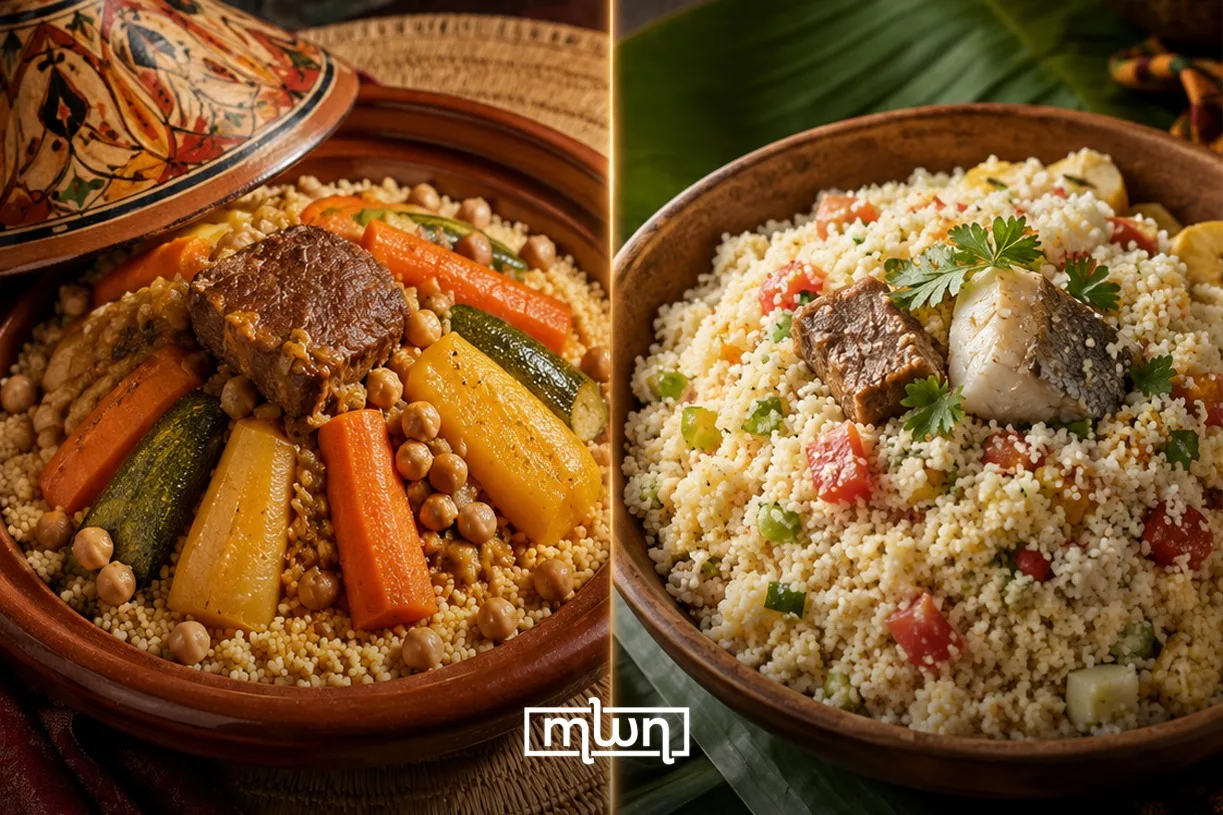
Rabat – At first glance, Moroccan couscous and Côte d’Ivoire’s attiéké seem remarkably similar.
Both are served as fluffy, grain-like side dishes, both accompany hearty meals, and both are deeply rooted in their respective food cultures.
But despite their similar appearance, they are made from entirely different ingredients and have distinct histories, flavors, and preparation methods.
The most significant difference lies in what they’re made from. Couscous is produced from durum wheat semolina, which is moistened and rolled into tiny granules before being steamed.
It has been a staple across North Africa for centuries, with Morocco making it one of the country’s most iconic dishes.
Traditionally, couscous is steamed multiple times to achieve its signature light texture and is commonly served with vegetables, meat, or legumes.
Attiéké, on the other hand, originates in Côte d’Ivoire and is made from cassava, a starchy root vegetable widely grown in West Africa.
The cassava is peeled, grated, fermented, pressed, and then steamed into small granules. The fermentation process gives attiéké a subtle tangy flavor that sets it apart from couscous, whose taste is milder and slightly nutty.
Their similar appearance is no coincidence. Both foods are prepared in a way that creates small, fluffy granules capable of absorbing sauces and complementing a variety of dishes.
Although they rely on different raw ingredients, steaming is essential to achieving the light texture that makes each staple so versatile.
The way they are enjoyed also reflects the culinary traditions of their regions. In Morocco, couscous is often the centerpiece of Friday family meals, served with slow-cooked vegetables, chickpeas, and beef, lamb, or chicken.
It also appears in sweet variations with caramelized onions, raisins, and cinnamon.
In Côte d’Ivoire, attiéké is commonly paired with grilled fish, fried chicken, or meat, alongside fresh tomatoes, onions, chili peppers, and a squeeze of lime.
It is a popular everyday dish and a staple of Ivorian street food culture.
While they may look alike in a bowl, couscous and attiéké tell two different stories about Africa’s rich culinary heritage.
One is born from wheat fields in North Africa, the other from cassava cultivation in West Africa.