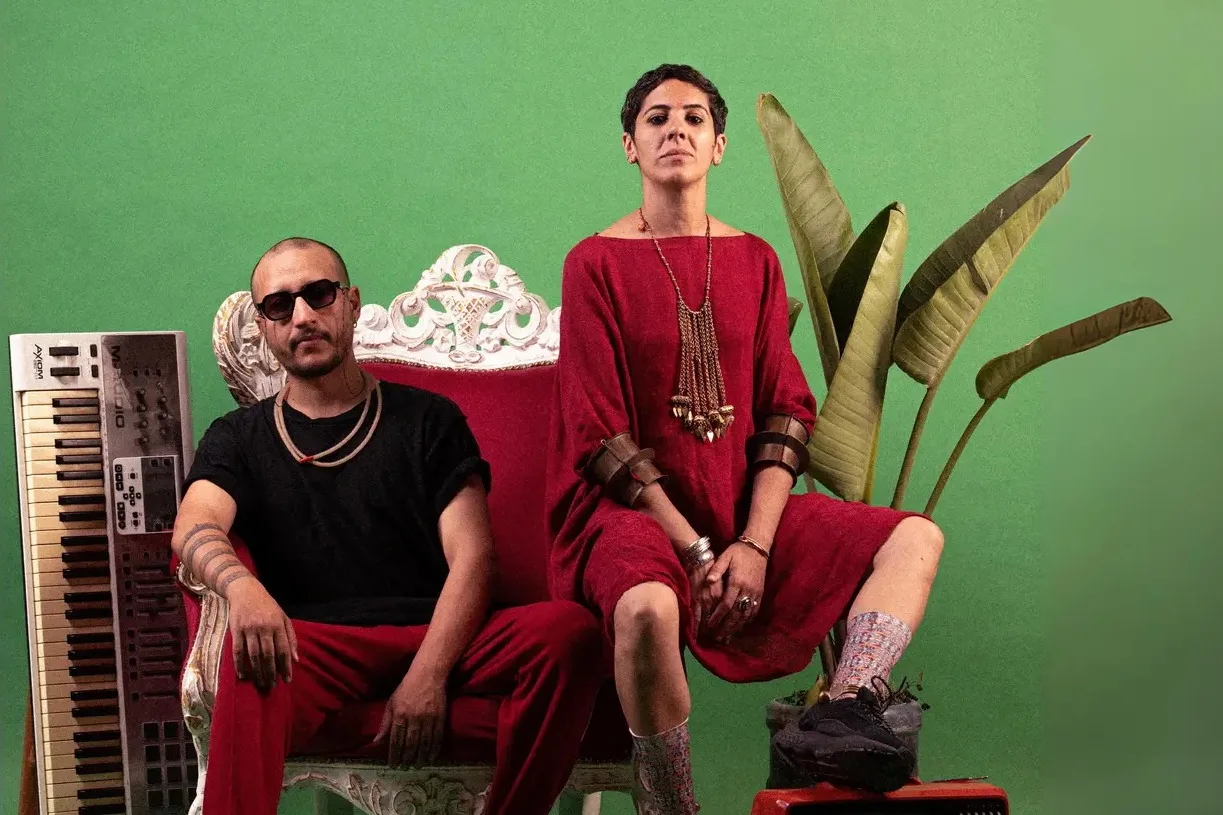
Rabat – Moroccan performers Widad Mjama and Khalil Hentati, known as Epi, captivated audiences at the 60th International Festival of Hammamet in Tunisia with “Aïta Mon Amour,” a performance that reimagines one of Morocco’s oldest oral musical traditions for a contemporary audience.
The 90-minute show explored the rich legacy of Aïta, a genre historically performed by chikhates, female singers who preserved and passed down the repertoire through generations.
Combining traditional vocals with electronic production, the performance highlighted how the centuries-old art form continues to evolve while remaining rooted in its cultural origins.
Throughout the concert, Mjama shared stories in Moroccan Darija, offering Tunisian audiences insight into Aïta’s history and significance.
The performance also revisited the role of the chikhates, whose songs often carried messages of resistance and identity during Morocco’s colonial era.
Their public performances challenged social conventions of their time, making Aïta both a cultural and symbolic form of expression.
Rather than recreating the repertoire in its original form, Aïta Mon Amour fused traditional melodies with Epi’s electronic arrangements, creating a dialogue between heritage and modern production. The set featured reinterpretations of well-known pieces including El Wed Wed, Sidi Hmed, Haajti, Amala, and Sebti.
The duo was joined on stage by musicians Amine Ouardini and Rchid Abidine, who became part of the project during the artists’ research into Aïta across Morocco in 2022.
The concert also expanded beyond Moroccan repertoire with a performance of Al Aëd, a composition by Lebanese musician Marcel Khalifé popularized by singer Oumaima Khalil.
By presenting Aïta to an international festival audience, Aïta Mon Amour underscored the growing global interest in Morocco’s intangible cultural heritage while demonstrating how traditional music can find new audiences through contemporary artistic interpretation.