Fez — Ji-Eun loves teaching. At 23, she enters the classroom with the conviction that she has found meaningful work, only to discover how quickly that certainty can erode when the pressure around her becomes impossible to ignore.
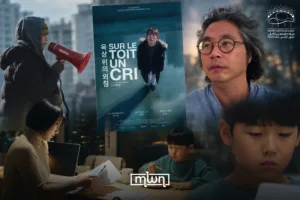
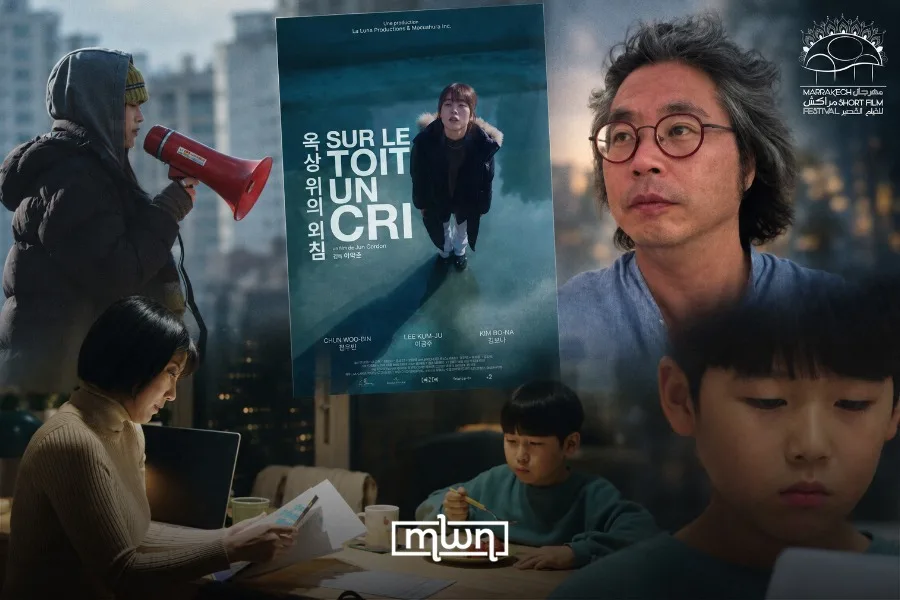
She is the central character of Jun Cordon’s “Sur le toit, un cri,” a 20-minute France-South Korea short that will screen at the sixth Marrakech Short Film Festival. The film stars Lee Kum-ju as Ji-Eun and was co-written by Cordon and Sarah Michel.
In an interview with MWN Lifestyle magazine, Cordon described Ji-Eun as a committed young teacher living far from her family and trying to establish herself alone in a large South Korean city. Her professional confidence begins to collapse when a pupil’s mother places increasingly insistent demands on her.
“The film tells the story of this turning point: the moment when a young woman who believed she had found her calling begins to wonder whether she can continue teaching.”
A tragedy that changed the story
Cordon had previously considered making a film in Korea about authority, education, and relationships between schools and families.
Then came the death of a young elementary-school teacher in Seoul in July 2023.
The case triggered nationwide anger over the pressures faced by teachers, with tens of thousands later demonstrating for stronger protections and changes to complaint systems. Debate around the incident continued in South Korea years later.
“This event affected me deeply and rekindled my desire to tell this story,” Cordon said.
He did not want “Sur le toit, un cri” to become a direct reconstruction or an accusatory social drama.
Instead, he focused on what institutional pressure does internally to one young person.
“What interested me about Ji-Eun was precisely this coexistence of vulnerability and strength.”
Her crisis is not presented as proof that she chose the wrong profession.
“Her sense of vocation does not falter because she lacks conviction or courage. It falters because external pressures eventually reach something deeply personal: her confidence in herself and in the meaning of her work.”
When a calling begins to hurt
For Cordon, Ji-Eun’s age is essential because beginning a career can mean entering work with ambition before developing the distance or experience required to absorb every conflict placed in front of you.
“When a system fails to offer young professionals enough protection, their commitment can quickly turn into loneliness.”
That idea extends beyond teaching. Cordon sees Ji-Eun’s experience as part of a wider uncertainty facing younger generations, particularly when the reality of professional life begins to clash with the values that brought them there.
“How do you remain true to a vocation when your environment ends up damaging it? How do you find the strength to set a boundary?”
Cordon gradually moves Ji-Eun toward what he describes as a “quiet act of bravery,” one that changes the way she responds to the isolation surrounding her.
Looking at Korea from both inside and outside
Cordon’s relationship with South Korea makes the project particularly personal.
A Franco-Korean filmmaker and Korean adoptee, he has previously explored his connection to the country through projects including “5 par jour” and “Retour en Corée, 30 ans après…”.
In 2025, he obtained Korean nationality, describing another stage in a relationship with the country that has evolved across his filmmaking.
With “Sur le toit, un cri,” he said he wanted to move beyond examining his own adoption history and look more directly at contemporary Korean society.
“I now seek to look at contemporary Korean society from within, to understand its tensions, silences and transformations.”
That position is neither entirely external nor entirely internal. “My perspective nevertheless remains that of a Franco-Korean filmmaker,” he explained, describing the combination of intimacy and distance that shapes his work.
A Korean story arrives in Morocco
“Sur le toit, un cri” had its world premiere in South Korea in August before travelling to Marrakech for what Cordon describes as its African premiere.
The transition carries particular meaning for a filmmaker whose work has also taken him to Senegal.
Cordon hopes Moroccan viewers will recognize questions in Ji-Eun’s story that extend beyond the Korean school system.
“The place of education, the weight of success, family and social expectations, the judgement of others, and the difficulty young professionals face in preserving the meaning of their commitment,” he said, are concerns that can cross borders.
Above all, he does not want Ji-Eun to be remembered only as someone overwhelmed by the system around her.
“She goes through a situation that leaves her deeply vulnerable, but she cannot be reduced to a victim.”
The film is also about resistance and the possibility of recovering a voice when pressure has made speaking feel impossible.
“The film also tells the story of her inner resistance and the possibility of finding a voice again, even in isolation.”
As “Sur le toit, un cri” reaches Marrakech, Cordon is leaving the meaning of that final cry to the audience.
What comes before it is clearer. A young woman enters a profession believing she knows why she is there. The film watches closely as that belief is tested, and asks what it takes to protect a vocation before the environment around it destroys the reason it mattered in the first place.