

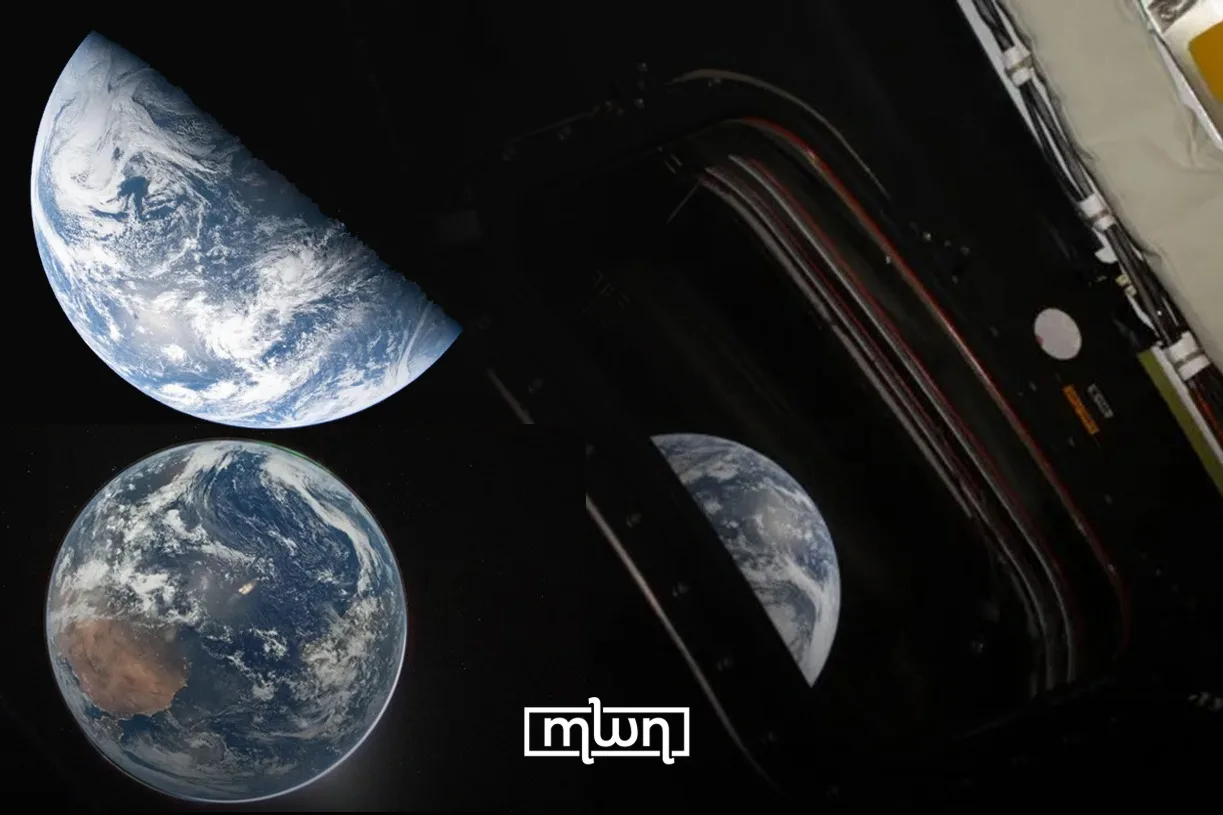
Fez — NASA’s Artemis II astronauts have sent back their first high-resolution views of Earth from deep space, offering a vivid early visual record of humanity’s return to crewed lunar travel.
The images were taken from the Orion spacecraft after a successful translunar injection burn pushed the mission out of Earth orbit and onto its path around the Moon.
NASA said the mission is now more than halfway to the Moon, with Orion continuing on a precise trajectory toward a lunar flyby on Monday, April 6.
One of the most widely shared photos, titled “Hello, World,” was taken by Artemis II commander Reid Wiseman from Orion’s window on April 2. NASA says the image shows Earth eclipsing the Sun, with auroras visible and zodiacal light appearing in the frame. Another photo, also credited to Wiseman, looks back at Earth from inside the capsule, underscoring the growing distance between the crew and the planet they left behind.
The mission launched on April 1 from NASA’s Kennedy Space Center in Florida with four astronauts aboard: Reid Wiseman, Victor Glover, Christina Koch, and Canadian Space Agency astronaut Jeremy Hansen. NASA has described Artemis II as the first crewed lunar flyby mission in more than 50 years, marking humanity’s first journey beyond Earth orbit since Apollo 17 in 1972.
First crewed return to deep space in more than 50 years
The translunar injection burn was the key milestone that shifted the mission from Earth orbit into deep space. NASA said Orion’s main engine completed that maneuver successfully, allowing the spacecraft to begin its free-return path around the Moon and back to Earth. A later outbound trajectory correction burn was canceled because flight controllers judged the spacecraft to already be on the right path.
NASA’s Artemis blog said the crew has since been using the transit period to prepare for lunar observations, exercise, and carry out onboard procedures while mission teams continue tracking Orion’s systems. The agency’s public updates indicate the crew remains on course for its lunar flyby before returning to Earth for a Pacific splashdown later this month.
The images matter beyond their beauty. They serve as a visual marker of a program trying to reconnect lunar exploration with the present, not only through rockets and mission architecture, but through imagery that places Earth back in a human window frame. More than five decades after Apollo 17, Artemis II is reviving that perspective — one where the farther humans travel, the more fragile and unified home appears.